How Much Higher Will Your Social Security Benefits Be If You Wait an Extra Year?
You can claim Social Security benefits starting at the age of 62. However, the earlier you claim your benefits, the smaller your checks will be. Waiting longer to begin your benefits can have a huge payoff, as each month you…

This post may contain links from our sponsors and affiliates, and Flywheel Publishing may receive compensation for actions taken through them.

You can claim Social Security benefits starting at the age of 62. However, the earlier you claim your benefits, the smaller your checks will be. Waiting longer to begin your benefits can have a huge payoff, as each month you delay results in an increase in the payments you get.
Just how much bigger will your benefits be as a result of waiting a year? It depends on exactly when you’re considering starting your checks. Here’s what you need to know about increasing your Social Security payments by delaying their start date.
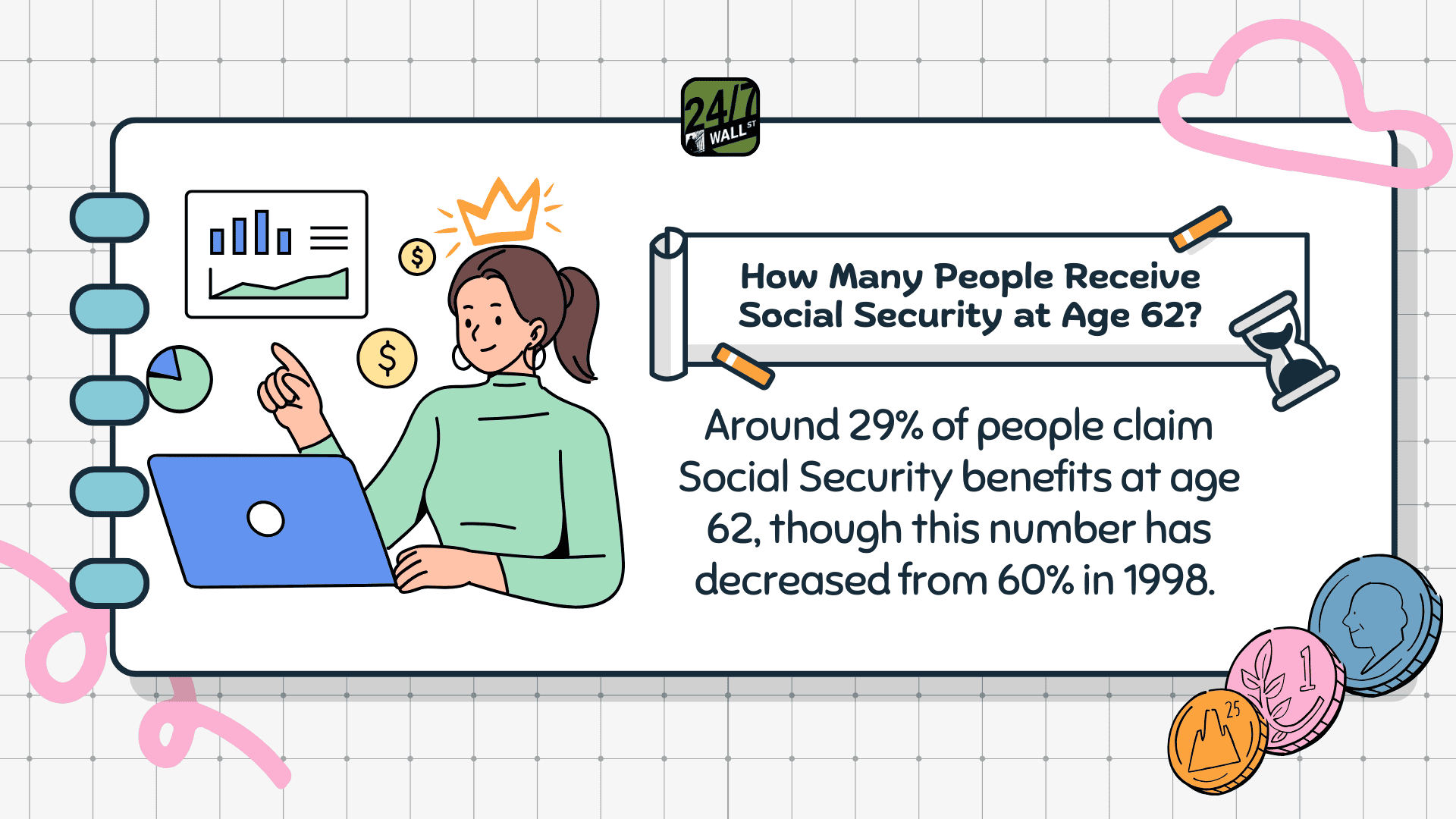
How much will your benefits go up if you avoid early filing penalties?
Retirees are entitled to a standard benefit at their full retirement age, or FRA. Your FRA is based on your birth year. If you were born in 1960 or later, your FRA is 67. If you were born in 1959, it is 66 and 10 months. Any month that you claim benefits before your FRA, benefits are reduced as a result of early filing penalties.
The specific penalty that applies depends on just how early you’re claiming benefits. For each of the first 36 months before your FRA, you’re hit with a penalty equal to 5/9 of 1% of your benefit amount. For each prior month before then, you’re hit with a penalty that equals 5/12 of 1%.
This means that:
- If you claim benefits a year early during the first three years before FRA, your benefits shrink by 6.7%
- If you claim benefits more than three years early, benefits shrink by an additional 5% per year.
Let’s say your standard benefit is equal to $2,000. If you’re thinking of claiming it at 62, you’d be hit with a 30% penalty (three years of 6.7% penalties plus two years of 5% penalties). You’d receive a monthly payment of $1,400. If you waited a year, though, one of those 5% penalties wouldn’t apply. You’d be hit only with a 25% penalty and your monthly payment would be $1,500. So, waiting a year in this case would give you an extra $100 a month.
Now, if you were thinking of claiming at 66 instead of 67, on the other hand, waiting that extra year would allow you to avoid a 6.7% penalty. Instead of getting $1,866 at 67, you’d receive $134 more per month and get your full standard benefit at 67.
Either way, the savings due to delay is pretty substantial — and it may well make it worth your while to wait.
How much will your benefits go up if you earn delayed retirement credits?
 Your opportunity to increase your monthly benefit doesn’t end when you hit your full retirement age. If you delay even longer, you can earn delayed retirement credits that boost your monthly check even more.
Delayed retirement credits are available until the age of 70 and they are worth 2/3 of 1%. This adds up to an 8% annual increase for each year you wait beyond FRA.
This means if you were on track to get a standard benefit of $2,000 at age 67 and you wait until 68, you’d increase that $2,000 benefit by 8% and get $2,160 a month instead — $160 more. Waiting beyond FRA has a bigger impact on raising your check amount because delayed filing credits are bigger than early filing penalties.
The bottom line is, Social Security provides more money for delaying payment because you get fewer checks during your lifetime when you wait. It’s up to you to decide whether you would rather get more payments at a lower amount by claiming early or whether you’d rather wait as long as you can to max out this source of guaranteed lifetime income so you’ll have more security later in life.
Contact [email protected] for any questions or corrections.
Christy Bieber has been a personal finance and legal writer since 2008. She has a JD from UCLA School of Law and a BA in English, Media and Communications with a certification in business from the University of Rochester.
Christy has been published by a wide variety of sites, including WSJ Buy Side, Forbes, Kiplinger, Fox Business, Credit Karma, Insurify, and Annuity.org. In addition to writing for the web, she has also ghostwritten textbooks on business and law and served as a subject matter expert for course design.