Suze Orman Has a Stern Warning on Social Security. You Should Listen to Her
As a retiree, you will almost certainly rely on Social Security for at least part of your income, and the single most consequential choice you face is deciding when to start your monthly benefit. Suze Orman has strong opinions on…

This post may contain links from our sponsors and affiliates, and Flywheel Publishing may receive compensation for actions taken through them.

As a retiree, you will almost certainly rely on Social Security for at least part of your income, and the single most consequential choice you face is deciding when to start your monthly benefit. Get that timing wrong, and the cost compounds quietly for decades.
Suze Orman has strong opinions on that question, and her advice could make a meaningful difference to your long-term finances. She has issued a stern warning that every near-retiree should read carefully before filing a claim with the Social Security Administration.
Here is what that warning says, and why it deserves your full attention.
Suze Orman’s stern warning on Social Security
Orman posted her Social Security warning on LinkedIn, writing: “Are you (or a family member) considering when to start claiming your Social Security benefits? It’s crucial to weigh your options carefully. While you can start claiming at 62, keep in mind that your benefit will be permanently lower than if you wait.”
The warning targets a decision that catches many people off guard. Age 62 is the earliest you can claim Social Security retirement benefits, and a large share of retirees start their checks right at that threshold. Some do so because they feel financially ready to retire and assume they need those checks right away. Others simply do not realize how much an early claim costs them over the long run. Because the government will send checks the moment you qualify, waiting can feel counterintuitive, even when the math clearly favors patience.
As Orman points out, claiming at 62 locks in a much smaller monthly check for life. Every worker has a designated full retirement age (FRA). For anyone born in 1960 or later, that FRA is 67. Claiming before FRA triggers a permanent benefit reduction, while claiming after FRA earns delayed retirement credits that increase your check for as long as you live.
Many people underestimate how large that reduction will be. Very few realize it cannot be undone. Once you lock in an early benefit, you can never recapture the monthly income you gave up by not waiting.
Why Orman’s warning on claiming Social Security deserves attention
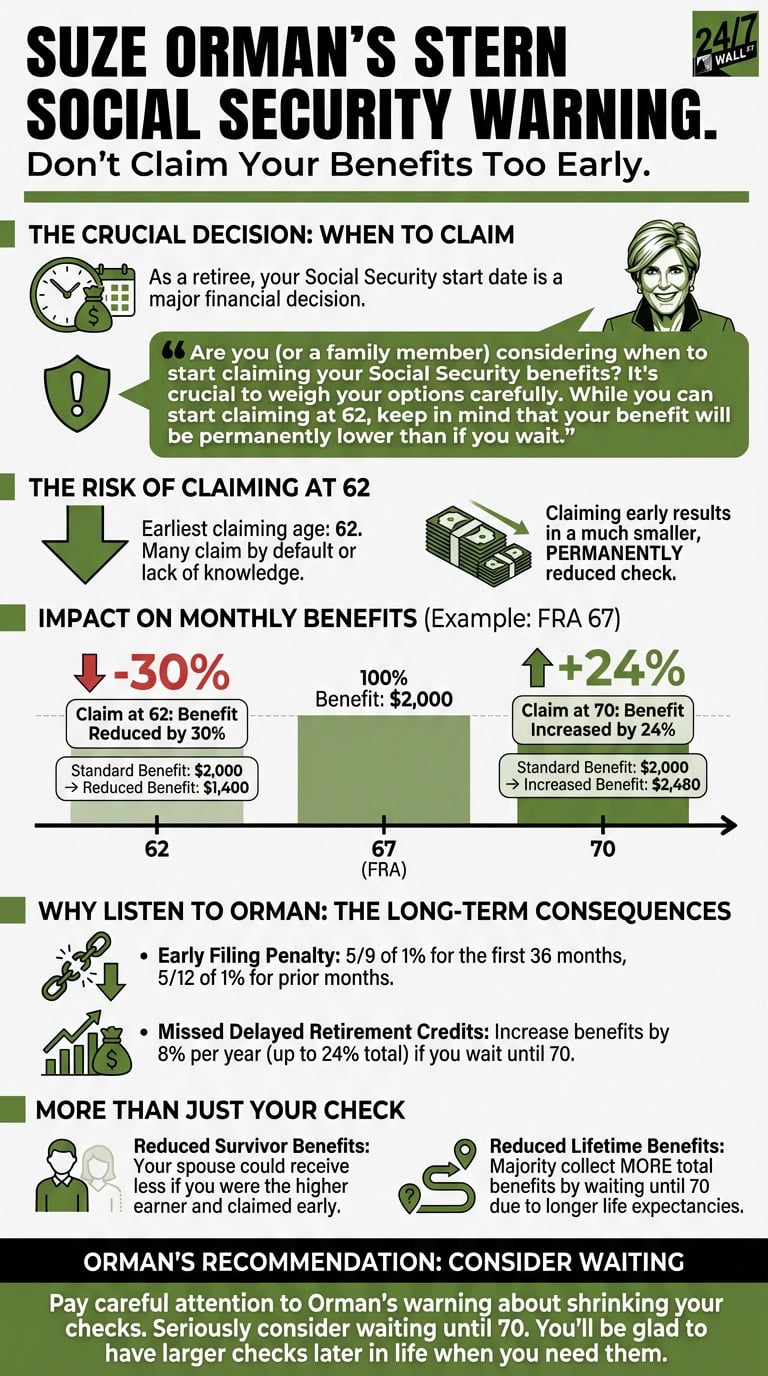
An early claim carries serious long-term consequences. Every month you claim before FRA triggers an early-filing penalty: 5/9 of 1% per month for the first 36 months before FRA, and 5/12 of 1% per month for any additional months beyond that. For someone with an FRA of 67 who claims at 62, those penalties stack up to a 30% permanent reduction. In concrete dollar terms, a benefit of $2,000 at FRA shrinks to just $1,400 at 62. Real-world SSA data from December 2025 tells the same story: new claimants who started benefits at 62 received an average of $1,335 per month, while new claimants who waited until 67 received an average of $2,521.
Delayed retirement credits reward patience on the other end of the spectrum. Waiting beyond FRA adds 2/3 of 1% per month, equal to 8% per year, and those credits accumulate until age 70. Someone with an FRA of 67 who holds off until 70 would collect a benefit 24% higher than their full amount, and more than 75% higher than what they would receive by filing at 62. A 2022 National Bureau of Economic Research study found that more than 90% of workers between ages 45 and 62 would maximize their lifetime Social Security income by waiting until 70 to claim. Critically, only about 10.2% actually do so, and the NBER researchers estimated that the median household loses $182,370 in lifetime discretionary spending by claiming at a suboptimal age.
Early-claiming applications surged sharply in 2025, reversing a decades-long trend of Americans gradually waiting longer to file. According to an Urban Institute analysis of SSA data, more than 2.3 million older Americans filed for retirement benefits between January and July of that year, a 16% jump compared with the same period in 2024. Program experts cited economic anxiety, concerns about SSA staffing cuts, stock market volatility driven by changing trade policies, and fears about the program’s long-term finances as key drivers. Even higher-income retirees who have the greatest ability to delay have increasingly been filing at 62, according to the Urban Institute’s senior policy fellow Jack Smalligan.
The stakes are even higher for married couples. An early claim does not just shrink your own check. It also reduces the survivor benefit your spouse could collect if you were the higher earner. By claiming early, you could leave your partner with substantially less guaranteed income for decades.
The broader context makes Orman’s warning more urgent than ever. Social Security’s 2026 cost-of-living adjustment came in at 2.8%, adding roughly $56 to the average retiree’s monthly check and pushing the SSA’s estimated average monthly benefit to about $2,071. At the same time, Medicare Part B premiums rose to $202.90 per month for 2026, an increase of $17.90 from the prior year’s $185.00. Those premiums are deducted directly from most retirees’ Social Security checks, meaning the net raise many people actually see is considerably smaller than the headline COLA figure suggests. Claiming at 62 locks in a permanently reduced base, and that smaller base is then subject to the same rising costs year after year.
The program’s long-term finances add a further layer of urgency. The Social Security Board of Trustees, in its June 2026 annual report, projects that the combined Old-Age, Survivors, and Disability Insurance trust funds will be depleted by the third quarter of 2034, at which point ongoing payroll tax revenue would cover about 83% of scheduled benefits. Looked at separately, the retirement-focused OASI trust fund is projected to run short sooner, in the fourth quarter of 2032, at which point it could cover only 78% of scheduled benefits. The trustees also reported that the 75-year actuarial deficit for Social Security grew to 4.42% of taxable payroll, up from 3.82% in the prior report. The One Big Beautiful Bill Act, a 2025 federal tax package, is identified as a key reason for the acceleration: its provisions are expected to reduce income tax revenue flowing into the trust funds going forward. None of this means benefits would disappear, but it reinforces why locking in the largest possible monthly check matters so much.
Orman responded to the Trustees Report directly. Two days after its June 9, 2026 release, she published a blog post reaffirming her advice that waiting until 70 remains the best claiming strategy available for most people. She called early claiming a “permanent pay cut” and specifically pushed back against viral social media voices urging Americans to file at 62. Her core point: under a scenario where the trust fund is depleted and only 78% of benefits are payable, someone who delayed to 70 still receives 78% of a larger base, which outpaces what an early filer collects even after any future congressional cut is applied.
Many retirees today outlive the life expectancies that shaped Social Security’s original design. The early-filing penalties and delayed retirement credits were calibrated to even out lifetime benefits for early and late claimers, but because so many people now live well into their 80s and beyond, waiting until 70 typically results in collecting far more over a lifetime. For someone comparing age-70 claiming to age-62 claiming, the break-even point at which cumulative benefits surpass what an early claimer collected typically falls around age 80 to 81, well within reach for a healthy retiree today.
Taking Orman’s warning seriously and holding off until 70 can be one of the most consequential financial decisions you make in retirement. A larger, guaranteed monthly check later in life, when other income sources may have dwindled, provides a cushion that no other retirement asset can fully replicate.
Editor’s note: This article was updated to include Suze Orman’s June 11, 2026 blog post doubling down on her delay-to-70 advice in direct response to the 2026 Social Security Trustees Report, and to note her argument that delayed claimers retain a mathematical advantage even under a reduced-benefits scenario. The 2026 Trustees Report figures, including the OASI depletion date of Q4 2032 and the 75-year actuarial deficit of 4.42% of taxable payroll, have been confirmed against the official SSA release and congressional research summaries.
Contact [email protected] for any questions or corrections.
Christy Bieber has been a personal finance and legal writer since 2008. She has a JD from UCLA School of Law and a BA in English, Media and Communications with a certification in business from the University of Rochester.
Christy has been published by a wide variety of sites, including WSJ Buy Side, Forbes, Kiplinger, Fox Business, Credit Karma, Insurify, and Annuity.org. In addition to writing for the web, she has also ghostwritten textbooks on business and law and served as a subject matter expert for course design.