Full Retirement Age is Changing for Social Security in 2026
Big changes are coming to Social Security in 2026, and if you’re nearing retirement, one stands out: full retirement age is shifting for the last time under current law. For anyone who turns 66 this year, your birth year is…


Big changes are coming to Social Security in 2026, and for anyone nearing retirement, one stands out above the rest: full retirement age is shifting for the final time under current law. If you turn 66 this year, your birth year is 1960, which means your full retirement age (FRA) is 67. That gap determines when you qualify for your standard benefit and permanently shapes how much money lands in your account every month for the rest of your life.
The mechanics of FRA matter because claiming even a single month early locks in a permanent benefit reduction, while waiting even one month past FRA adds to your check through delayed retirement credits. Here is what the 2026 change means in practice and why it should factor into your claiming decision.
Full retirement age reaches 67 in 2026
Full retirement age is the precise point at which you qualify for your standard Social Security benefit, also called your primary insurance amount. Claim at exactly that age and you receive 100% of what you have earned. Claim a month earlier and you accept a permanent reduction. Wait a month longer and your benefit grows.
For decades, FRA was 65 for every worker. In 1983, with the trust fund facing mounting financial pressure, Congress passed bipartisan reforms that gradually raised FRA over more than 40 years. That phase-in is now complete. Anyone born in 1960 or later has an FRA of 67, the final scheduled step under current law. Workers who had not yet reached FRA by the end of 2025 are in this new cohort and will wait longer for their full monthly check than workers who retired even a few years earlier.
Those 1983 reforms bought the program decades of solvency, but they did not permanently close Social Security’s structural deficit, and the outlook has continued to worsen. The 2026 Social Security Trustees Report, released June 9, 2026, projects that the OASI trust fund will be depleted in the fourth quarter of 2032, one quarter earlier than the prior year’s estimate. Once reserves run out, incoming payroll tax revenue would cover only about 78% of scheduled benefits, an automatic cut of roughly 22% applied to every recipient. The accelerated timeline reflects three main factors: a revised fertility rate assumption (down from 1.90 to 1.75 children per woman), lower projected immigration (the model now assumes 1.2 million temporary or unlawfully present immigrants annually, down from 1.35 million), and the One Big Beautiful Bill Act signed into law on July 4, 2025, which reduced income taxation of Social Security benefits and cut a key revenue stream to the trust fund. The program’s 75-year actuarial deficit widened to 4.42% of taxable payroll, up from 3.82% in the prior year’s report, leaving the program an estimated $30.3 trillion short over the next 75 years. The worker-to-beneficiary ratio has already fallen from more than 5-to-1 in 1960 to roughly 2.9-to-1 today. Some legislative proposals suggest raising FRA further in the future, potentially to 69 or even 70, though no such change is currently law.
Should you claim Social Security at your full retirement age?
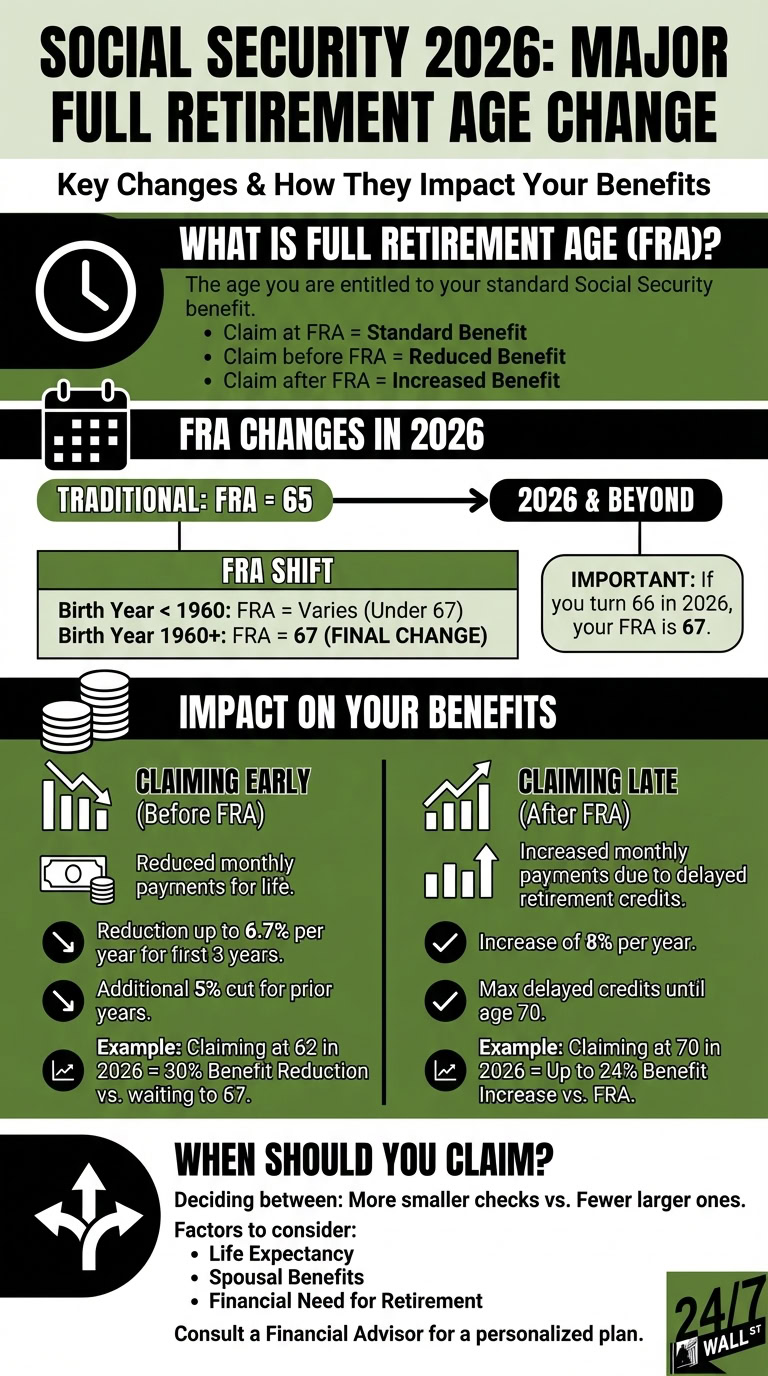
The decision of when to start benefits comes down to a fundamental trade-off: more smaller checks or fewer larger ones. You can claim as early as 62, but doing so locks in a permanent reduction for life. The formula is precise: benefits are reduced by 5/9 of 1% for each of the first 36 months before FRA, then by 5/12 of 1% for every additional month. For someone with an FRA of 67 who claims at 62, the full five-year gap produces a 30% reduction, applied permanently to every check you receive.
Real 2026 numbers illustrate the stakes. After the 2.8% cost-of-living adjustment, the maximum monthly benefit for a worker claiming at exactly 62 is $2,969. Wait until your FRA of 67 and that maximum rises to $4,152 per month. Delay all the way to 70 and it climbs to $5,181. These figures assume maximum taxable earnings (capped at $184,500 in 2026) across 35 years, so most workers will see lower amounts. The average retired worker collects about $2,083 per month as of mid-2026, roughly half the FRA ceiling. The proportional gaps between claiming ages, however, hold regardless of your individual earnings history.
If you claim early at 62 and keep working, the earnings test applies. In 2026, you can earn up to $24,480 before Social Security withholds anything. Beyond that threshold, the SSA holds back $1 in benefits for every $2 earned. Only wages and net self-employment income count against the limit. Pensions, investment income, rental income, and retirement account distributions are excluded entirely. In the year you reach FRA, the limit rises to $65,160 and the withholding rate drops to $1 for every $3 over the threshold, applied only to earnings in the months before your birthday. Once you hit FRA, the earnings test disappears entirely. Amounts withheld before FRA are not permanently lost: at FRA, Social Security recalculates your benefit upward to credit you for the months that were withheld.
The earnings test has drawn fresh attention in Congress. Senator Rick Scott introduced S. 4184, the Senior Citizens’ Freedom to Work Act of 2026, on March 24, 2026, with Senator Tommy Tuberville as a cosponsor; Representative Greg Murphy is carrying the companion House bill. All three sponsors are Republicans. The legislation would repeal the Retirement Earnings Test altogether, on the argument that the rule discourages older workers from staying in the workforce at precisely the moment when their payroll tax contributions are most needed to shore up the trust fund’s finances. As of September 2026, the Senate bill has not moved out of the Senate Finance Committee.
Delaying past FRA runs in the other direction. Delayed retirement credits add 2/3 of 1% for each month you wait beyond your FRA, totaling 8% per year. With an FRA of 67, waiting until 70 produces a benefit that is 24% higher than your standard amount. Credits stop accruing at 70, so there is no financial gain from delaying past that age.
One detail that catches many people off guard: Social Security and Medicare run on separate timetables. Medicare eligibility begins at 65 regardless of your Social Security FRA. If you plan to defer your retirement benefit until 67 or later, you still need to enroll in Medicare at 65. Missing the initial enrollment window can trigger costly lifetime premium penalties that follow you for as long as you hold Part B coverage.
The right claiming age turns on your health, expected longevity, spousal and survivor benefit considerations, and whether you need the income immediately. For married couples in particular, coordinating claim dates can significantly affect the survivor benefit the lower-earning spouse will ultimately collect. A fee-only financial advisor can model these variables and help you build a strategy that fits your specific situation.
Editor’s note: This version corrects the maximum monthly benefit at full retirement age (67) from $4,207 to $4,152, consistent with SSA data and multiple financial sources; adds Senate bill number S. 4184 and Senator Tommy Tuberville’s cosponsor role for the Senior Citizens’ Freedom to Work Act; updates the bill’s legislative status to reflect that it remained in the Senate Finance Committee as of September 2026; and adds the average retired-worker benefit of approximately $2,083 per month as of mid-2026 for proportional context alongside the maximum benefit figures.
Contact [email protected] for any questions or corrections.
Christy Bieber has been a personal finance and legal writer since 2008. She has a JD from UCLA School of Law and a BA in English, Media and Communications with a certification in business from the University of Rochester.
Christy has been published by a wide variety of sites, including WSJ Buy Side, Forbes, Kiplinger, Fox Business, Credit Karma, Insurify, and Annuity.org. In addition to writing for the web, she has also ghostwritten textbooks on business and law and served as a subject matter expert for course design.