I’m 52 with $7.8 million saved – can I retire and send my kids to college?
For all intents and purposes, our primary function in life is to work long enough as to build up enough worth to retire comfortably. In the case of one Redditor, this post shows that sometimes the decision to retire isn’t…

This post may contain links from our sponsors and affiliates, and Flywheel Publishing may receive compensation for actions taken through them.

Retiring comfortably is the financial finish line most people spend their careers chasing. But for one Redditor posting in r/fatFIRE, that finish line turns out to be far more complicated than a single number. With $7.8 million saved and two kids approaching college age, the question is whether stepping back now leaves enough runway to fund the whole picture: two college educations, a multi-decade retirement, and a life that actually feels worth living.
The concerns this Redditor raises resonate well beyond the high-net-worth crowd. The real cost of sending two children to a quality school is genuinely significant, and the anxiety over whether savings will hold up is universal, even when the dollar amounts are not.
The Scenario
A quick note before diving in: this is not financial advice, only an outside perspective on a situation many people find relatable. The basics of this Redditor’s position are clear enough. He has roughly $7.8 million spread across bonds, stocks, and retirement accounts, and he is weighing two paths. The first means grinding another four years to cross the $10 million mark, buying a larger cushion at the cost of more time. The second means scaling back to part-time work now, accepting a sharp drop in income in exchange for reclaiming some of his life. Running beneath both options is a genuine concern about burnout. A nest egg of $7.8 million is large enough to make stepping back defensible, but the math has to hold up first.
Some Observations
College costs are the stated focus of this post, but the Redditor’s budget has notable gaps. There is no mention of a home, travel plans, or broader discretionary retirement spending. Car insurance comes up briefly, with no real detail on what those vehicles cost to own or maintain. As the kids head toward campus, questions like whether they each carry their own cars, and how that affects monthly premiums, become genuine line items. Each of these extras can push expenses well above what a base-case model suggests.
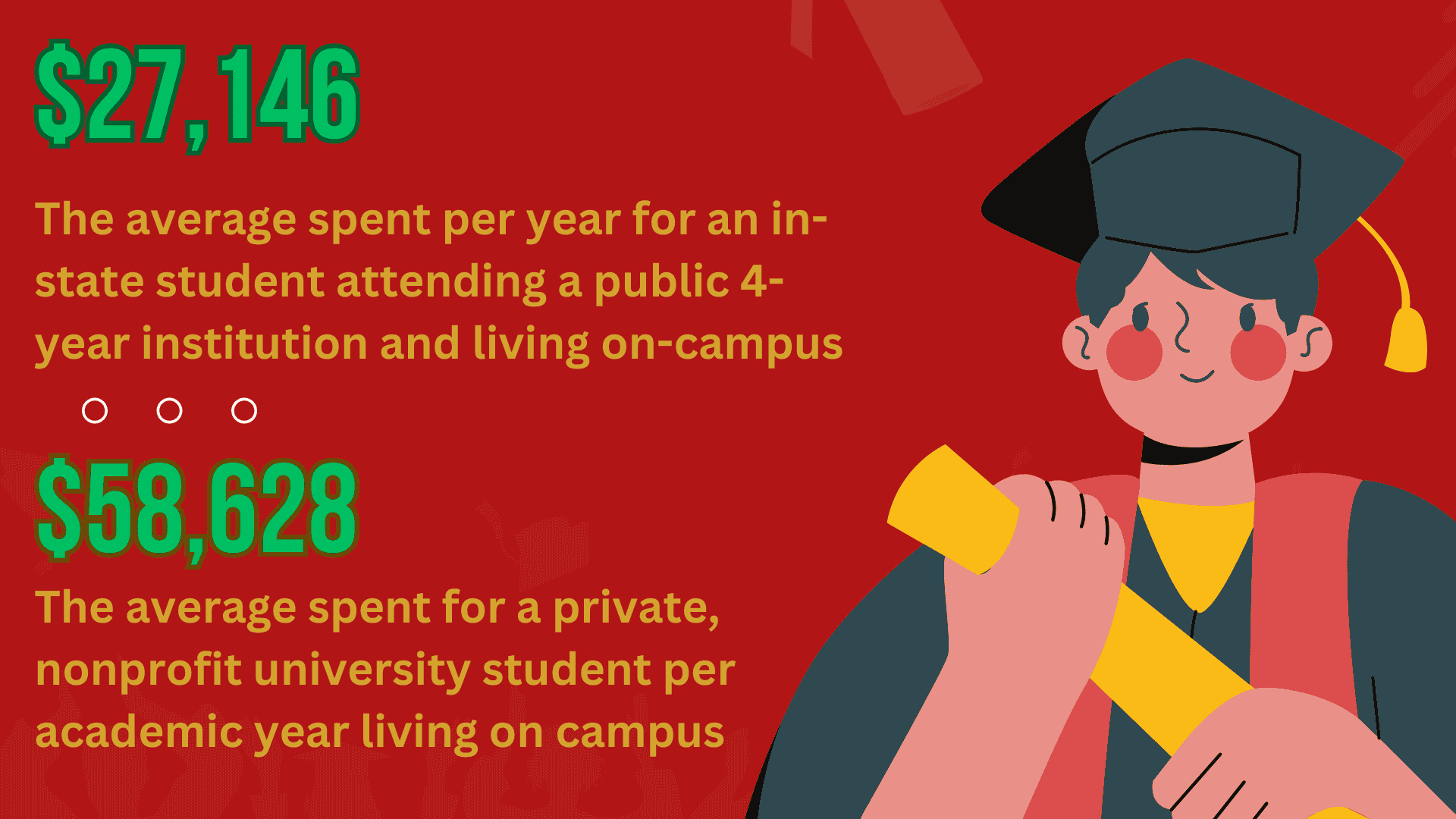
The $300,000 per child figure also deserves scrutiny. The critical question is whether that number covers tuition alone or the full cost of four years on campus, because the distinction matters considerably. According to College Board data, average published tuition and fees at private nonprofit four-year colleges rose 4% in 2025-26, reaching $45,000 per year. Add room and board averaging $15,920 annually at private schools, along with books, supplies, and personal expenses, and the total cost of attendance reaches $65,470 per year, or roughly $262,000 over four years at today’s prices.
That four-year total sits close to the $300,000 estimate, but only if prices stay frozen. Private college tuition jumped 4% in 2025-26 alone, and education cost inflation has historically outpaced general CPI. The Redditor’s model assumes an 8% investment return against 3% general inflation, but college cost inflation has been running in the 4% to 6% range annually. That gap is worth revisiting carefully before locking in a static college budget for either child.
There is also the question of net price versus sticker price. The 2025 NACUBO Tuition Discounting Study, covering 258 private nonprofit institutions, found that the average discount rate for first-time, full-time undergraduates reached 57.1% in 2025-26, a new record. (The finalized rate for 2024-25 came in at 56.3%.) In practical terms, private schools are awarding roughly 57 cents in grant aid for every dollar of published tuition. The College Board separately estimates that after grants and institutional aid, the average private nonprofit student pays around $16,910 per year in net tuition and fees. Families at this wealth level may not qualify for need-based aid, but merit awards can still reduce the bill substantially, and planning against the sticker price alone overstates the likely out-of-pocket cost.
On the savings vehicle side, a 529 college savings plan remains the right tool for this situation, and the rules have changed. The One Big Beautiful Bill Act, signed into law on July 4, 2025, expanded the list of qualified 529 expenses. Starting with tax year 2026, the annual K-12 withdrawal cap doubles to $20,000, and career credentialing costs now count as eligible uses. For 2026, contributions up to $19,000 per beneficiary ($38,000 for a married couple filing jointly) fall within the annual gift tax exclusion. Families can also front-load through superfunding: a single contributor can put in up to $95,000 per beneficiary at once, or $190,000 for a married couple, by electing to spread the gift over five years for tax purposes. A well-funded 529 reduces the pressure on liquid assets when tuition bills arrive, though it does not resolve the broader retirement math on its own.
The Takeaway
One detail in this post reframes the entire retirement debate. The Redditor notes that his parents passed away at 69 and 72. At 52, he is keenly aware that grinding until 56 to reach $10 million could consume a meaningful share of the healthy, active years he actually has. That is not a small consideration, and it deserves to sit alongside the spreadsheet math rather than beneath it.
Both paths are defensible at $7.8 million. The case for pushing to $10 million is straightforward: more buffer, more flexibility, more margin for unexpected expenses including college cost overruns. The case for scaling back now rests on quality of life, longevity uncertainty, and the reality that $7.8 million invested prudently can support a reasonable retirement even before Social Security eligibility kicks in. What the model truly needs is a sharper college cost projection that accounts for actual inflation, a realistic household expense budget for retirement, and a clear-eyed look at the gap between sticker price and the likely net price at the schools his children actually want to attend.
Editor’s note: This article updates the NACUBO institutional tuition discount rate to 57.1% for first-time, full-time undergraduates in 2025-26 (a record, per the 2025 NACUBO Tuition Discounting Study covering 258 institutions), adds the finalized 2024-25 rate of 56.3% for context, and confirms the 2026 superfunding limits of $95,000 per beneficiary for single contributors and $190,000 for married couples contributing jointly to 529 plans.
Contact [email protected] for any questions or corrections.
David Beren has been a Flywheel Publishing contributor since 2022. Writing for 24/7 Wall St. since 2023, David loves to write about topics of all shapes and sizes. As a technology expert, David focuses heavily on consumer electronics brands, automobiles, and general technology. He has previously written for LifeWire, formerly About.com. As a part-time freelance writer, David’s “day job” has been working on and leading social media for multiple Fortune 100 brands. David loves the flexibility of this field and its ability to reach customers exactly where they like to spend their time. Additionally, David previously published his own blog, TmoNews.com, which reached 3 million readers in its first year. In addition to freelance and social media work, David loves to spend time with his family and children and relive the glory days of video game consoles by playing any retro game console he can get his hands on.