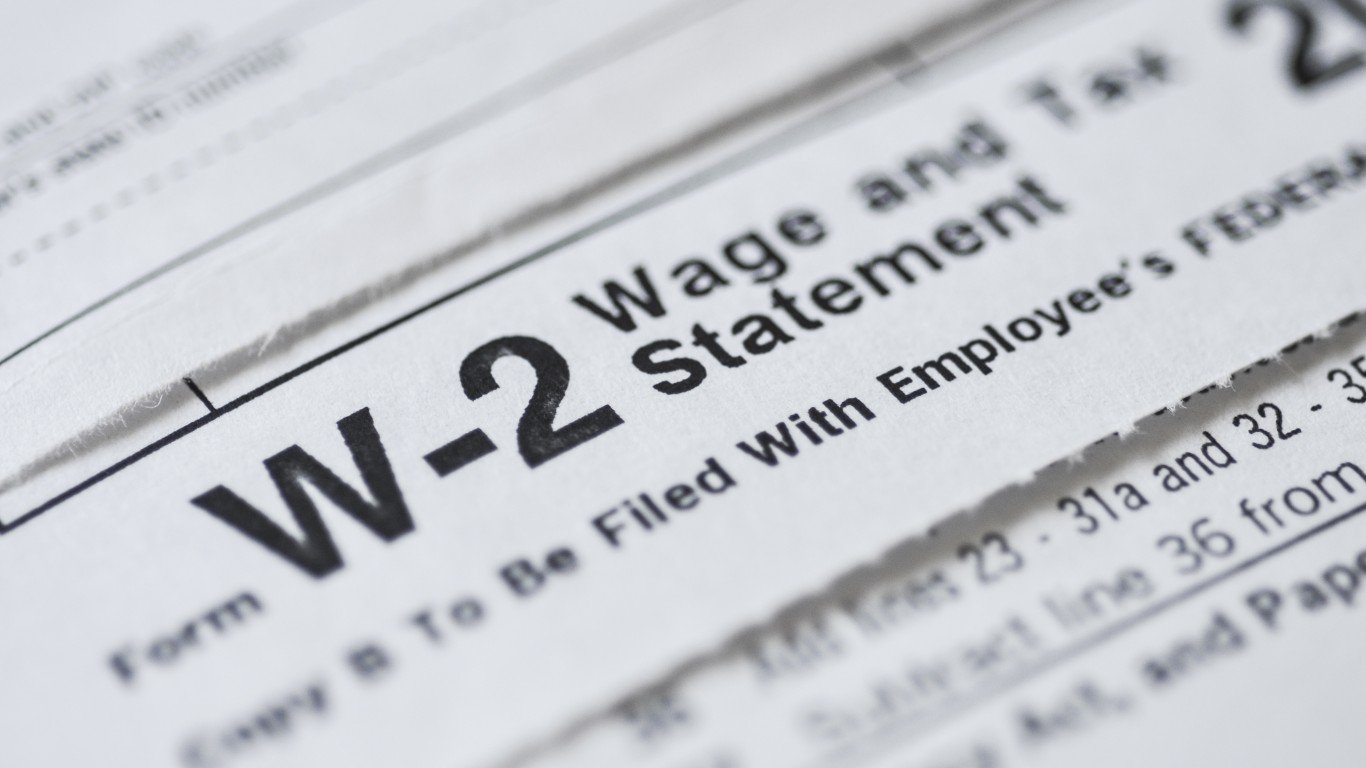
The One Social Security Document You Need Before Age 55 to Recover $96,000 in Lifetime Benefits
A 67-year-old who spent three decades running her own contracting business logs into her Social Security account and is in for a shock: seven of her earliest years, roughly 1995 through 2001, show either zero earnings or a fraction of…

This post may contain links from our sponsors and affiliates, and Flywheel Publishing may receive compensation for actions taken through them.

A 67-year-old who spent three decades running her own contracting business logs into her Social Security account and is in for a shock: seven of her earliest years, roughly 1995 through 2001, show either zero earnings or a fraction of what she actually made. She filed her Schedule SE. The money was real. But somewhere between her tax return and the Social Security Administration’s (SSA’s) earnings record, the wages never matched up.
This is common among self-employed workers who filed paper returns in the 1990s. One retiree on a personal finance forum recently described logging in at 66 and seeing four blank years from a small business she ran in her thirties.
That earnings record is the entire foundation of her monthly check for life. With Social Security paying out $1,631.2 billion in the first quarter of 2026 alone, the program is the single largest income source for most retirees, and the household savings rate has slipped to 4%. There is not much room to absorb a benefit that is quietly too small.
The form almost nobody knows exists
The document to pull up is Form SSA-7008, the Request for Correction of Earnings Record. It is the official way to tell Social Security that a year on your statement is wrong and the only mechanism that can recover benefits already embedded in a miscalculated record.
Social Security calculates your benefit from your highest 35 years of indexed earnings, averaged into a monthly figure called your Average Indexed Monthly Earnings (AIME). In the contractor’s case, plugging the missing years back in adds roughly $480,000 of indexed wages to her record, which lifts her AIME by about $1,250 a month.
That AIME bump runs through the benefit formula. Most of her increase lands in the middle band, where Social Security credits 32% of earnings between roughly $1,200 and $7,200. Applying that rate to the AIME increase works out to about $400 a month in additional benefits at full retirement age, or $96,000 in lifetime payments over a 20-year retirement before any cost-of-living adjustments compound on top.
The three-year window has real exceptions
The standard correction window is three years, three months, and 15 days from the end of the year the wages were earned. On paper, 1995 through 2001 closed long ago. In practice, the rule has carve-outs for SSA processing errors, employer mistakes, and fraud, and those exceptions can extend the window indefinitely if you can document the events. Original W-2s, signed tax returns, and Schedule SE filings are the evidence that turns a denied claim into an approved correction.
How a bigger benefit changes the rest of the plan
A $400 monthly correction does more than pad the checking account. The CPI stood at 330.213 in March 2026, meaning prices have roughly tripled since the 1982 baseline, and Social Security’s annual cost of living adjustment (COLA) is applied to whatever base benefit you have locked in. A higher base means every future adjustment adds more in dollar terms, so the gap between the corrected and uncorrected benefit widens each year rather than staying flat.
It also reshapes withdrawal strategy. An extra $4,800 a year from Social Security is $4,800 less that has to come out of an IRA or brokerage account, which can keep a retiree in a lower tax bracket and reduce how much of her Social Security itself becomes taxable. For a household relying on a thin savings cushion, that compounding effect over two decades is the difference between drawing down principal and leaving it alone.
What to actually do this week
- Pull your Social Security statement now, even at 50. Open a my Social Security account and scroll through every year of earnings. Compare each line to your old W-2s or Schedule SE filings. Catching a gap at 50 gives you decades to gather records; catching it at 67 means hunting for paperwork from before the turn of the century.
- If a year looks wrong, file Form SSA-7008 with documentation. Attach copies, never originals, of W-2s, tax returns, and self-employment schedules. The form is free, the process is slow, and the payoff can run into five or six figures of lifetime benefits.
The hardest mistake to undo is the one you never notice. A benefit that is $400 a month too small looks identical to one that is correct, and Social Security will not flag it for you. A quick conversation with a fiduciary advisor or a call to your local SSA office before filing is usually time well spent.
Contact [email protected] for any questions or corrections.
Gerelyn Terzo is the author of dividend investing handbook "Dividend Investing Strategies: How to Have Your Cake & Eat It Too." A veteran financial journalist, she covers agri-finance for outlets like Global AgInvesting and the broader stock market and personal finance for 24/7 Wall Street. She began at CNBC and later helped launch Fox Business in New York. Gerelyn currently resides in Woodland Park, Colorado and dabbles in nature photography as a hobby.