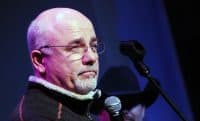
Disabled Millionaire Asks Dave Ramsey When to Quit: His Answer Will Surprise You
On the May 19, 2026 episode of The Ramsey Show, a 33-year-old disabled caller named James told Dave Ramsey he’d "been very diligent about saving since junior high" and had "finally crossed the millionaire, I guess, threshold." He wanted to…

This post may contain links from our sponsors and affiliates, and Flywheel Publishing may receive compensation for actions taken through them.

On the May 19, 2026 episode of The Ramsey Show, a 33-year-old disabled caller named James told Dave Ramsey he’d "been very diligent about saving since junior high" and had "finally crossed the millionaire, I guess, threshold." He wanted to know his “freedom number”: the brokerage balance that would let him quit his day job and pursue public speaking. Ramsey’s answer focused on the timeline.
“What breaks my heart is the FIRE people out there,” Ramsey said. "They go, well, I’m going to go do something I’m passionate about one day. Like, well, just do it today. Go do the encore career now instead of when you’re 55 and exhausted."
The stakes for Financial Independence, Retire Early: if you build your plan around a future version of yourself who finally gets to live, you may arrive at the finish line with the money and none of the energy. Ramsey is telling James to start the second life now and let the math catch up.
The verdict: Ramsey is right, and the bridge math proves it
James has $435,000 in a brokerage account, earns $80,000 in salary with a $10,000 annual bonus, pulls in roughly $20,000 from side work, and saves close to $45,000 a year. He’s about to buy a house in cash. He initially floated $30,000 to $40,000 in annual expenses but conceded $60,000 to $80,000 was more honest.
Ramsey and co-host Rachel Cruze independently landed on the same target: $1.5 million in the brokerage account would function as the bridge between leaving work and the age when retirement accounts unlock penalty-free. That bridge has to do real work. Pulling from a 401(k) early triggers what Ramsey described as "a 10% penalty plus your tax rate, 30% in your case, for a total 40% hit." A taxable brokerage avoids that.
Here is the mechanic FIRE adherents often skip. A 4% safe withdrawal on $1.5 million produces $60,000 a year before taxes, which barely covers the low end of James’s real expense range. Inflation makes that worse. The Fed’s preferred measure, core PCE, sat at an index value of 129 in March 2026, up from 126 a year earlier. Costs are still climbing, and the University of Michigan consumer sentiment reading just printed at 53.3, near recessionary territory. A bridge built for $60,000 today does not buy $60,000 of life ten years from now.
At James’s current pace, Ramsey estimated roughly 10 years to hit $1.5 million. That is a decade of waiting for the encore career to begin. The bridge gets built either way. The question is whether James spends those years grinding silently or building the speaking business that may eventually retire the day job for him.
The variable that flips the whole plan: side income trajectory
Whether James waits 10 years or three depends on whether his public speaking income grows. Today it sits inside the $20,000 side work bucket. If it stays there, the brokerage has to do all the lifting and the timeline is long. If speaking scales to $60,000 or $80,000 annually within a few years, it replaces the salary entirely, and the $1.5 million target becomes optional rather than mandatory.
The interest rate environment helps too. The 10-year Treasury yield is currently 4.6%, the high end of its 12-month range, and the Fed funds rate sits at almost 4%. Fixed-income inside the bridge account can carry more of the load than it could a year ago, which means James does not need to be 100% in equities to make $1.5 million produce a livable income.
What James should actually do
- Start the encore career this quarter, not after the bridge is built. Book paid speaking dates while the W-2 still pays the bills. The downside is small. The optionality compounds.
- Run a realistic expense audit before buying the house cash. James already revised his estimate from $30,000 to $60,000-$80,000. Lock in the real number with 12 months of bank data, then design the bridge around it.
- Stress-test the $1.5 million target against inflation. Use a 3% annual cost-of-living adjustment on your real expense number, not today’s number.
- Separate the bridge from the retirement accounts mentally and operationally. The brokerage funds years one through roughly age 59. The 401(k) and IRA fund everything after. Different timelines, different allocations.
- Don’t deprive yourself on the way there. Cruze’s caution matters: take the vacation, go on the dates. A plan you abandon at year four is worse than a plan that takes six years instead of five.
The freedom number is real. The freedom date is negotiable. Ramsey’s argument is that the people who win at FIRE are the ones who stop treating their passion as a retirement gift to a future self and start collecting on it now.
Contact [email protected] for any questions or corrections.
I am a long time investor and student of business, and believe finding good companies that can become great investments is the best game on earth. After 20 years of writing and researching the public markets it is clear that individuals have never had more tools and information to take control of their financial lives. From ETFs and $0 commissions to cryptos and prediction markets there has never been a greater democratization of access to investing.
I write to help people understand the investments available to them so they can make the best choice for their portfolio, whether they're starting out or looking for income in retirement.