Their Horse Rescue Eats $90,000 a Year. Can Their Retirement Savings Survive the Strain?
Retirement was supposed to be slower. Instead, Jim and Linda spend their days feeding horses, coordinating veterinary visits, repairing fences, and keeping a twelve-horse rescue operation running. The farm they inherited from her grandparents is paid for, but the rescue…

This post may contain links from our sponsors and affiliates, and Flywheel Publishing may receive compensation for actions taken through them.
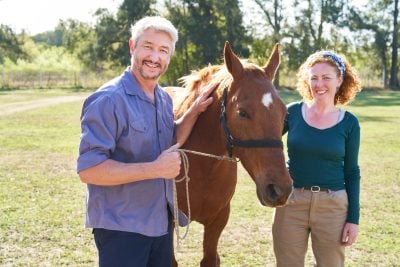
Retirement was supposed to be slower. Instead, Jim and Linda spend their days feeding horses, coordinating veterinary visits, repairing fences, and keeping a twelve-horse rescue operation running. The farm they inherited from her grandparents is paid for, but the rescue still costs about $90,000 per year. With $3.4 million in retirement savings, the couple appears wealthy on paper. The question is whether that wealth can sustain both their retirement and a mission that consumes nearly six figures annually. To find out, we ran the numbers.
The $90,000 line item is only part of the cost
The rescue budget itself is reasonable for a twelve-horse operation. The couple spends about $30,000 on feed and hay, $18,000 on veterinary care, $8,000 on farrier services, $10,400 on a part-time farm hand, $10,000 on equipment, fencing, and repairs, and another $13,600 on insurance, utilities, transportation, and miscellaneous expenses. That brings the annual cost to roughly $90,000, and there is nothing unrealistic about the figure.
The problem is that the rescue is only half the budget.
Even with a paid-off farm, two retirees are likely to spend another $60,000 to $75,000 per year on their own living expenses. Food, property taxes, homeowner’s insurance, healthcare, vehicle replacement, fuel, personal spending, and income taxes do not disappear simply because the mortgage is gone. Healthcare alone can easily consume $10,000 to $15,000 annually for a retired couple, while maintaining the trucks, tractors, and equipment required to operate a working farm creates expenses many suburban retirees never face.
Once the couple’s personal expenses are added to the rescue budget, total annual spending rises to approximately $150,000 to $165,000 per year. That is the number that matters. The question is no longer whether they can afford twelve horses. It is whether their retirement savings can support a lifestyle that requires well over $150,000 every year for the next two or three decades.
Running the withdrawal math
Call the all-in number $160,000. Two earners claiming Social Security at full retirement age, each with an average benefit in the neighborhood of $24,000 a year, contribute roughly $48,000 of guaranteed income. That leaves a portfolio gap of about $112,000. Against $3.4 million, that is a withdrawal rate close to 3.3%, which is defensible for a thirty-year horizon, especially with Suze Orman’s 3% rule as the conservative anchor and the traditional 4% rule as the upper bound.
If they retire before Social Security kicks in, the picture tightens fast. Drawing the full $160,000 from the portfolio alone is a 4.7% rate, and that is where the plan starts to crack. With Core PCE running at 129.63 in April 2026 and CPI at 333.020, feed, hay, and veterinary costs are compounding faster than headline inflation in most agricultural regions. A bridge strategy of a treasury ladder covering the gap years until both spouses claim Social Security is the realistic fix.
When the horses age and so do you
The biggest risk is not this year’s budget. It is the next decade’s. Many rescue horses arrive in middle age and can live well into their twenties or thirties. As they age, costs rise. Senior feed, dental work, medications, joint treatments, and end-of-life veterinary care can push annual expenses well beyond today’s levels. A rescue that costs $90,000 a year now could easily cost $115,000 to $125,000 a year within a decade, even before inflation.
The couple faces another challenge: they are aging too. Much of the rescue’s labor is currently provided free by the owners. As they move through their seventies and eighties, they will likely need to hire additional help, adding further pressure to the budget. That makes growth the wrong strategy. The couple should stop taking in new horses and focus on finding good homes for adoptable animals already in their care. A rescue with eight horses is easier to sustain than one with twelve, and a rescue with five is easier still.
A 501(c)(3) nonprofit structure can also help by opening the door to donations, grants, and sponsorships. The long-term goal should be reducing both the financial and physical demands of the operation rather than assuming today’s budget will remain manageable forever.
What it actually takes
The honest answer: $3.4 million works if both spouses are at or near Social Security claiming age, the portfolio stays diversified across index funds, dividend ETFs, and a treasury ladder earning a real return near 4% to 5%, the withdrawal rate stays under 3.5%, and the rescue is restructured as a 501(c)(3) so outside money helps carry the herd’s senior years. Retire five years earlier with the same herd and the same portfolio, and the math does not survive the bridge. The farm is paid off. The horses are not.
Contact [email protected] for any questions or corrections.
Drew Wood has edited or ghostwritten nine books and published more than 1,500 articles on investing, business, politics, travel, world cultures, wildlife, and earth science. He holds a doctorate and four master's degrees and has nearly 30 years of college teaching experience. His travels have taken him to 25 countries, including three years living in Ukraine.