Bernie Sanders vs. Elon Musk: Would Taxing the Rich Actually Save Social Security?
Senator Bernie Sanders fired off a single sentence on X this month that frames the entire fight over how to keep Social Security solvent: “Today, Elon Musk, a trillionaire, pays the same amount into Social Security as someone making $184,500.”…

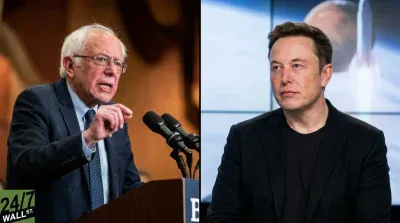
Senator Bernie Sanders fired off a single sentence on X this month that frames the entire fight over Social Security’s solvency: “Today, Elon Musk, a trillionaire, pays the same amount into Social Security as someone making $184,500.” The Vermont independent paired the post with the Social Security Expansion Act, a bill he says would end that disparity and expand benefits by $2,400 a year, funded by applying the payroll tax to all income above $250,000.
The stakes are real for anyone counting on a check. Social Security transfers hit $1,629.6 billion in the first quarter of 2026. The program’s OASI trust fund is now projected to be exhausted in the fourth quarter of 2032, one year sooner than last year’s estimate, and the long-term shortfall has widened sharply to $29.3 trillion over 75 years, up from $26.1 trillion in the prior Trustees Report. Lower fertility and immigration assumptions, along with reduced revenue from the One Big Beautiful Bill Act, drove most of that deterioration. If Congress does nothing, scheduled benefits face an automatic 22% cut the day the OASI fund hits zero.
Right diagnosis, partial cure
Sanders is correct that the payroll tax is steeply regressive at the top. He is wrong that lifting the cap on its own balances the books. The math is worth doing carefully, because it tells you exactly how much of the gap his fix actually closes.
The Social Security payroll tax is 6.2% from the worker and 6.2% from the employer, for a combined 12.4%. It applies only to wages up to the cap, currently $184,500 in 2026. A worker who earns exactly the cap pays roughly $11,000 on the employee side. A worker who earns $1 million pays the same $11,439, an effective rate of roughly 1% on total wages. A worker who earns $10 million still pays $11,439. That is the regressivity Sanders keeps invoking, and it is real. Worth noting: the payroll tax currently covers only about 83% of all covered wages, down from 90% in 1983, because high-income earners’ wages have grown far faster than the taxable maximum.
Musk’s case is more nuanced. His SpaceX salary is publicly disclosed at $54,000, which generates roughly $3,300 in employee-side payroll tax. The trillion-dollar net worth that produced the headline is paper wealth in Tesla (NASDAQ:TSLA | TSLA Price Prediction) and SpaceX shares. Stock that has not been sold does not generate wages, and Social Security does not tax capital gains, dividends, or unrealized appreciation. Sanders’ shorthand collapses two different tax bases into one sentence.
Closing the gap with payroll taxes alone would require raising the combined rate from 12.4% to 15.9% in 2035, with further increases after that, per the Stanford Institute for Economic Policy Research. Lifting the cap helps considerably but does not get you all the way there. Most independent estimates put cap removal at roughly half the 75-year shortfall, which is why serious reform packages pair it with either benefit changes or a broader tax base.
The variable that decides the answer
The single factor that determines whether Sanders’ fix works is where you draw the tax base. Tax wages above the cap and you raise considerable revenue from doctors, lawyers, executives, and senior engineers, the people whose income shows up on a W-2. You raise very little from the Musk archetype, whose compensation is structured in equity. The Sanders bill addresses this partially by applying the payroll tax to all income above $250,000, not just wages, which would reach some investment income. But unrealized gains on shares like those that make up the bulk of Musk’s net worth remain outside any payroll-tax framework.
Tax investment income or net worth and you reach the trillion-dollar fortunes Sanders keeps invoking. Corporate profits hit $4,392.5 billion in the first quarter of 2026, up 12% from a year earlier. Asset income across the economy ran $4,284.4 billion in the same quarter. That is where the money the senator wants is actually sitting. A bill that only lifts the wage cap leaves it entirely untouched.
Inflation adds urgency to the choice. The 2026 cost-of-living adjustment is 2.8%, while CPI ran from 321.465 in May 2025 to 335.123 in May 2026. The worker-to-beneficiary ratio compounds the problem further: there were more than five workers per Social Security beneficiary in 1960; today that ratio has fallen to 2.9-to-1 and is projected to drop to 2.2-to-1 by the 2070s. Beneficiaries are already losing ground in real terms before any trust-fund cut materializes.
What to do with this
- Pull your own benefit estimate. Log into your account at SSA.gov and look at the “scheduled” figure. Then mentally apply a 20% to 25% haircut to see what 2032 looks like if Congress does nothing.
- Stress-test your retirement plan against two scenarios. Run it once assuming full scheduled benefits, once assuming the post-depletion reduction. The gap is your political risk exposure.
- Watch which tax base each bill targets. Lifting the wage cap, taxing investment income, and taxing net worth are three different policies with very different revenue profiles. The label “tax the rich” covers all three, and they are not interchangeable.
- Track the annual Trustees Report. The depletion date shifts by a year or two with each release. That number is the closest thing to a real countdown clock the program publishes.
The current cap does let the highest earners off cheaply. Fixing the cap alone will not save the program. Both statements can be true at once, and the reform that actually solves the math has to grapple with both sides of the ledger.
Editor’s note: This article was updated to reflect the 2026 Social Security Trustees Report (released June 9, 2026), which moved the OASI trust fund depletion date to Q4 2032 (from 2033) and raised the 75-year unfunded obligation to $29.3 trillion (from $26.1 trillion). The projected benefit cut at depletion was also revised to 22%, and context was added on the One Big Beautiful Bill Act’s role in accelerating the shortfall and the current 2.9-to-1 worker-to-beneficiary ratio.
Contact [email protected] for any questions or corrections.
I am a long time investor and student of business, and believe finding good companies that can become great investments is the best game on earth. After 20 years of writing and researching the public markets it is clear that individuals have never had more tools and information to take control of their financial lives. From ETFs and $0 commissions to cryptos and prediction markets there has never been a greater democratization of access to investing.
I write to help people understand the investments available to them so they can make the best choice for their portfolio, whether they're starting out or looking for income in retirement.