Here’s How You Can Retire to Palm Springs at 62 With a Pool and Warm Winters
Someone in their late fifties falls for Palm Springs on a long weekend, spots a mid-century pool home on Zillow, and wonders if retiring there at 62 is feasible. The answer: it can work, but the true costs differ sharply…

This post may contain links from our sponsors and affiliates, and Flywheel Publishing may receive compensation for actions taken through them.
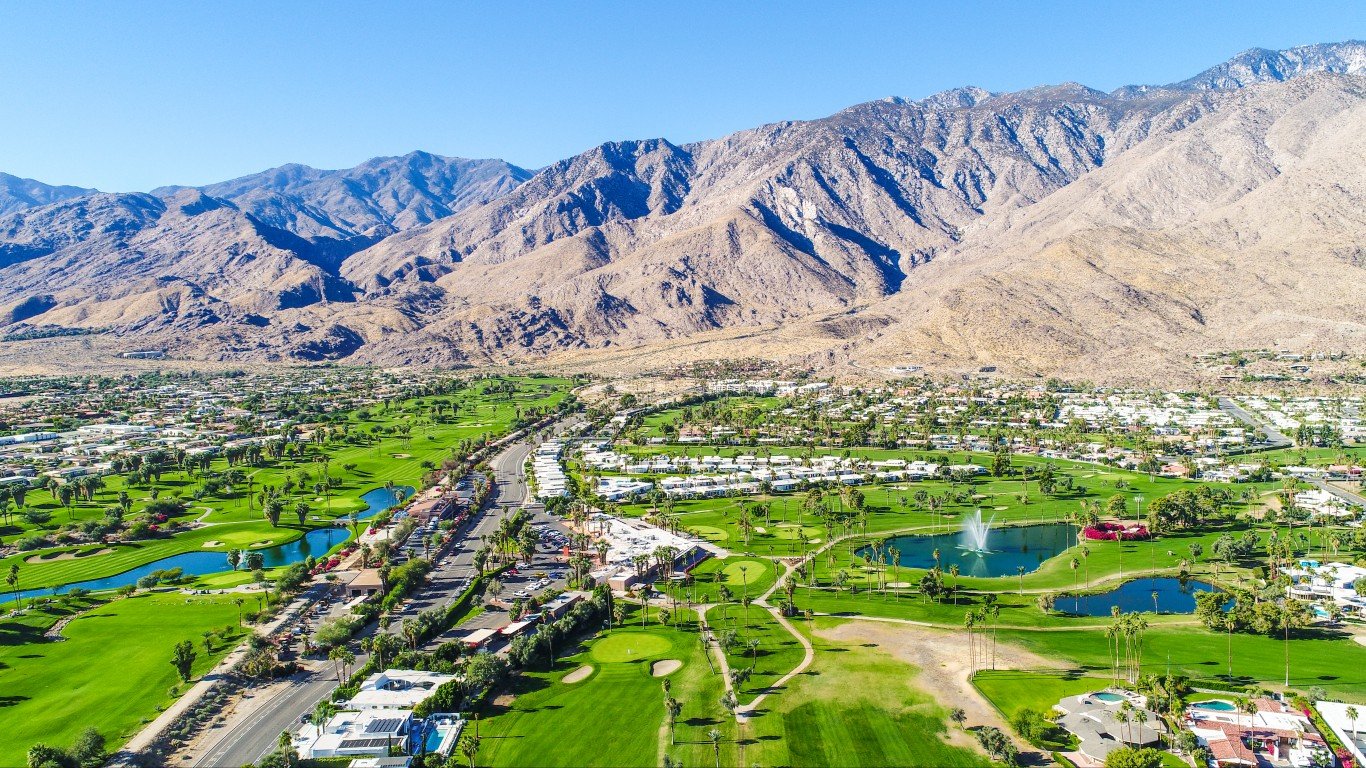
Someone in their late fifties falls for Palm Springs on a long weekend, spots a mid-century pool home on Zillow, and wonders if retiring there at 62 is feasible. The answer: it can work, but the true costs differ sharply from what most calculators show.
The Palm Springs cost reality
A pool-equipped single-family home in a desirable Palm Springs neighborhood currently trades in the high $600s to low $800s. Assume you pay cash, so no mortgage. Annual ownership costs in current dollars:
- Property tax under Proposition 13: around $8,000 on a $750,000 assessment
- Homeowners insurance with wildfire and pool liability riders: around $2,800
- HOA, if any: $5,000 to $7,000
- Pool service, chemicals, pump electricity, and water: around $5,500
- Summer-heavy electric and water utilities: around $4,800
- General home maintenance reserve: around $5,000
- Food (USDA moderate plan for two): around $11,000
- Transportation and vehicle reserve: $6,500
- Discretionary (travel, dining, gifts, hospitality): $14,000
- Federal taxes on portfolio withdrawals: $6,000 to $9,000
A realistic all-in working budget lands near $85,000 a year for a couple, or about $72,000 for a single retiree.
The healthcare bridge from 62 to 65
Medicare does not begin until 65, so the first three years run through ACA marketplace coverage. To qualify for premium tax credits, manage modified adjusted gross income carefully by leaning on Roth and taxable-account basis rather than draining a traditional IRA. Budget $11,000 to $14,000 per person for premiums and out-of-pocket during the bridge, then roughly $7,500 per person once Medicare Parts B, D, and a Medigap policy begin.
The income side and the claiming question
Claiming Social Security at 62 cuts your benefit by up to 30% versus full retirement age, and each year you delay past full retirement age adds about 8% to the check. For a Palm Springs retiree leaving work at 62, bridging with the portfolio and letting Social Security grow usually makes sense. A reduced benefit at 62 might deliver $1,900 to $2,200 per month for a moderate earner; waiting to 67 or 70 lifts that meaningfully. California does not tax Social Security, though it does tax IRA and pension withdrawals at ordinary rates, and its overall tax competitiveness rank of 48 means you feel the income tax bite on every dollar pulled from a traditional account.
The number, with a 30-plus year horizon
For a couple with $36,000 in combined Social Security starting at 67, bridged by the portfolio from 62 to 67, the gap to cover is $85,000 minus $36,000, or about $49,000 a year in steady-state withdrawals, plus heavier draws during the five bridge years. At a 3.3% withdrawal rate appropriate for a 33-year horizon, you need roughly $1.5 million in invested assets at 62, on top of the paid-off house. Add a $250,000 to $350,000 cushion for bridge draws and healthcare shocks, and the realistic target is $1.75 million to $1.85 million in liquid investments plus the home. A blended portfolio of broad index funds, a dividend ETF sleeve, and a five-year treasury ladder handles sequence-of-returns protection without exotic risk.
The Palm Springs detail almost everyone misses: land leases
A meaningful share of Palm Springs residential land, particularly in older condo developments and some single-family pockets, sits on leased land owned by the Agua Caliente Band of Cahuilla Indians. The home is yours; the dirt under it is rented, often on 65-year leases that reset periodically. That stunning pool condo listed at $400,000 instead of $650,000 is almost always a land-lease property. The lease payment can run $400 to $1,200 a month, it escalates on a schedule written decades ago, and as the remaining lease term shortens, your resale equity compresses toward zero. Lenders treat short remaining terms as unfinanceable, which shrinks your future buyer pool. Add the lease payment to carrying costs, treat the home as a depreciating asset rather than an inflation hedge, and the $1.75 million portfolio target becomes closer to $2 million because you lose the late-life option of tapping home equity through a sale or reverse mortgage.
The Palm Springs retirement at 62 with the pool and warm winters is achievable on roughly $1.75 million in investments plus a fee-simple home, a 3.3% withdrawal rate, Social Security deferred to at least full retirement age, and a disciplined ACA bridge through 64. Push to $2 million if you are buying on leased land, and read every page of that lease before you commit.
Contact [email protected] for any questions or corrections.
I am a long time investor and student of business, and believe finding good companies that can become great investments is the best game on earth. After 20 years of writing and researching the public markets it is clear that individuals have never had more tools and information to take control of their financial lives. From ETFs and $0 commissions to cryptos and prediction markets there has never been a greater democratization of access to investing.
I write to help people understand the investments available to them so they can make the best choice for their portfolio, whether they're starting out or looking for income in retirement.