Retire Across The Gulf From Iran? Don’t Rule It Out Too Fast
Americans considering retirement abroad usually look at Portugal, Mexico, Costa Rica, or Panama: places with favorable climates, political stability, and many of the comforts of home at a lower cost. Oman almost never enters the conversation. For many Americans, the…

This post may contain links from our sponsors and affiliates, and Flywheel Publishing may receive compensation for actions taken through them.
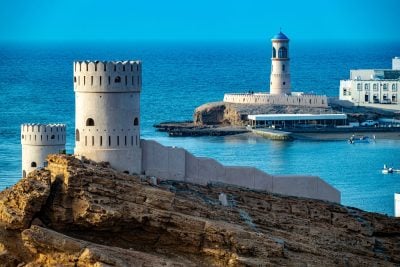
Americans considering retirement abroad usually look at Portugal, Mexico, Costa Rica, or Panama: places with favorable climates, political stability, and many of the comforts of home at a lower cost. Oman almost never enters the conversation. For many Americans, the fact that it sits across the Strait of Hormuz from Iran is enough to end the discussion before it begins. For a select group of retirees, that may be a mistake.
The Lifestyle Case for Oman
Oman appeals to a particular type of retiree. It is one of the safest and most politically stable countries in the Middle East, with a reputation for moderation, low crime, and a slower pace of life than many of its Gulf neighbors. Muscat, the capital, stretches along a dramatic coastline framed by rugged mountains and the Arabian Sea. The city offers modern hospitals, reliable infrastructure, clean streets, and a growing expatriate community without feeling overbuilt or crowded.
Many retirees are drawn to the climate, especially during the winter months when daytime temperatures are comfortable and sunshine is nearly guaranteed. Others appreciate the relaxed atmosphere, the absence of mass tourism, and the country’s tradition of welcoming foreign residents. Life in Oman lacks the constant bustle of larger global cities. However, it’s not isolated, either. Muscat is only a short flight or a few hours by car from Dubai and Abu Dhabi, with world-class shopping, international airports, major medical centers, concerts, sporting events, and virtually any Western product or service you might miss. In practical terms, retirees can enjoy Oman’s quieter pace, lower density, and more relaxed atmosphere while keeping one of the world’s most connected and modern urban regions within easy reach.
What About the Neighborhood?
Oman has a lot to commend it, but retirees would be foolish to ignore its location. It sits across the Strait of Hormuz from Iran, a strategic chokepoint that is the center of global attention during the current U.S.-Iran conflict. But Oman’s advantage is its diplomacy. Muscat has long maintained working relations with both Tehran and Washington, serving as a mediator rather than a combatant. The U.S. and Oman remain close partners with security and trade ties, while Oman also keeps channels open with Iran.
That neutrality does not eliminate risk. The U.S. State Department currently advises Americans to reconsider travel to Oman because of terrorism and armed conflict, and specifically warns against the Yemen border area. Oman also had a rare Islamic State-claimed mosque attack in Muscat in 2024.
Oman is not risk-free. Regional tensions, terrorism concerns, and the wars in neighboring Yemen and Iran are realities retirees must consider. At the same time, Oman has remained more stable, more secure, and more insulated from regional conflict than many outsiders assume. The question is not whether risk exists. It is whether the lifestyle benefits justify accepting it.
The Financial Piece Works
The biggest adjustment for most American retirees is healthcare. Medicare does not cover routine care in Oman, so private health insurance becomes an essential expense. For someone in their late sixties, a comprehensive policy plus out-of-pocket medical costs can easily run several thousand dollars per year. Beyond that, however, many of the numbers work in Oman’s favor.
A retiree living comfortably in Muscat might spend roughly $15,000 a year on housing, $3,000 on utilities, $5,000 on groceries, $4,000 on dining and entertainment, $4,500 on a car and fuel, $6,000 on healthcare, $4,500 on annual trips back to the United States, and another $8,000 on miscellaneous expenses, renewals, gifts, and unexpected costs. That produces an all-in budget of about $50,000 a year before U.S. taxes on portfolio withdrawals.
For a retiree receiving $3,000 per month from Social Security, annual benefits cover about $36,000 of that budget. The remaining gap is only about $14,000. On a $1.5 million portfolio, that translates to a withdrawal rate of less than 1%. Financially, Oman is often easier than Americans expect.
The Residency Problem
Oman does not have a traditional retiree visa. The Investor Residency Program, updated in 2025, has two tiers. The five-year option requires either a property or company investment of about OMR 250,000 (roughly $650,000) or, for retirees, a documented monthly income of OMR 4,000, which at the current exchange rate of 0.3845 OMR per dollar is roughly $10,400 a month, or $125,000 a year. The 10-year tier requires roughly $1.3 million in qualifying investment.
That is the catch. A $3,000 Social Security check does not clear the income threshold alone. Pulling enough from a $1.5 million portfolio to document $125,000 a year in steady distributions pushes you into a higher U.S. tax bracket and erodes the portfolio faster than the actual budget requires. The realistic path is the property route: buy in one of the designated Integrated Tourism Complexes, the only way foreigners can own freehold, and use that purchase to anchor a five-year residency. Sinking $650,000 into Omani real estate leaves about $850,000 to support the rest of life, and the property is not liquid.
The Cultural Caveat
Retirees should also understand that Oman is an Islamic country with social norms that differ from those in the United States. Daily life is generally relaxed and welcoming toward foreigners, but modest dress is expected in public places, particularly outside expatriate areas and tourist resorts. Religious minorities are allowed to worship, and expatriates from many faiths live in the country, but public criticism of religion, the government, or the ruling family is not permissible. Arabic is a beautiful language, but one of the most complex in the world. However, learning at least a little of the language goes a long way, and retirees who approach the culture with respect, curiosity, and a willingness to keep a relatively low profile tend to adapt most successfully.
The Bottom Line
The lifestyle math works easily. A 67-year-old with $1.5 million and $3,000 in Social Security can fund a comfortable Muscat life on a withdrawal rate well under 2%, even with CPI running above its 12-month average. The deciding factor is the residency structure. If you are willing to buy property in a designated complex and treat $650,000 as illiquid for a decade, Oman is genuinely underrated. If you need full portfolio flexibility, your $3,000 check will not buy you a visa. That single structural fact, more than language or distance or culture, is why most Americans who consider Oman end up choosing somewhere else.
So the answer is: consider it, but do not romanticize it. For a well-funded couple willing to rent first, keep U.S. escape options open, buy serious health coverage, adapt culturally, and accept geopolitical uncertainty, Muscat can make sense. For retirees who want maximum predictability, easy family access, Medicare coverage, or zero security stress, Oman is probably too spicy a retirement stew.
Contact [email protected] for any questions or corrections.
Drew Wood has edited or ghostwritten nine books and published more than 1,500 articles on investing, business, politics, travel, world cultures, wildlife, and earth science. He holds a doctorate and four master's degrees and has nearly 30 years of college teaching experience. His travels have taken him to 25 countries, including three years living in Ukraine.