




Replacing $17,500 a month in dividend income means generating $210,000 a year. That is roughly the after-tax lifestyle of a household pulling a $250,000 to $300,000 pre-tax salary. It is a high bar, and the capital required is the story.
The math is unforgiving. Income target divided by yield equals the portfolio you need. To keep the income durable, most of that portfolio should sit in dividend-safe holdings rather than the highest yield on the screen. The numbers land differently at three yield tiers, each anchored by real names.
Bucket 1: Dividend Growth Anchor (3% to 4% Yield)
$210,000 divided by 0.035 equals $6,000,000. This is the “sleep at night” tier: broad dividend-growth equities where the yield is modest but the payout compounds annually and the principal tends to appreciate.
Johnson & Johnson (NYSE:JNJ | JNJ Price Prediction) is the archetype. The company has 64 consecutive years of dividend increases, raised the quarterly payout to $1.34 per share, and delivers a 2.0% yield on shares trading near $262. Over the past decade the stock is up 182% before dividends.
Procter & Gamble (NYSE:PG) pairs a 2.9% yield with 70 consecutive years of dividend increases and plans to return roughly $10 billion in dividends in FY2027.
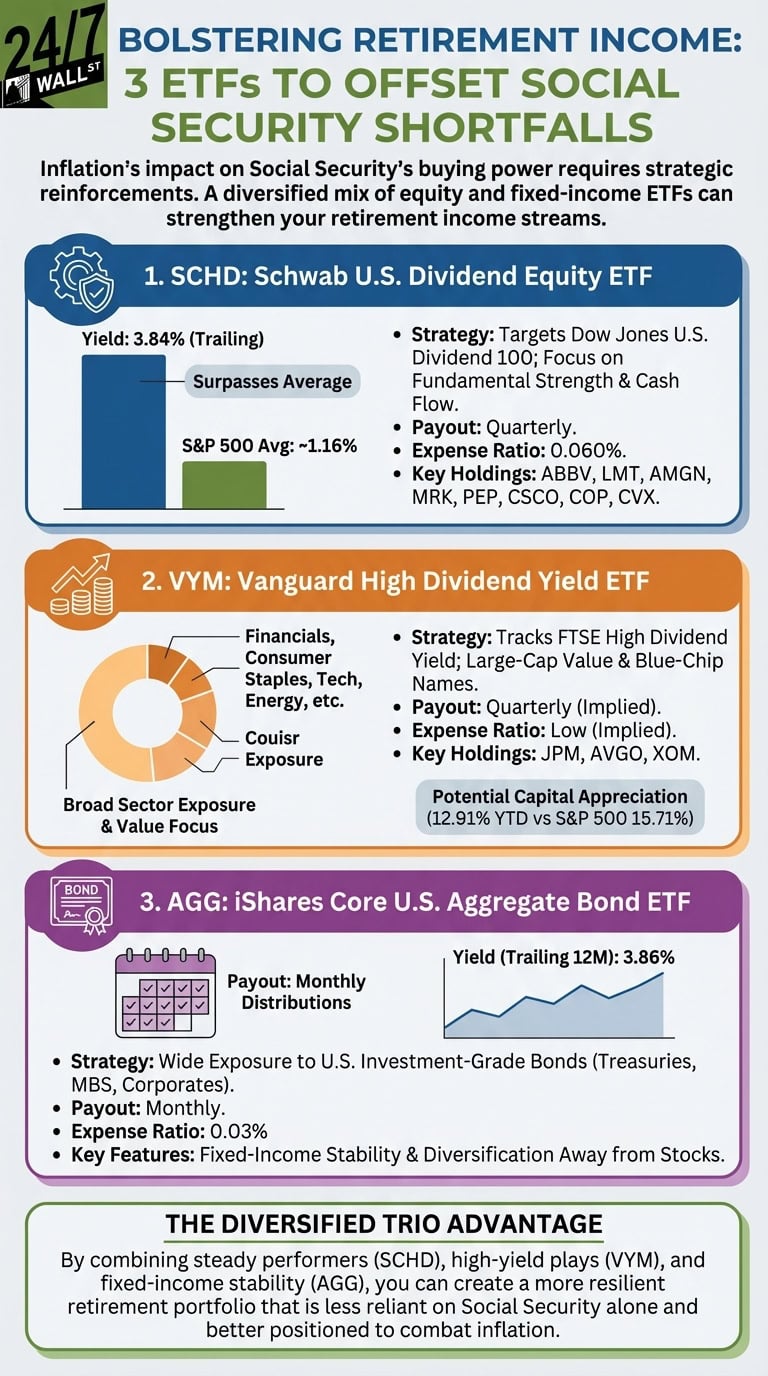
For a diversified wrapper, the Schwab U.S. Dividend Equity ETF (NYSEARCA:SCHD) holds names like QUALCOMM, Texas Instruments, UnitedHealth, Coca-Cola, Merck, and Chevron and has returned 237% over the last ten years including distributions.
Bucket 2: REITs and High-Dividend Equity (5% to 7% Yield)
$210,000 divided by 0.06 equals $3,500,000. Yield roughly doubles, and so does income per dollar invested. Growth slows and the price action gets more rate-sensitive.
Realty Income (NYSE:O) pays monthly, with an annualized rate of $3.252 per share and a 5.2% yield. It has now delivered 115 consecutive quarterly dividend increases and 670 consecutive monthly dividends, with portfolio occupancy at 98.8%.
NNN REIT (NYSE:NNN) just raised its quarterly payout 3.3% to $0.62, its 37th consecutive annual increase, and yields 5.3% with a 67% AFFO payout ratio and 99.1% occupancy. Both trade at meaningful spreads above the 4.7% 10-year Treasury.
Bucket 3: The High-Yield Sleeve (8% to 12% Yield)
$210,000 divided by 0.10 equals $2,100,000. This is the smallest capital requirement and the largest set of tradeoffs. Categories include covered-call ETFs, business development companies, mortgage REITs, and high-yield bond funds.
Expect capped upside, distributions that can be trimmed, and NAV that often drifts lower over time. This bucket boosts current income while payouts tend to stagnate or shrink over time.
The Compounding Insight
Wes Moss made the point cleanly on The Clark Howard Podcast: “dividends have grown at twice the rate on average of inflation”. A 3.5% starting yield that grows 6% to 8% a year doubles the income in roughly a decade. A 10% yield with a flat or shrinking distribution stays put, and the principal underneath it often shrinks too.
That is why a $17,500-a-month plan built entirely on 10% yielders is fragile. A blended portfolio, roughly 50% Bucket 1, 35% Bucket 2, 15% Bucket 3, lands the yield near 5% to 6% on capital of about $3.5 million to $4 million while keeping most of the income backed by growing payouts.
Three Moves Before You Commit Capital
- Price the after-tax number first. $17,500 a month pre-tax may be closer to $12,000 net once federal and state brackets are applied, and REIT distributions are taxed as ordinary income while qualified dividends from JNJ, PG, and most SCHD holdings are not.
- Compare 10-year total returns across positions. SCHD returned 237% over ten years; Realty Income returned 54%. Higher current yield did not equal higher wealth.
- Blend the buckets deliberately. Fix the mix in writing (for example 50/35/15) and rebalance annually so the aggressive sleeve does not quietly grow into a dividend-cut risk.
One caveat: yields above 10% almost always carry a reason. Model every high-yield position at a 25% distribution cut before you buy it. If the plan still works, the position earns its seat.
Contact [email protected] for any questions or corrections.














 Top Gaining Stocks
 Top Losing Stocks