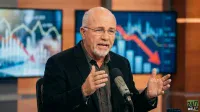
‘Most Women Don’t Want to Marry a Couch Potato’: Ramsey Tells a 46-Year-Old With $2.7 Million Not to Retire
Dave Ramsey looked at a 46-year-old sitting on $2.7 million, conceded the math worked, and then told him to keep working anyway. The reason he gave had nothing to do with money.

This post may contain links from our sponsors and affiliates, and Flywheel Publishing may receive compensation for actions taken through them.

A 46-year-old caller named Oliver phoned into The Ramsey Show this week asking for permission to stop working. He told Dave Ramsey he is single, has no kids, no debt, and has not held full-time work in about a year and a half. His balance sheet, as read on air: $2.7 million in a brokerage account with $1 million of that in a Roth, a three-family rental cash-flowing about $300 a month, $30,000 in an HSA, and $40,000 in high-yield savings.
His annual spending need is about $85,000.
Ramsey ran the numbers and conceded the obvious. “Your non-Roth investments should be generating more than $85,000 a year. And so, yeah, you could quit today,” he said. Then he refused to bless it. “Aside from the finances, I don’t think you need to quit today.” Co-host John Delony escalated the pitch to a health warning, telling Oliver that “when you quit to do nothing, your body gets the message, and it will start to send the signals, we’re done here,” and that his emotional and mental health would “fall off a cliff.” The kicker, delivered as a warning about dating prospects: most women don’t want to marry a couch potato.
Verdict: Ramsey’s Math Checks Out, His Advice Is Lifestyle
Oliver has already won. What Ramsey and Delony gave him was a lifestyle opinion dressed up as financial guidance. The mechanic that matters here is the safe withdrawal rate, and Oliver clears it with room to spare.
The 4% rule, drawn from the Trinity study and used industry-wide as shorthand, says a portfolio invested in a stock and bond mix can support annual withdrawals of 4% of the starting balance, adjusted for inflation, for roughly 30 years without running out. Financial-independence researchers who model longer horizons (Oliver could easily need 45 or 50 years of income) often push that starting rate down to 3% or 3.5% as a margin of safety.
[calculator type=”withdrawal-rate” portfolio_value=”2700000″ withdrawal_rate=”3.2″ rate=”7″ time=”45″]
Oliver needs $85,000 against a $2.7 million portfolio, and the rental throws off another $300 a month on top of that. His initial draw sits well inside the conservative range for a long retirement, and $1 million of the balance is Roth money that grows and withdraws tax-free after 59½. The HSA covers medical costs with a triple tax advantage. There is no math problem here, though the classic 4% framework was built for 30-year horizons rather than the 45-year runway Oliver is planning for (we made the full case against leaning on it, and what to run instead, in a free report: The 4% Rule Is Broken).
Compare that to the goalpost Ramsey himself sets for everyone else. Earlier in the same episode he told listeners that “$100 a month invested from age 25 to age 65 in a decent growth stock mutual fund at market rates of return is $1,176,000. Anyone can become a millionaire.” Oliver crossed that finish line 19 years early and more than doubled it, then was told he still couldn’t collect.
One Variable Decides It: Whether $85,000 Stays $85,000
The factor that flips this from safe to shaky is lifestyle creep, not longevity. Oliver rents today and wants to buy a house. If he pays cash for a modest home, his spending number holds and the portfolio keeps compounding above his draw. If he finances a home, adds a car payment, and lets annual spending drift to $130,000 or $150,000, his withdrawal rate climbs into territory where a bad sequence of early returns can permanently damage the balance.
Northwestern Mutual’s 2025 Planning & Progress Study pegged the “magic number” Americans think they need for retirement at $1.26 million, with Gen X putting the figure at $1.57 million.
Oliver is sitting on roughly double the Gen X target at an age where 54% of Gen X don’t think they’ll be financially prepared for retirement at all. Fidelity’s benchmark of 10x salary by age 67 assumes retirement at 67, not 46, and Oliver still clears it against any reasonable salary base.
What Oliver (and You) Should Actually Do
- Run the withdrawal-rate calculation against your real spending, not your aspirational spending. Track 12 months of actual outflows before locking in a number.
- Separate the portfolio into a five-year cash and short-bond bucket for spending, and a long-duration equity bucket for growth. This is the standard bucket strategy that neutralizes sequence-of-returns risk.
- Model a house purchase two ways: all-cash out of the taxable brokerage, and financed. Compare the withdrawal rate under each scenario before deciding.
- Decide separately whether you want to work. That is a purpose question, and it has nothing to do with whether the math clears.
Ramsey conceded the finances. Everything after that was opinion, and Oliver is free to disagree.
Contact [email protected] for any questions or corrections.
Jake has been been working in financial media for almost 15 years. He focuses on all things personal finance for 24/7 Wall St. with high hopes to educate and entertain. Most recently, Jake spent 12 years working various roles at The Motley Fool. He started copy editing fool.com content, worked on premium and marketing campaigns, and helped launch The Ascent, a personal finance brand.
His work has been featured on platforms like MSN, Yahoo Finance, USA Today, and more. He's written about credit cards, social security, ETFs, savings accounts, and just about anything else you can imagine when thinking about money. Jake love to cook, play golf, and tell people he's never had a cavity. (It's true!)