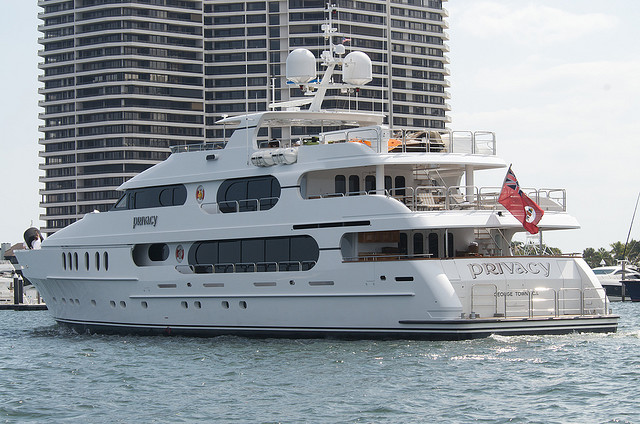
$4 Million Net Worth Caller Asks Dave Ramsey: Is a $400,000 Boat Too Expensive?
A retiree with a $4 million net worth called Dave Ramsey ready to pay cash for a $400,000 boat, knowing full well the purchase broke one of Ramsey's hardest rules. What Ramsey said next reframes everything most people think they…

This post may contain links from our sponsors and affiliates, and Flywheel Publishing may receive compensation for actions taken through them.

A 60-year-old caller phoned into Ramsey Everyday Millionaires with a problem most people would love to have. He had a $4 million net worth and $250,000 in annual income, and he wanted to pay cash for a $400,000 Great Harbor trawler. But here’s the catch: The purchase would blow through one of Ramsey’s most-quoted rules. The caller said it himself, admitting the boat would be “more than half of our annual income in boats, motors, wheels et cetera, which you say not to do.”
Ramsey’s answer was unambiguous: “Yes, I would buy that boat.” His reasoning was that the half-income rule does not apply to someone in this caller’s position. As he put it, “When you’re in a no income, low income portion of retirement and a huge net worth, that rule does not apply.”
The Verdict: Ramsey Is Right, and the Math Backs Him Up
The half-your-income rule exists to protect people in their wealth-building years from sinking too much into depreciating toys. A 35-year-old earning $120,000 who buys a $70,000 boat is locking up capital that should be compounding in retirement accounts. That math punishes them for decades.
The 60-year-old caller is in a different chapter. His wealth is already built. The relevant question is what percentage of his nest egg the boat consumes. Ramsey reframed it that way on the call, pointing out that the $400,000 boat represents only 10% of the caller’s $4 million net worth.
Run the retirement math and the picture gets clearer. A standard 4% safe withdrawal rate on a $4 million portfolio supports $160,000 of annual spending. Pull $400,000 out for the boat and the portfolio drops to $3.6 million, which still supports $144,000 a year at the same withdrawal rate. The caller gives up roughly $16,000 of annual sustainable spending in exchange for the trawler. That is a real cost, but it is not a retirement-wrecking cost for someone already living on $250,000.
Compare that to a household with a $400,000 net worth buying a $40,000 boat. Same 10% ratio, but the safe withdrawal math drops their sustainable annual spending from $16,000 to $14,400. When your retirement income is already tight, even a proportional purchase hurts.
The Variable That Flips the Answer
The factor that decides whether this advice fits you is the ratio of liquid investable assets to the purchase price. A useful gut check: after writing the check, can your remaining portfolio still fund the lifestyle you want using a 4% to 5% withdrawal rate?
For the caller, the answer is yes. For a 60 year old with $1 million in retirement accounts eyeing the same $400,000 boat, the answer is no. That purchase would gut 40% of the portfolio and drop safe annual withdrawals from $40,000 to $24,000. Same boat, same age, completely different verdict.
Cost of ownership matters too. Boats burn fuel, dock fees, insurance and maintenance. With energy prices up roughly 14% year over year and goods inflation running near 4%, operating costs are climbing. A common rule of thumb is that annual boat ownership runs 10% of purchase price, which would mean roughly $40,000 a year on a $400,000 trawler. The caller’s $250,000 income absorbs that. A retiree pulling $60,000 from a smaller portfolio cannot.
Context Worth Knowing Before You Sign
The broader backdrop is not flattering for discretionary spending. University of Michigan consumer sentiment sat at 49.8 in April 2026, the lowest reading in 12 months and within striking distance of recessionary territory below 60. The national savings rate has dropped to 4% from 6% in early 2024. Buying a $400,000 boat into a softening market may also mean better pricing leverage with dealers carrying inventory.
What to Do With This
- Calculate your real ratio: Divide the purchase price by your total liquid net worth, not your salary. If you are retired or near retirement, that number is the one that matters.
- Stress-test your withdrawal rate: Subtract the purchase from your portfolio and run a 4% withdrawal on what remains. If the result still funds your lifestyle, the purchase is sustainable.
- Budget the 10% rule for ownership: Assume annual operating costs equal to 10% of the purchase price and confirm your income or withdrawals can absorb it without touching principal.
- Pay cash or do not buy: Financing a depreciating asset at today’s rates compounds the cost. Ramsey’s broader point holds: if writing the check hurts, the boat is too expensive regardless of the rule.
Rules of thumb work until your circumstances outgrow them. When net worth dwarfs income, measure the purchase against the balance sheet.
Contact [email protected] for any questions or corrections.
Joel South covers large-cap stocks, dividend investing, and major market trends, with a focus on earnings analysis, valuation, and turning complex data into actionable insights for investors.
He brings more than 15 years of experience as an investor and financial journalist, including 12 years at The Motley Fool, where he served as an investment analyst, Bureau Chief, and later led the Fool.com investing news desk. He has also co-hosted an investing podcast and appeared across TV and radio discussing market trends.