Two of America’s Biggest Money Voices Give Opposite Advice on Dividend Stocks
Dave Ramsey and Suze Orman have built careers on helping people retire with dignity, yet on one of the most consequential investment decisions a retiree faces, they point in completely opposite directions. For a nest egg of $107,000, that disagreement…

This post may contain links from our sponsors and affiliates, and Flywheel Publishing may receive compensation for actions taken through them.

Ramsey Solutions, citing Transamerica Institute research, puts the median Gen X worker’s retirement savings at $107,000. With a balance that size, how you invest it decides whether the money can pay a retiree’s bills. Two of the most trusted names in personal finance give opposite answers.
In a piece dated July 15, 2026, Ramsey Solutions told readers: “Don’t invest retirement money in single stocks, cryptocurrency or anything else being billed as the ‘next big thing.'” The organization points retirement savers toward growth stock mutual funds instead.
On her Women & Money podcast on January 11, 2026, Suze Orman argued the other side: “As you get older and look for income, buy dividend-paying stocks of good quality that pay you a good dividend along with some money invested purely for growth.”
Orman picks the right vehicle for retirees who need income, but she is wrong to brush off bonds at today’s rates. Ramsey Solutions gives the right advice to savers still adding money.
Why Ramsey Solutions Keeps Single Stocks Out of Retirement Accounts
One bad company can sink a five-stock portfolio, while a fund holding hundreds of stocks absorbs the loss. Funds also protect savers from picking stocks based on headlines.
PepsiCo (NASDAQ:PEP | PEP Price Prediction) shows the risk. It has raised its dividend for 54 consecutive years, yet the stock is down 5% over five years. A long dividend streak didn’t protect the share price.
Dave Ramsey’s line points the same way: “Your most powerful wealth-building tool is your income.” For a saver, new contributions from each paycheck move the balance more than any single stock pick.
Orman’s Case: Retirees Need Cash the Portfolio Actually Produces
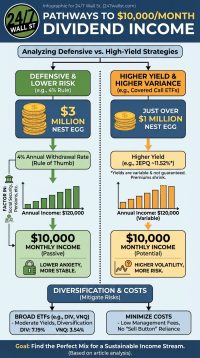
A retiree living off an index fund must sell shares to raise cash, including during a crash. Dividends get paid regardless of share price, so the retiree never has to sell at a low. That is a real advantage if the dividend is safe.
To check safety, compare dividends paid with free cash flow, which is operating cash flow minus capital spending:
| Company | Yield | Dividends as % of Free Cash Flow | Raise Streak |
|---|---|---|---|
| Johnson & Johnson (NYSE:JNJ) | 2.1% | 63% | 64 years |
| Procter & Gamble (NYSE:PG) | 2.9% | 68% | 70 years |
| PepsiCo | 4.6% | 100% | 54 years |
Johnson & Johnson and P&G keep about a third of their free cash flow after paying the dividend, a cushion to absorb a bad year. PepsiCo has the highest yield but almost no cushion. In the first quarter of 2026 it generated $41 million in operating cash flow and paid out $1.97 billion in dividends.
Run the Math on $107,000 Before You Write Off Bonds, according to Ramsey Solutions, citing Transamerica Institute
Put $107,000 into equal amounts of the three stocks and annual income comes to about $3,410, according to Ramsey Solutions, citing Transamerica Institute. With the 10-year Treasury yielding 5.3%, the same money in Treasuries pays about $5,650.
Dividend growth narrows the gap but takes years to do it. Say the payouts rise 4% a year, close to PepsiCo’s latest 4% raise (an example rate). Year-ten income would reach about $5,047, which is still less than the Treasury pays in year one. Today, dividend stocks earn their place through rising payouts and the chance for the share price to grow. Their starting yield doesn’t beat bonds.
One Question Decides Which Advice Fits You
While you’re still contributing, the paycheck does most of the work, and a diversified fund removes both the research burden and the risk of one stock failing. Once withdrawals begin, cash flow becomes the job, and quality dividend payers handle it well.
- Test every holding’s coverage. Subtract capital spending from operating cash flow, then compare to dividends paid. If dividends take close to 100% of free cash flow, the payout has little room to grow.
- Price your income both ways. Multiply your balance by your portfolio’s dividend yield and by the Treasury yield. If bonds pay more for the income you need now, that gap is worth weighing against the growth dividend stocks offer.
- Check the share price record as well as the dividend record. Look at five-year price returns next to the dividend streak, because a rising payout doesn’t help if the stock keeps falling.
For savers still adding money, Ramsey Solutions’ fund approach fits the job. For retirees who need their portfolio to pay them, Orman’s dividend approach fits best when limited to payers with real cash cushions and combined with bonds while they yield above 5%. The whole point of a dividend ladder is never having to sell a share, and we walked through how to build one in a free guide here.
Contact [email protected] for any questions or corrections.
Chris Lange is a financial and geopolitical writer with more than a decade of experience covering a myriad of topics. He has published thousands of articles for 24/7 Wall St., with past coverage focused heavily on stocks, IPOs, healthcare, defense, global affairs, and technology.
His work has been quoted, or referenced by a number of outlets including Business Insider, USA Today, Yahoo Finance, MSN, The Motley Fool, and many other publications. A graduate of Southwestern University, he studied business with a focus on investments and has previous experience in banking and startups.
When not reading or writing the news, he is following his passion for Lacrosse, playing chess, or building solar projects with his dad.