The Dermatologist’s Full-Body Skin Check Isn’t a Medicare Preventive Service. If Biopsied, the Visit Can Produce Three Bills
She booked a routine skin check and expected a clean bill. What arrived instead revealed a Medicare coverage gap that catches patients only after the biopsy is already done and the tissue is already in a lab across town.

This post may contain links from our sponsors and affiliates, and Flywheel Publishing may receive compensation for actions taken through them.
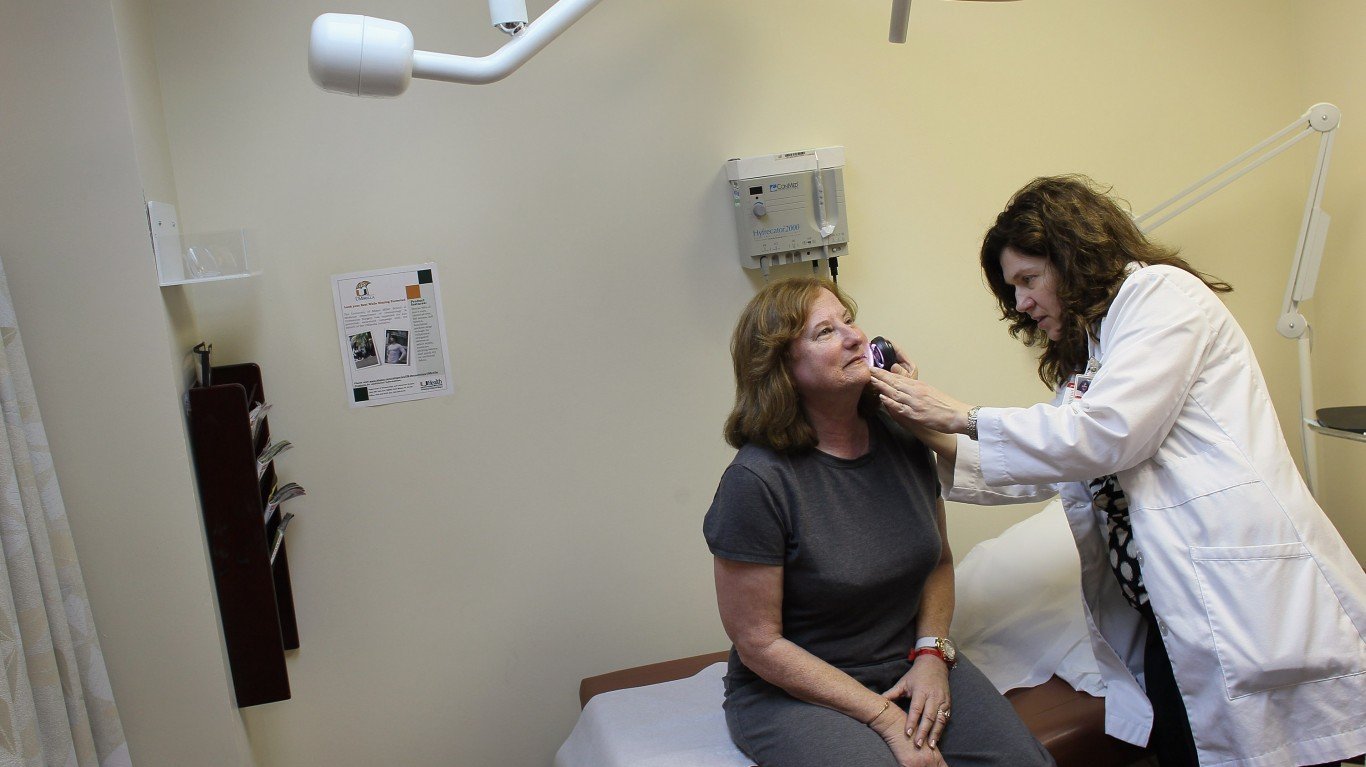
A 68-year-old with a lifetime of sun exposure books the annual full-body skin exam her primary care doctor suggested. She expects it to work like the yearly wellness visit: covered, no bill, done. A month later the explanation of benefits arrives with three lines on it. An office visit. A shave biopsy of one suspicious spot. A charge from an outside pathology lab.
She may owe on all three. She may also owe the full cost of the exam itself, which is the part nobody warns about.
Two Facts That Get Collapsed Into One
Two things are separately true here, and the link between them isn’t what most people assume. The U.S. Preventive Services Task Force gives skin cancer screening in asymptomatic adults an “I” statement, meaning it found insufficient evidence to recommend for or against it. Separately, Medicare does not list routine skin cancer screening among its preventive benefits.
Both are accurate. But Medicare’s preventive coverage isn’t controlled exclusively by the Task Force’s grades, so the first doesn’t cause the second. They’re two independent reasons the skin check sits outside the preventive category.
The Coverage Question Comes Before the Cost-Sharing Question
Here’s the distinction that decides your bill, and it turns on why you’re in the chair. If you’re asymptomatic with no relevant history, Medicare may treat the entire screening exam as noncovered. That isn’t deductible-and-coinsurance territory. It means the full charge is yours.
If the visit is diagnostic, prompted by a suspicious lesion, by symptoms, or by surveillance after a prior skin cancer, Medicare may cover it. Then the standard Part B cost-sharing applies: the $283 annual deductible if you haven’t met it, then 20% of the approved amount. Same exam room, same dermatologist, two different billing outcomes.
Where the Additional Bills Come From
If the dermatologist samples a lesion, the biopsy is separately billable with its own coinsurance. The tissue goes to pathology, which may bill independently and carry its own Part B cost-sharing depending on how the service is classified.
A same-day office visit is separately payable only when the evaluation is distinct enough from the procedure to stand on its own. So three bills is a possible outcome rather than an automatic one, which is precisely why the explanation of benefits is where most patients first learn which version they got.
What It Costs in 2026
The standard Part B premium is $202.90, up from $185.00 in 2025. The annual deductible is $283, up from $257. That deductible resets every January, and dermatology appointments cluster early in the year, so a patient may be covering the full allowed amount before coinsurance engages at all. Original Medicare has no out-of-pocket maximum, so the 20% keeps applying to every service the visit generates.
It’s the same mechanic that turns a wellness visit into a $51 charge once a knee comes up, or a screening colonoscopy into a $326 bill once a polyp is removed. Coverage gaps like this one run throughout the program, and we mapped the rest in a free guide to Medicare’s hidden bills.
What Medigap and Advantage Actually Do
Medigap Plan G covers the 20% coinsurance on the visit, the biopsy and the pathology once the Part B deductible is met, for Medicare-covered services from providers who accept assignment. The limitation matters more than the coverage. Plan G pays cost-sharing on services Medicare covers. It cannot convert a noncovered routine screening exam into a covered benefit. If the exam falls outside Medicare’s coverage entirely, the supplement doesn’t reach it.
Medicare Advantage enrollees face plan-specific cost-sharing at every step, and the network question has to be asked plan by plan. Some plans contract with the lab your dermatologist uses; some don’t. If the lab is out of network, an HMO may not cover routine out-of-network pathology at all, while a PPO may cover it against a higher combined in-network and out-of-network maximum. There’s no general rule here worth leaning on.
Go on Offense
The cheapest moment to settle coverage is before the biopsy. Take the following steps to avoid any surprise bills:
- Ask how the visit will be coded and whether Medicare is expected to cover it. If you’re asymptomatic with no history, ask directly whether they anticipate billing you for a noncovered service. That’s a different conversation than deductible and coinsurance.
- Pause before the biopsy. A dermatologist who spots something will often sample it on the spot. You can ask what the biopsy and the pathology will cost you before consenting.
- If you’re on an Advantage plan, ask which lab receives the sample and confirm it participates. If it doesn’t, ask for an in-network alternative before the tissue leaves the office.
Skin cancer is serious, and suspicious or changing lesions deserve prompt evaluation. The coverage distinction should shape the budget, not discourage necessary care.
Contact [email protected] for any questions or corrections.
Gerelyn Terzo is the author of dividend investing handbook "Dividend Investing Strategies: How to Have Your Cake & Eat It Too." A veteran financial journalist, she covers agri-finance for outlets like Global AgInvesting and the broader stock market and personal finance for 24/7 Wall Street. She began at CNBC and later helped launch Fox Business in New York. Gerelyn currently resides in Woodland Park, Colorado and dabbles in nature photography as a hobby.