Think Your Backdoor Roth IRA Is Tax Free? Think Again
A by-the-book backdoor Roth conversion can still hand the IRS a surprise tax bill, and the culprit is an IRA you opened years ago and probably forgot about.

This post may contain links from our sponsors and affiliates, and Flywheel Publishing may receive compensation for actions taken through them.

Consider a 58-year-old consultant who does a standard 2026 backdoor Roth and still owes the IRS $1,665.
She makes too much to contribute directly to a Roth. So she contributes $7,500 to an IRA without deducting it, then converts it to a Roth a few days later. She also has $92,500 in an old rollover IRA from a former employer.
That old account sets off a rule in the Internal Revenue Code that turns most of her “tax-free” conversion into taxable income.
How a Backdoor Roth Works When Everything Goes Right
Roth IRAs have income limits. In 2026, your right to contribute directly phases out once modified adjusted gross income falls between $153,000 and $168,000 for individuals and $242,000 and $252,000 for married couples filing jointly. The 2026 IRA contribution limit is $7,500.
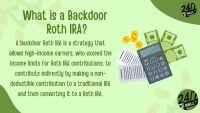
The backdoor gets around those limits. You make a nondeductible IRA contribution, which has no income cap, and convert it to a Roth. Since you already paid tax on that money, the conversion costs nothing when it’s the only money in your IRAs. You report it on IRS Form 8606, which tracks your after-tax dollars, called your “basis.”
Pro-Rata Rule Turns a Clean Conversion Into a Tax Bill
Section 408(d)(2) of the Internal Revenue Code treats all of your individual retirement plans “as 1 contract.” When you convert, the IRS lumps together every traditional, SEP, and SIMPLE IRA you own, valued on December 31 of the conversion year. Then it taxes the conversion in proportion to how much of that pool is pre-tax money. Roth IRAs and workplace 401(k)s aren’t considered.
Here’s her calculation, assuming single filer status, a 24% federal bracket, and no account growth during the year:
| Line | Amount |
|---|---|
| Nondeductible contribution (basis) | $7,500 |
| Pre-tax rollover IRA on Dec. 31 | $92,500 |
| Tax-free share of IRA pool | 7.5% |
| Tax-free portion of conversion | $562.50 |
| Taxable portion of conversion | $6,937.50 |
| Federal tax at 24% | $1,665 |
Her remaining $6,937.50 of basis stays in the traditional IRA. It carries forward on future Forms 8606 and will make part of her later withdrawals tax free. Depending on her state, she may owe state income tax on top of the federal bill.
Three Ways a Backdoor Roth Becomes Taxable
- You have pre-tax IRA money on December 31. The pro-rata rule kicks in. Money rolled into an IRA in December counts, even if you converted earlier.
- Your contribution grows before you convert. Earnings are taxed when you convert. Converting quickly keeps that amount small.
- You don’t file Form 8606. Without it, the IRS has no record of your basis. Failing to file costs $50 per form; overstating basis costs $100, under Section 6693.
Deadlines to Fix a Botched Backdoor Roth Are Close
A conversion can’t be undone. The Tax Cuts and Jobs Act of 2017 ended recharacterization for 2018 conversions forward. Once you convert, you owe the tax.
Excess contributions have a correction window. If you put money directly into a Roth when your income passed the limit, you can move the money to an IRA or withdraw it with earnings. Either way, you have until your filing deadline, including extensions. For 2025 contributions, that date is October 15, 2026, about two weeks away.
Miss it and the penalty comes back every year. Section 4973 charges a 6% excise tax on excess contributions for each year they stay in the account. On a $7,500 excess, that’s $450 a year until you fix it.
You can still file a missing Form 8606. If you skipped the form in an earlier year, filing it late for that year places your basis on record before the IRS taxes it twice.
How to Keep Your Next Backdoor Roth Tax Free
- Empty your traditional IRAs by December 31. If your employer’s 401(k) takes incoming rollovers, moving pre-tax IRA money into it removes that money from the pro-rata calculation. In her case, the $1,665 bill falls to almost nothing.
- Convert quickly and keep the money in cash until you do. A money market fund minimizes taxable earnings between contribution and conversion.
- File Form 8606 every year you contribute or convert. Keep copies. They’re your only proof of basis.
Rolling the old IRA into a 401(k) or converting it fully is a question of your tax bracket now versus in retirement. If you’re in that quiet stretch between your last paycheck and your first RMD, the conversion math often tilts in your favor, which is the whole subject of our free Roth Window guide. Either way, it’s worth running the numbers with a tax professional.
Contact [email protected] for any questions or corrections.
Vilma Rios is a tax professional and tax content contributor with more than 15 years of experience in tax and accounting. She specializes in federal tax research, tax education, and translating complex tax rules into clear, practical information for individuals, families, and small-business owners.
Vilma is a Content Tax Contributor II with the National Association of Tax Professionals (NATP), where she contributes to tax education and professional content. She has also presented tax information through webinars, including Spanish-language tax education, and has appeared on Telemundo 47 discussing tax topics and helping viewers understand important tax-filing requirements.
Her experience also includes tax and accounting work, tax research, IRS-related matters, and public tax education. While in college, Vilma volunteered in an IRS-sponsored tax assistance program and was recognized for her community service by local and state officials.
Known as “Your Tax Geek,” Vilma is passionate about making taxes easier to understand and helping people navigate an increasingly complex tax system.