For Twenty Years He Made IRA Contributions the IRS Never Let Him Deduct. One Form Filed Every April Is the Only Thing Standing Between Him and Being Taxed on That $150,000 Twice
Millions of IRA holders quietly overpay their retirement taxes because one annual form never made it into their filing routine. Missing it even once hands the IRS permission to treat money you already paid tax on as fully taxable income…

This post may contain links from our sponsors and affiliates, and Flywheel Publishing may receive compensation for actions taken through them.
If you have a traditional IRA and your income was too high to deduct the contribution, you’ve been quietly building a stash of after-tax money inside a pre-tax account. That stash is called basis, and the only thing separating you from paying tax on it a second time when you retire is one form: IRS Form 8606, filed with your return every year you make a nondeductible IRA contribution or take a distribution from an IRA that holds basis.
If you miss the form, the IRS presumes your basis is zero. Twenty years of nondeductible contributions, say $150,000 of already-taxed money, gets taxed again on the way out. In other words, the paperwork is the whole game.
How Nondeductible Contributions Quietly Pile Up
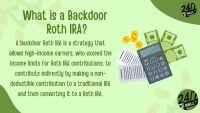
If you (or your spouse) are covered by a workplace retirement plan and your modified adjusted gross income exceeds the annual phase-out, the traditional IRA deduction disappears. You can still contribute, but the deposit lands in the account as after-tax money. The same thing happens if you’re using the backdoor Roth strategy: you contribute to a traditional IRA with post-tax dollars, then convert.
Every one of those after-tax dollars is basis, and when you eventually take distributions, only the growth should be taxable. Your original contributions have already paid their tax bill. But the IRS can’t know that unless you tell them year by year on Form 8606.
Statute That Backs It Up
The rulebook here is Internal Revenue Code §408(o), which authorizes nondeductible contributions, and §408(d)(1) and (2), which govern how distributions are taxed and how basis is recovered. The reporting requirement lives in the Form 8606 instructions, and the penalty for skipping it is written into IRC §6693(b)(2): $50 for each failure to file, unless you show reasonable cause. Overstating your basis carries an additional $100 penalty.
As a caller on the Clark Howard show once put it, “There is no account called a nondeductible IRA. It is just a traditional IRA with contributions that aren’t deducted on your tax forms. In addition, you must keep track of the nondeducted basis using the IRS Form 8606.” That is exactly right.
Who Actually Needs to File
You need Form 8606 for any year you make a nondeductible traditional IRA contribution, take a distribution from a traditional, SEP, or SIMPLE IRA that has basis, convert any portion of a traditional IRA to a Roth, or inherit an IRA with basis. High earners locked out of the Roth income limits, backdoor Roth users, and anyone whose spouse’s workplace plan phased out the deduction all fall in scope. If you’ve fully deducted every contribution you’ve ever made and done no conversions, you don’t need it.
Filing Mechanics for 2026
- Confirm the 2026 IRA contribution ceiling: $7,500, or $8,600 if you’re 50 or older (a $1,100 catch-up).
- If your deduction is fully or partly phased out, contribute anyway and label the after-tax portion.
- File Form 8606 with your Form 1040 by April 15, 2027. It attaches directly to your return.
- On Line 1, enter this year’s nondeductible contribution. On Line 2, carry over your prior basis. Line 14 becomes your new running total.
- Save every Form 8606 forever. When you or your heirs finally draw the money down, that stack of forms is the proof of basis.
Pro-Rata Trap That Ruins Backdoor Roths
Here’s the catch nobody advertises. Under IRC §408(d)(2), when you take a distribution or do a Roth conversion, the IRS aggregates every traditional, SEP, and SIMPLE IRA you own and treats them as one pool. You cannot cherry-pick the after-tax dollars.
If you have $150,000 of basis and $850,000 of pretax money across all your IRAs, only 15% of any conversion or withdrawal comes out tax-free. The other 85% is ordinary income, even though you were trying to convert only the after-tax slice. This is why financial planners tell backdoor Roth users to roll pre-tax IRA balances into a 401(k) first: those employer-plan dollars sit outside the pro-rata calculation.
The thing to remember is that the deadline is unforgiving, as Form 8606 is due with your return. Skip it for two decades, and you’re staring at a stack of missing filings, a compounding basis you can no longer prove, and a retirement withdrawal the IRS is fully prepared to tax from the first dollar. It’s one of a handful of quiet IRS rules that can drain six figures from a retirement account, and we mapped the rest of them in a free guide here.
Contact [email protected] for any questions or corrections.
David Beren has been a Flywheel Publishing contributor since 2022. Writing for 24/7 Wall St. since 2023, David loves to write about topics of all shapes and sizes. As a technology expert, David focuses heavily on consumer electronics brands, automobiles, and general technology. He has previously written for LifeWire, formerly About.com. As a part-time freelance writer, David’s “day job” has been working on and leading social media for multiple Fortune 100 brands. David loves the flexibility of this field and its ability to reach customers exactly where they like to spend their time. Additionally, David previously published his own blog, TmoNews.com, which reached 3 million readers in its first year. In addition to freelance and social media work, David loves to spend time with his family and children and relive the glory days of video game consoles by playing any retro game console he can get his hands on.