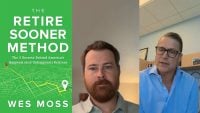
Wes Moss: Retirement’s Two Biggest Threats Have Nothing to Do With Your 401(k)
Retirement expert Wes Moss says the two forces most likely to derail your retirement years are growing fast across America, and your account balance does almost nothing to stop either one.

This post may contain links from our sponsors and affiliates, and Flywheel Publishing may receive compensation for actions taken through them.

Every day, roughly 11,000 Americans turn 65. Retirement author and radio host Wes Moss thinks most of them have prepared for only one of the risks waiting for them. In a recent interview with me, Moss named the two threats he sees growing across the country:
“A lot of what’s happening in America, these two things, the purpose vacuum and a friendship recession… Who gets hit hardest by that purpose vacuum? It’s 60 plus. Who gets hit by the friendship recession? It’s the 60 plus.”
Moss pointed out that U.S. net worth was roughly $90 trillion in 2016 and is now about $190 trillion. Yet both problems grew anyway. A bigger account balance alone solves neither.
Moss Is Right: Money Stops Buying Happiness at a Certain Point
Moss’s own research backs him up. In The Retire Sooner Method, he reports a clear happiness jump once retirees pass $1 million in investable assets. Happiness keeps rising into the $3+ million range, and then it flattens out. In his words, “More money does correlate with greater happiness but begins to wane at a certain point.”
Each extra dollar adds less happiness than the one before. Once your income needs are covered, how you spend your hours limits your retirement.
That is the purpose vacuum: years of open time with nothing meaningful scheduled. Moss calls his fix core pursuits, or “hobbies on steroids.” He writes that “Purpose is created, not found.”
Your Core Pursuit Count Is the Number That Matters
The one variable that best separates happy retirees from unhappy ones in Moss’s data is how many different hobbies they keep up. Happy retirees have five or more core hobbies. Unhappy retirees have four or fewer.
The gap shows up in time, too. Happy retirees spend about two hours and forty minutes a day on core hobbies. Unhappy retirees spend one hour and fifty minutes. Over a year, that adds up to 280+ extra hours of meaningful activity. Moss suggests aiming for at least 2.5 hours per day.
Moss treats five as a tipping point. He writes that crossing it “creates a self-enforcing cascade where one meaningful activity naturally leads to another.” Someone with three hobbies is missing momentum that keeps retirement full.
Friendship Recession Hits the Same Retirees
The second threat makes the first one worse. Happy retirees average 1.5 social core hobbies, compared with 1.0 for unhappy retirees. Unhappy retirees are also 60% more likely to live alone.
Moss warns that “even the most electrifying core pursuits can feel hollow when experienced in isolation.” Choose hobbies with other people built in: walking groups, leagues, volunteer crews.
Retirement Has No Single Lever
Wes Moss is a Certified Financial Planner® and Managing Partner and Chief Investment Strategist at Capital Investment Advisors. He says readers ask him for the one thing that decides a good retirement. His answer:
Moss, who takes listener questions at wesmoss.com/ask, lays out his retirement framework in The Retire Sooner Method.
“I really look at it as a collection of let’s do as many of these habits or parameters that move us in the direction of the happier retiree, and that gives us a greater and greater chance to end up landing in a place where most of us want to be,” Moss said.
He adds that a full retirement means more than a money goal: “We want to have a really fun, fulfilling, purpose-filled retirement.” When asked to name the most overrated retirement advice, he picked the idea that “you need $10 million to think about retirement.”
Draw Your Retirement Life Map Before 50
Moss said the best age to draw a first life map is “40.” His reason: “You can’t manufacture meaning overnight, but you can cultivate it gradually while you still have the energy and structure that work provides.”
- List your core values. Write six to ten values and circle your top three or four.
- Count your current hobbies. If you have four or fewer, you are below Moss’s threshold. Brainstorm activities under each value, then sort them into daily and yearly purposes.
- Rethink your to-dos. Turn “I like golf” into building friendships while working to improve. Spelling out the deeper reason makes a hobby easier to stick with.
- Make it specific. Replace “travel more” with something like “two international trips annually plus four weekend getaways.”
- Start some hobbies now. Mark which activities can begin while you’re still working. Make sure at least one involves other people.
Your 401(k) pays for retirement, but the number of hobbies you’ve built before you leave work decides how those years actually feel.
Contact [email protected] for any questions or corrections.
Jake has been been working in financial media for almost 15 years. He focuses on all things personal finance for 24/7 Wall St. with high hopes to educate and entertain. Most recently, Jake spent 12 years working various roles at The Motley Fool. He started copy editing fool.com content, worked on premium and marketing campaigns, and helped launch The Ascent, a personal finance brand.
His work has been featured on platforms like MSN, Yahoo Finance, USA Today, and more. He's written about credit cards, social security, ETFs, savings accounts, and just about anything else you can imagine when thinking about money. Jake love to cook, play golf, and tell people he's never had a cavity. (It's true!)