Walmart’s Robots Are Struggling With Jobs Humans Do Easily. For Workers in Their 50s, Staying on the Payroll Could Be Worth More Than Another 401(k) Catch-Up
Walmart's robots keep fumbling frozen turkeys while warehouse workers in their 50s face a countdown clock on their careers. Before Ray makes any move, he needs to understand what one more year on the payroll is actually worth compared to…

This post may contain links from our sponsors and affiliates, and Flywheel Publishing may receive compensation for actions taken through them.

Walmart (NASDAQ:WMT | WMT Price Prediction) has spent billions trying to get machines to do what its warehouse workers do every shift, and the machines keep running into trouble with cardboard boxes and turkeys. At one California warehouse, robotic arms struggled to handle large frozen turkeys ahead of Thanksgiving. Walmart had to ask its supplier for sturdier boxes and turn to nearby warehouses to help fill orders.
A recent Wall Street Journal report called the retailer’s automation push a multibillion-dollar struggle, quoting the line “We are kind of in this peak complexity.” Walmart still depends on more than 140,000 warehouse workers to unload trucks, move pallets and sort goods.
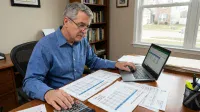
Meet Ray, a hypothetical 57-year-old Walmart warehouse worker with three decades on the job. He earns $60,000 a year, has $650,000 in his 401(k) and wonders how much longer his job will last as robots take on more warehouse work. Should he prepare to retire early and save as much as possible while he still has a paycheck?
What One More Year on the Payroll Delivers
Assume Ray contributes 5% of his $60,000 salary, or $3,000. Walmart matches eligible employees’ contributions dollar for dollar up to 6% of pay, adding another $3,000 to his account.
That’s $6,000 in annual retirement contributions. If he raises his contribution to 6%, he gets the full match, bringing the combined total to $7,200.
The bigger number is the paycheck itself. Wages cover groceries and the mortgage, leaving Ray less dependent on his 401(k). If he retires and starts drawing from his pretax account, those withdrawals generally count as ordinary income. Suppose working another year lets him leave $60,000 invested instead of withdrawing it. At an assumed 6% annual return, that money could grow to about $80,000 over five years.
Large retirement withdrawals can also carry a Medicare cost. Medicare generally looks back two tax years when calculating income-related premium surcharges. If Ray takes substantial withdrawals at 63, they could raise his Part B and Part D premiums when he turns 65. The income thresholds and premiums in effect then will determine how much he pays.
How a Standalone Catch-Up Stacks Up
At 57, Ray qualifies for an $8,000 catch-up on top of the $24,500 standard limit, bringing his potential total to $32,500. But reaching that amount would take more than 54% of his $60,000 salary, and Walmart’s plan generally caps employee contributions at 50% of eligible pay.
That leaves him with a practical ceiling of $30,000, including $5,500 in catch-up contributions. Assuming he files as single, has no other income and makes pretax contributions, that extra $5,500 could save him about $660 in federal income tax under the 2026 brackets.
That helps, but every catch-up dollar comes out of his own paycheck. The job is what produces the $60,000 that makes any contribution possible, plus a match that costs him nothing extra. For a median-wage worker like Ray, staying employed comes first.
A higher earner who already maxes out the base limit faces different math. In 2026, the catch-up rises to $11,250 for workers ages 60 through 63. Those who earned more than $150,000 from their plan’s sponsoring employer in 2025 generally must make catch-up contributions as Roth, giving up the immediate tax deduction. For those savers, the catch-up offers more room, but a different tax trade-off.
If the Job Ends Anyway, Rule of 55 Is the Bridge
Automation could still reach Ray’s role. If it does, the tax code gives him an escape route. Workers who leave a job during or after the year they turn 55 can generally withdraw from that employer’s 401(k) without the usual 10% early-withdrawal penalty. Ordinary income tax still applies. The exception doesn’t follow the money into an IRA, so Ray should check his plan’s withdrawal options before rolling anything over if he might need the savings before 59½.
Three Moves to Make Before Any Resignation Decision
- Lock in the full match today. Check your contribution rate and raise it enough to capture the maximum employer match if your budget allows. Walmart’s 401(k) matching contributions vest immediately, so Ray won’t forfeit those dollars by leaving. Other employer-provided benefits may have different rules worth checking before he resigns.
- Train for the jobs automation creates. The Journal’s reporting shows these systems still need people to troubleshoot, maintain and work around them. Walmart’s automation push is creating more work managing and maintaining machines. Find out whether your employer offers training or covers certification costs for those roles.
- Negotiate flexibility before you quit. A part-time schedule keeps cash coming in and may keep you in the plan. If Ray eventually claims Social Security before full retirement age while working, earnings above that year’s limit could temporarily reduce his benefits. He should check the applicable limit before deciding how many hours to work.
For Ray, the robots’ trouble with turkeys is a reminder that people are still needed in the warehouse. Every additional year on the payroll brings another paycheck and more retirement contributions, while giving his 401(k) more time for compounding.
Contact [email protected] for any questions or corrections.
Gerelyn Terzo is the author of dividend investing handbook "Dividend Investing Strategies: How to Have Your Cake & Eat It Too." A veteran financial journalist, she covers agri-finance for outlets like Global AgInvesting and the broader stock market and personal finance for 24/7 Wall Street. She began at CNBC and later helped launch Fox Business in New York. Gerelyn currently resides in Woodland Park, Colorado and dabbles in nature photography as a hobby.