How to Build $6,800 a Month in Dividend Income Without Selling a Single Share
Collecting four figures a month from dividends without ever selling a share sounds straightforward until you price out what it actually costs and see which companies are holding the whole structure together.

This post may contain links from our sponsors and affiliates, and Flywheel Publishing may receive compensation for actions taken through them.
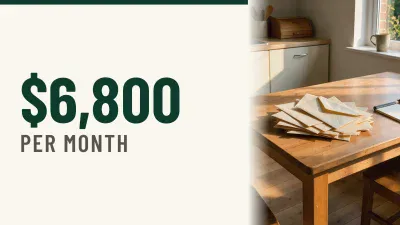
For most people, a $6,800 monthly dividend check can cover the mortgage, groceries, and more, while your share count never changes. That’s the appeal of living on dividends: you keep your shares, the companies send you a piece of their profits, and you never sell anything to pay the bills.
Here’s what it takes to collect $6,800 a month, or $81,600 a year, from one portfolio split equally among three dividend payers: a fund of mid-sized companies, a biotech giant, and a packaged-food maker. At recent prices, the three together yield about 2.6%. Yield is the annual dividend divided by the stock’s price. At that rate, you’d need around $3.1 million invested, or about $1 million in each holding.
It’s a hefty number, and it’s the real price of the “never sell” promise. Your share count stays the same, but your income still depends on these companies keeping and raising their payouts. The lower the combined yield, the bigger the portfolio you need. (A free guide here explains how to build a dividend ladder you never sell from.)
A Mid-Cap Fund Built on 15-Year Dividend Raisers
ProShares S&P MidCap 400 Dividend Aristocrats ETF (CBOE:REGL) holds mid-sized U.S. companies that have raised their dividends for at least 15 consecutive years. Think utilities, regional banks, insurers, and industrial firms. It also spreads your money fairly evenly. In its latest holdings report, each stock made up around 1% to 2% of the fund.
REGL takes one-third of the portfolio. Its trailing yield (the last 12 months of payouts divided by today’s price) is about 2.2%. On a $1 million stake, that’s around $22,400 a year. However, its quarterly checks vary, with the latest payment at about 40 cents a share, down from about 61 cents last December. Budget around the annual total.
Amgen Brings the Fastest Dividend Growth
Amgen (NASDAQ:AMGN | AMGN Price Prediction) ranks among the largest biotech companies in the country. It sells drugs for high cholesterol, bone loss, asthma, and cancer. Amgen also takes one-third of the portfolio, yields about 2.2% and generates about $22,600 a year.
Its dividend has risen every year since 2011 and is now nine times its starting level. Its most recent increase was 6%. Amgen pays out about 62% of its official accounting profit as dividends. Compared with the midpoint of its adjusted earnings guidance, that figure drops to about 44%. That leaves room to keep raising. Free cash flow was $3.5 billion last quarter.
Amgen has $57.3 billion of debt, and drug patent expirations are the main long-term threat to its cash flow. You can already see it happening, as sales of Prolia and XGEVA fell 33% last quarter after cheaper biosimilar copies launched.
Smucker Anchors the Portfolio’s Yield
J.M. Smucker (NYSE:SJM) makes Folgers, Jif, Uncrustables, Hostess, and Milk-Bone. The yield base is about 3.5%, so its one-third piece throws off around $36,600 a year, most of the time.
Smucker’s quarterly dividend has grown in the records all the way back to 1999, rising from 15 cents to more than $1 today. Its most recent increase was small, about 2%.
On paper, the payout ratio looks high at about 204% of reported earnings because accounting charges reduced reported profit. Against adjusted earnings guidance, it’s closer to 42%, and that guidance gets a one-time lift from tariff refunds. Debt is what really holds back the dividend.
Smucker borrowed heavily to buy Hostess, a deal that closed in November 2023. Management plans to pay down about $500 million of debt this year, and it just reached its target of debt at three times annual operating profit. Until the balance sheet improves, plan on small increases.
What to Check Every Year to Protect the $6,800
Each piece of that $3.1 million plays a different role. Smucker is the steadiest payer of the three, with the longest unbroken record of increases and the highest yield. Amgen brings the fastest dividend growth.
Don’t overlook the risk, though. Two individual stocks make up two-thirds of this portfolio. That’s a concentrated position in two companies, and a bad patent ruling or a stumble at Smucker would hit your income directly.
Once a year, check one thing: did each holding raise its dividend faster than inflation? If the increases stop, your $6,800 buys a little less each year, and you’ll need either more money invested or a higher-yielding mix to make up the gap.
Contact [email protected] for any questions or corrections.
David Beren has been a Flywheel Publishing contributor since 2022. Writing for 24/7 Wall St. since 2023, David loves to write about topics of all shapes and sizes. As a technology expert, David focuses heavily on consumer electronics brands, automobiles, and general technology. He has previously written for LifeWire, formerly About.com. As a part-time freelance writer, David’s “day job” has been working on and leading social media for multiple Fortune 100 brands. David loves the flexibility of this field and its ability to reach customers exactly where they like to spend their time. Additionally, David previously published his own blog, TmoNews.com, which reached 3 million readers in its first year. In addition to freelance and social media work, David loves to spend time with his family and children and relive the glory days of video game consoles by playing any retro game console he can get his hands on.