These 5 Grocery Aisle Giants Are Splitting Into Dividend Winners and Losers
Five household grocery names faced the same brutal pressures, but their dividends went in three different directions. The balance sheet details behind each decision reveal which income payouts are built to last and which still carry hidden risk.

Five of the best-known names in the grocery sector took the same hits: soft volumes, tariff-driven input costs, and more careful shopper spending. They gave income investors three different answers. Conagra Brands (NYSE:CAG | CAG Price Prediction) and Campbell’s (NASDAQ:CPB) cut their dividends. J.M.
Smucker (NYSE:SJM) and Hormel Foods (NYSE:HRL) raised theirs. Kraft Heinz (NASDAQ:KHC) has paid the same amount for years. The clearest sign of the split is Conagra’s new quarterly dividend of $0.175. The financials behind each decision show which of these payouts income investors can count on.
Conagra Brands: A Smaller Dividend to Pay Down Debt
Conagra shows a trailing yield of 8.64%, but that number still includes payments at the old quarterly rate of $0.35. The board cut the payout to $0.175 a quarter. That works out to $0.70 per share a year, with the stock at $14.45. Anyone buying today gets the $0.70 rate, so that is the figure that matters.
Earnings cover the new payout well. Management confirmed fiscal 2027 adjusted EPS guidance of $1.40 to $1.50 and expects free cash flow conversion above 90%. Fiscal 2026 free cash flow was $978.7M, down 24.9%. First-quarter free cash flow was negative $127.9M, which the company put down to seasonal factors and higher litigation payments.
Debt is the real limit. Net leverage ended the quarter at 3.99x, above the 3x target. CFO Dave Marberger said rating agencies “obviously looked at our cut of the dividend as a positive in terms of our credit rating and our position.” On track record, Conagra raised its quarterly payout from $0.2125 in 2020 to $0.35 in 2023. It then held the dividend flat until the cut.
The bull case: the dividend has been reset to a level earnings can easily cover, and the stock trades at a forward P/E of 11. First-quarter adjusted EPS of $0.41 beat the $0.28 consensus. Paying down debt is what would let dividend growth return.
The risk: organic net sales are still guided to -3% to -1%, and management said inflation is running near the top of its 5% to 6% range.
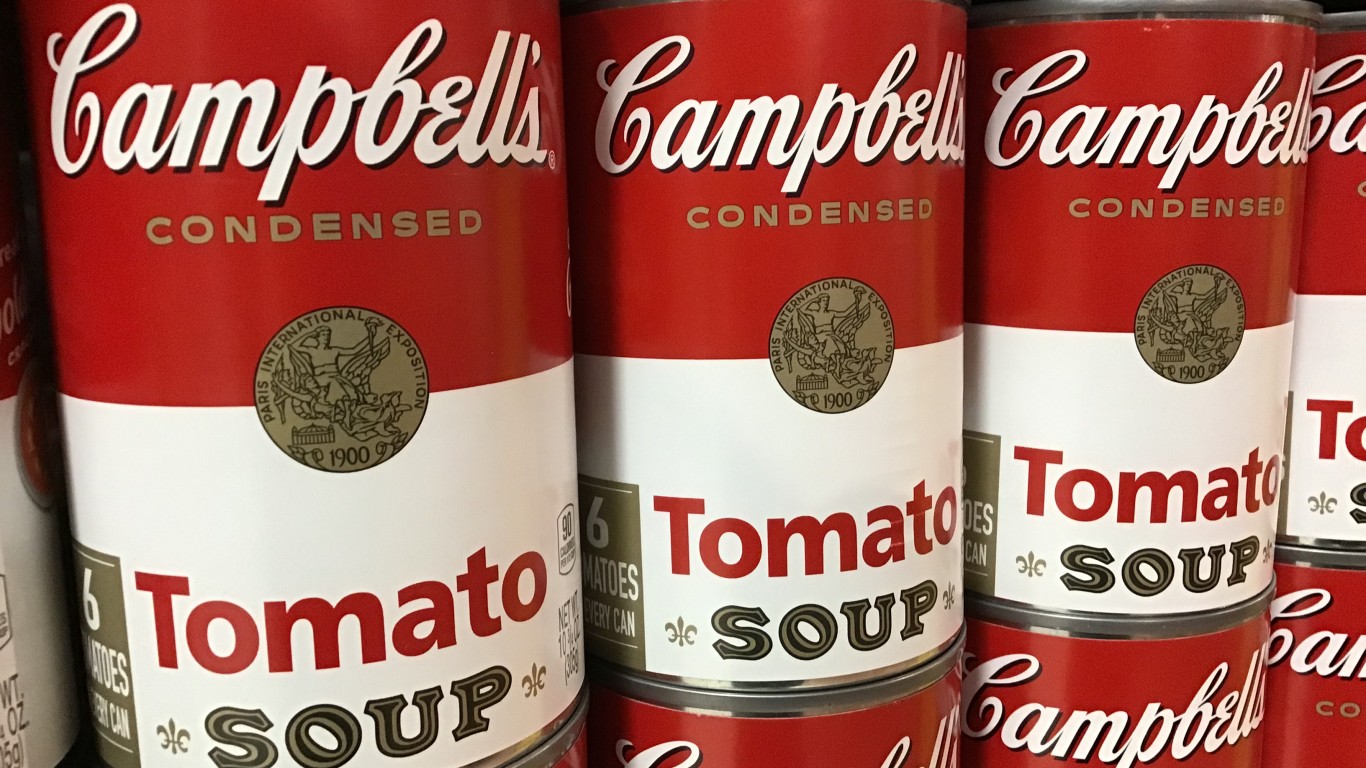
Campbell’s: A 36% Cut Months After Promising Stability
Campbell’s trailing yield of 7.85% also reflects the old $0.39 rate. The new quarterly dividend is $0.25, a 36% cut, and shareholders have not yet received a payment at that rate. The stock trades at $19.95 and is down 23.88% year to date.
Coverage is still enough, but it is getting thinner. Fiscal 2027 adjusted EPS is guided to $1.65 to $1.80, a drop of 24% to 17%. Fiscal 2026 operating cash flow was $1.039B, capital spending was $361M, and total liabilities were $11.492B. On the fiscal third-quarter call, the CFO said, “The dividend is extremely important to our shareholders” and that keeping the investment-grade rating “is an imperative.” Within months, the rating won out. The dividend history shows $0.37 per quarter from 2021 through 2024 and $0.39 in 2025, before the cut.
The bull case: Meals & Beverages grew 3% organically in the fiscal fourth quarter, led by brands like Rao’s and Prego. A new $500M cost-savings program runs through fiscal 2030. The forward P/E of 12 suggests the stock price already reflects much bad news.
The risk: Snacks sales fell 6% organically in the fiscal fourth quarter, and that segment needs the most turnaround.
J.M. Smucker: The Lowest Yield and the Strongest Cash Flow
Smucker yields 3.47%, the lowest in this group, but its dividend has the most behind it. The quarterly payout rose to $1.12 from $1.10. The dividend history shows an increase every year from 2021 through 2026, with no cuts.
The cash flow backs it up. First-quarter operating cash flow was $425.7M, compared with -$10.6M a year earlier, and free cash flow was $337.3M. Management raised full-year free cash flow guidance to about $1.1B and adjusted EPS guidance to $10.50 to $11.00. Debt is falling too: net interest expense fell 18%. The trailing P/E of 59 looks high because of a $980M Hostess impairment. On forward earnings, the P/E is 12.
The bull case: U.S. Retail Coffee sales rose 13% to $807.8M on higher Dunkin’ and Café Bustelo prices. Adjusted EPS of $3.24 beat the $2.22 consensus. The stock is up 36.2% year-to-date.
The risk: that quarter included about $115M in tariff refunds, worth $0.84 a share, and guidance assumes no more tariff refunds. Sweet Baked Snacks (Hostess) is still falling.
Hormel Foods: A Small Raise That Keeps the Streak Going
Hormel yields 5.73%, the higher of the two raisers. The quarterly dividend rose to $0.2925 from $0.29. It was a small increase, but the history shows a higher quarterly payout in every year from 2017 through 2026.
On a GAAP basis, the payout looks stretched. Trailing EPS of $0.62 is below the $1.168 in annual dividends per share. The gap comes from one-time charges, including a $56M loss on the Brazil sale and a $48.2M Indonesia impairment. On an adjusted basis, raised fiscal 2026 guidance to $1.45-$1.51 per share to cover the dividend. Cash climbed 40% to $839.6M, and operating cash flow rose 54%.
The bull case: Foodservice posted its 12th consecutive quarter of organic growth, adjusted operating margin expanded to 9.0% from 8.4%, and the forward P/E is 13.
The risk: net sales fell 2.4% and missed estimates. Raises are hard to keep up when sales are falling.
What Separates the Cutters From the Raisers
| Company | Action | Quarterly Dividend | Yield |
|---|---|---|---|
| Conagra | Cut | $0.175 | 8.64% (trailing) |
| Campbell’s | Cut | $0.25 | 7.85% (trailing) |
| J.M. Smucker | Raised | $1.12 | 3.47% |
| Hormel | Raised | $0.2925 | 5.73% |
| Kraft Heinz | Frozen | $0.40 | 6.73% |
Three things separate the two groups. Leverage comes first. Conagra has net leverage near 4.0x, and Campbell’s is trying to get back to the “low threes.” Meanwhile, Smucker is cutting its interest costs, and Hormel has no major debt concerns. The second is earnings direction.
Both raisers raised their guidance, while Campbell’s expects adjusted EPS to fall. The third is sales. Campbell’s guides net sales down 4% to 2%, while Hormel expects organic growth of 1% to 2%. These are the same red flags that tend to show up before a cut, and we rounded up all seven of them in a free dividend trap guide for income investors who want to spot the next one early.
Kraft Heinz: A Frozen Dividend That Looks More Like the Raisers
Kraft Heinz yields 6.73%. It has paid $0.40 every quarter since cutting the dividend from $0.625 in 2019.
Coverage is solid. It raised fiscal 2026 adjusted EPS guidance to $2.09 from $2.03, well above the annual dividend of $1.60. Management expects free cash flow conversion of about 110%, and first-quarter free cash flow was $766M. Cash stood at $2.419B.
On the numbers that usually trigger a cut (coverage, cash flow and cash on hand), Kraft Heinz looks most like Smucker and Hormel. Its sales look more like the cutters’: North America fell 2.7%, and constant currency adjusted operating income is expected to drop 16% to 18%. That combination explains the freeze. There is enough cash to protect the dividend but not enough growth to raise it.
The bull case: Emerging Markets grew 10.4%, and brand spending is rising to about $700M as management aims for “volume-led, sustainable and profitable growth.” The forward P/E is 11.
The risk: a $7.4B goodwill and intangible impairment points to declining brand value, and the paused plan to split the company leaves its strategy uncertain.
Balance Sheets Decided Who Cut and Who Raised
In all five cases, financial health drove the dividend decision. Conagra and Campbell’s cut because high debt and falling sales left them no room to maneuver. Smucker and Hormel raised because cash was growing and guidance was improving. Kraft Heinz covers its dividend like a raiser but has sales trends like a cutter, so its $0.40 quarterly payout hasn’t moved.
Contact [email protected] for any questions or corrections.
Chris Lange is a financial and geopolitical writer with more than a decade of experience covering a myriad of topics. He has published thousands of articles for 24/7 Wall St., with past coverage focused heavily on stocks, IPOs, healthcare, defense, global affairs, and technology.
His work has been quoted, or referenced by a number of outlets including Business Insider, USA Today, Yahoo Finance, MSN, The Motley Fool, and many other publications. A graduate of Southwestern University, he studied business with a focus on investments and has previous experience in banking and startups.
When not reading or writing the news, he is following his passion for Lacrosse, playing chess, or building solar projects with his dad.