How to Build $4,200 a Month in Dividend Income From Three Income Buckets: SDY, TSLX, and UTG
Three very different income sources can share the load of funding a serious monthly paycheck, but each one carries a hidden risk that could quietly erode the income you're counting on.

This post may contain links from our sponsors and affiliates, and Flywheel Publishing may receive compensation for actions taken through them.
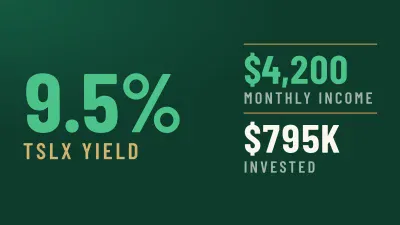
A $4,200 monthly income holds up better when three different sources share the load. One source pays modestly but continues growing.
Another pays a lot and takes on credit risk, and the third sits in the middle and sends a check every month. If one stumbles, the other two keep paying.
The total comes to $50,400 a year. This plan splits one portfolio equally among State Street SPDR S&P Dividend ETF (NYSEARCA:SDY), Sixth Street Specialty Lending (NYSE:TSLX), and Reaves Utility Income Fund (NYSEAMERICAN:UTG).
At late October 2026 prices, the combined yield comes to about 6.3%, which means you would need roughly $795,000 invested, or about $265,000 in each bucket.
SDY Supplies the Growing Paycheck
For its part, SDY is the growth-of-income bucket, and it owns companies that have raised their dividends for at least 20 consecutive years, including utilities, consumer staples, insurers, and chipmakers. Its biggest holding, Verizon (NYSE:VZ | VZ Price Prediction), makes up only about 2% of the fund, so no single company can sink it. It costs 0.35% a year.
Its forward yield is about 2.3%, the lowest of the three. On a one-third share, that comes to roughly $6,050 a year.
This bucket pays off through growth. Over the past decade, the price has risen about 166%, and the companies inside continue raising their payouts. The quarterly checks do bounce around, though. Its most recent payment was about 92 cents a share, down from about 97 cents the quarter before.
Sixth Street Delivers the Biggest Income Check
Sixth Street is the high-income bucket. It’s a business development company, or BDC. It lends to mid-sized private businesses and passes nearly all the interest it collects on to shareholders. The high rates on those loans produce the yield, and they also bring the risk, so when a borrower struggles, the lender takes the hit.
For a BDC, Sixth Street lends fairly carefully. About 88% of the portfolio is first-lien debt, so it gets repaid first if a borrower fails. Non-accruals, meaning loans that have stopped paying, make up just 1% of fair value.
Its $0.42 quarterly base dividend works out to a forward yield near 9.5%. On its share of the portfolio, that’s about $25,280 a year, the biggest contribution of the three.
The dividend has already been cut once when Sixth Street lowered its base dividend from $0.46 to $0.42 earlier this year. Second-quarter net investment income, which is lending profit after expenses, came in at $0.43 a share, just enough to cover it. On the August call, CEO Robert Stanley said: “Our second-quarter operating earnings exceeded the base dividend level we established last quarter.”
Supplemental dividends are extra payouts on top of the base, and they aren’t guaranteed. They’ve fallen to just $0.01 so far this year. The shares also trade about 8% above their net asset value of $16, so buyers pay a premium for the loan book.
Reaves Mails a Utility Check Every Month
Reaves is the steady-income bucket. It’s a fund focused on utilities. These funds issue a fixed number of shares that trade on an exchange, so the share price can drift above or below the value of what the fund owns. That value is called net asset value. In late October, UTG traded about 0.6% below it, which is close to fair.
The fund pays $0.21 a month, up from $0.20 before July. That’s a distribution rate of about 7.2% based on the share price. The rate on net asset value comes in a little lower because the shares trade just under it. On its share of the portfolio, that’s roughly $19,070 a year.
Two risks stand out. First, the fund uses leverage, meaning it takes on debt to amplify its stock holdings. That boosts income in good years and makes losses bigger in bad ones. It reported about $4.3 billion in total managed assets, compared with net assets near $3.2 billion.
Second, some payouts give back part of your own investment, so a portion of each check is money you already put in. The fund estimates that 19% of its fiscal-year payouts through September came from that source. The September payment itself came entirely from long-term gains.
Continues $4,200 a Month on Track
Two of these buckets carry real risk. Sixth Street lends to mid-sized companies, and Reaves runs partly on borrowed money, so splitting the money three ways helps, but it can’t guarantee the income. Even with its dividend still flowing, Sixth Street stock fell about 15% over the past year.
Of the roughly $795,000 invested, SDY is the steadiest bucket because it’s spread across many companies and built on decades of dividend increases.
Once a year, check one thing: whether each payout is covered by what the holding actually earns. For Sixth Street, compare net investment income to the base dividend. For Reaves, read its Section 19(a) notices to see how much of each payout is your own money coming back. If coverage slips, the income usually follows.
Contact [email protected] for any questions or corrections.
David Beren has been a Flywheel Publishing contributor since 2022. Writing for 24/7 Wall St. since 2023, David loves to write about topics of all shapes and sizes. As a technology expert, David focuses heavily on consumer electronics brands, automobiles, and general technology. He has previously written for LifeWire, formerly About.com. As a part-time freelance writer, David’s “day job” has been working on and leading social media for multiple Fortune 100 brands. David loves the flexibility of this field and its ability to reach customers exactly where they like to spend their time. Additionally, David previously published his own blog, TmoNews.com, which reached 3 million readers in its first year. In addition to freelance and social media work, David loves to spend time with his family and children and relive the glory days of video game consoles by playing any retro game console he can get his hands on.