How a 66-Year-Old Collects $4,400 a Month From Just Three Tickers: FDVV, CSWC, and UTF
Three tickers, one retirement account, and a monthly income target that most financial planners say requires far more diversification. Here is how the math actually works out.

This post may contain links from our sponsors and affiliates, and Flywheel Publishing may receive compensation for actions taken through them.

A 66-year-old retiree wants three names, one portfolio, and $4,400 each month. It totals $52,800 a year. The plan below splits the money equally among Fidelity High Dividend ETF (NYSEARCA:FDVV), Capital Southwest (NASDAQ:CSWC), and Cohen & Steers Infrastructure Fund (NYSE:UTF).
The math uses end-of-October prices. FDVV yields about 2.8% based on its past year’s payments. Capital Southwest yields about 11.1% on the same basis. UTF pays about 7.5% at its current monthly rate. Average the three, and the portfolio yields about 7.1%. Divide $52,800 by that combined yield to get roughly $745,000, or about $248,000 in each holding.
Fidelity High Dividend ETF
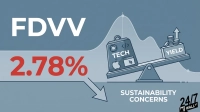
FDVV is a big basket of mostly U.S. dividend payers with about $10 billion in net assets. It tracks a Fidelity index that picks large companies expected to keep paying and raising their dividends. Its top holding is a chipmaker at about 6.6% of assets. The rest of the list leans on banks, consumer staples, utilities, and real estate trusts.
Its one-third share, at a 2.8% yield, throws off about $6,850 a year. Keep in mind that quarterly checks can fluctuate. The latest was $0.362 a share, down from $0.519 the quarter before. Ultimately, FDVV earns its place through growth: shares rose about 263% over 10 years.
Capital Southwest
Capital Southwest is a business development company, or BDC. Put simply, it lends money to mid-sized private businesses and passes nearly all of its profit along to shareholders. Its one-third share, at an 11.1% yield, produces about $27,450 a year. That’s more than half the portfolio’s income.
Here’s the part that matters most. The regular dividend is $0.58 a quarter, paid monthly at $0.1934. On top of that comes a $0.06 quarterly supplemental dividend, and the company can drop it whenever it wants. Last quarter, net investment income (the profit left over from lending) came to $0.57 a share. That covers about 98% of the regular payout. Management points to 109% cumulative coverage since starting its credit strategy.
About 99% of its credit portfolio sits in first-lien loans, which means it has top priority for repayment when a company defaults. Rate cuts are the weak spot, as a 75-basis-point drop in base rates would cut income by about $0.19 a share.
Cohen & Steers Infrastructure Fund
UTF is a closed-end fund that owns utilities, pipelines, cell towers, and transportation assets. A closed-end fund has a fixed number of shares that trade like a stock. Buyers and sellers set the price, so it can differ from what the fund’s holdings are worth. Its one-third share, at 7.5% of the market price, returns about $18,500 a year.
The monthly payout is $0.165, up from $0.155 earlier this year. UTF also uses leverage. That means it borrows money to buy more assets, so both its income and its swings get bigger. Return of capital means a fund returns part of your own money as a payout.
In its August notice, the fund estimated no return of capital so far in 2026. So far this year, the payouts have come from investment income and long-term gains. Look up the current premium or discount before buying, since paying above asset value reduces your real yield.
What Turning 66 Changes
Someone born in 1960 doesn’t face required withdrawals until age 75 under 26 U.S.C. § 401(a)(9)(C)(v)(II), so IRA withdrawals aren’t forced yet. In a taxable account, this income counts toward Medicare’s surcharge test. The standard Part B premium of $202.90 applies up to $109,000 for single filers or $218,000 for joint filers, based on the tax return from two years earlier.
Where This Income Can Crack
Two-thirds of this money sits in a lender to medium-sized firms and a fund that runs on borrowed money. This income carries no guarantee. Capital Southwest is the shakiest piece because both rate cuts and loan defaults hit it directly. UTF has been the steadiest check, holding at $0.155 from 2019 until this year’s raise. FDVV owns the widest set of companies and gives the portfolio its best shot at growth.
Your $745,000 Checklist
It takes roughly $745,000, split equally, to collect $4,400 a month. UTF is the most reliable payer of the three, but check one number every year: whether Capital Southwest’s net investment income still covers its regular dividend. If it falls short two quarters in a row, expect the income plan to need fixing.
Contact [email protected] for any questions or corrections.
David Beren has been a Flywheel Publishing contributor since 2022. Writing for 24/7 Wall St. since 2023, David loves to write about topics of all shapes and sizes. As a technology expert, David focuses heavily on consumer electronics brands, automobiles, and general technology. He has previously written for LifeWire, formerly About.com. As a part-time freelance writer, David’s “day job” has been working on and leading social media for multiple Fortune 100 brands. David loves the flexibility of this field and its ability to reach customers exactly where they like to spend their time. Additionally, David previously published his own blog, TmoNews.com, which reached 3 million readers in its first year. In addition to freelance and social media work, David loves to spend time with his family and children and relive the glory days of video game consoles by playing any retro game console he can get his hands on.