Suze Orman Says Doing Nothing Can Be the Right Move When Stocks Fall
When stocks drop, most investors feel compelled to act fast, but Suze Orman argues that impulse could be quietly destroying your long-term returns in ways the math makes painfully clear.

This post may contain links from our sponsors and affiliates, and Flywheel Publishing may receive compensation for actions taken through them.

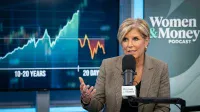
In the Oct. 25 episode of Suze Orman’s Women & Money, Suze Orman pushed back on a reflex many disciplined investors share. Her advice to listeners was straightforward. “You don’t have to think, oh, the markets went down, I have to dollar-cost average; now is the time. No, you don’t always have to do something.” Orman is a longtime personal finance author and broadcaster.
Her timing was good. The Invesco QQQ Trust (NASDAQ:QQQ) has fallen 8% over the past month after a sell-off in tech stocks. Investors are now bracing for more volatility. In a market like this, the urge to act costs money in two ways, as some people put cash they will soon need into stocks to catch the dip. Others sell near the low and lock in a loss.
Orman Gets This One Right, and the Math Shows Why
Dollar-cost averaging means investing a fixed dollar amount on a fixed schedule, whatever the price, so say you invest $500 a month, and the share price goes from $50 to $40 and back to $50.
You end up with 32.5 shares at an average cost of about $46. That is below the price in two of the three months.
That is the point Orman is making. A regular schedule already buys more shares when prices drop. Adding extra purchases every time stocks fall turns the plan back into market timing, which is the very habit dollar-cost averaging exists to replace.
Even with the recent pullback, the year has been strong. When Orman recorded the episode, she said the Dow was up approximately 9% for the year. Orman said the S&P 500 was up more than 11% and the Nasdaq almost 12%.
The figures today are close to hers. The SPDR Dow Jones Industrial Average ETF Trust (NYSEARCA:DIA) is up about 8% this year. The SPDR S&P 500 ETF Trust (NYSEARCA:SPY) is up about 11%. QQQ is up about 12%, so a painful month has erased only a small part of the year’s gains.
Suze Orman summed it up on the show: “Markets are not made in 20 days. Markets are made over 10 and 20 years.” Over the past decade, SPY has gained 262%, and that period included several sell-offs worse than this one.
Why Retirees Gain the Most From Doing Nothing
Staying put matters most for people living off their portfolios, like a retiree who needs $40,000 a year and sells stocks to get it right after a 20% drop. That sale uses up shares that were worth $50,000 before the fall. About $10,000 of pre-crash value is gone and will never recover.
Losses also take more to recover than they took to happen. A 20% drop needs a 25% gain to get back to even. Selling at the bottom turns a temporary paper loss into a permanent one, and you miss the rebound. A retiree who instead pays the bills from $80,000 in cash, two years of withdrawals, can leave the stocks alone until they recover.
One Number Decides Whether Sitting Tight Works
That number is how soon you need the money. Suze Orman’s rule: “You need at least five or ten years till you need this money to be invested in the stock markets.”
Suppose a home down payment due in two years is sitting in stocks when they fall 20%, and holding on is no plan at all because the bill may come due before prices recover. Money with a 10-year horizon is in a very different position. SPY is up 62% over five years even with this fall’s slide. A temporary drop only hurts the investor who has to sell during it.
Orman’s advice therefore has a limit. Doing nothing works only for money you will not need for years. The first stretch of retirement withdrawals is where a bad market does its permanent damage. We laid this out in a free guide on defending the early years. Move money you need within a few years out of stocks before the next drop.
Your Move Before the Next Sell-Off
- Add up the next five years of withdrawals. Include tuition, a car, a down payment, or retirement income. Move that money into cash, a high-yield savings account, or Treasuries so a crash cannot touch it.
- Set up automatic contributions and leave them alone. A fixed monthly amount already buys more shares in a down market. Headlines are no reason to change it.
- Use limit orders for extra cash instead of guessing. In an earlier episode, Orman suggested a more patient approach: “But you don’t have to do it tomorrow. You could take it, and you could put it in order, 10% below the market, 20% below the market, whatever it may be.”
- Retirees, keep one to two years of withdrawals in cash. Multiply your annual withdrawal by two and hold that amount outside stocks. That way, a sell-off never forces you to sell.
A market drop calls for action only when the money in stocks is money you need soon, and a cash cushion covers that before the drop comes.
Contact [email protected] for any questions or corrections.
Chris Lange is a financial and geopolitical writer with more than a decade of experience covering a myriad of topics. He has published thousands of articles for 24/7 Wall St., with past coverage focused heavily on stocks, IPOs, healthcare, defense, global affairs, and technology.
His work has been quoted, or referenced by a number of outlets including Business Insider, USA Today, Yahoo Finance, MSN, The Motley Fool, and many other publications. A graduate of Southwestern University, he studied business with a focus on investments and has previous experience in banking and startups.
When not reading or writing the news, he is following his passion for Lacrosse, playing chess, or building solar projects with his dad.