Suze Orman on a Shaky Market: “Markets Are Not Made in 20 Days”
Suze Orman looked at the same shaky index numbers her listeners were panicking over and reached a conclusion most of them missed completely. Her framework for retirees challenges the most common instincts people act on during a rough stretch in…

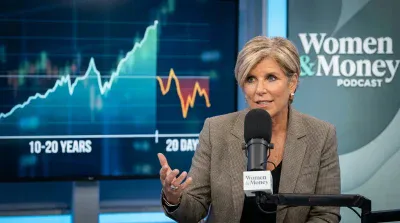
Suze Orman spent part of her October 25 Women & Money episode, “When Is a Decision Right For You?”, talking listeners through a rough few weeks in stocks. Her main point came down to one line, which Orman delivered right after reading off the year’s index returns: “Markets are not made in 20 days. Markets are made over 10 and 20 years.” That line speaks directly to anyone near or at retirement who is watching their balances drop. You can find the episode in her official podcast archive.
What Suze Orman Told Nervous Investors
About a week before the elections, Orman explained where the jitters were coming from: “The market doesn’t like inconsistency. It doesn’t like not knowing what’s going to happen.”
Then she put the pullback in perspective. Orman said that as of October 25, the Dow Jones was “still up approximately 9%,” the S&P 500 was “still up more than 11%,” and the Nasdaq was “up almost 12% for the entire year.”
She also took aim at the reflex to jump in on every dip: “You don’t have to think, oh, the markets went down, I have to dollar cost average, now is the time. No, you don’t always have to do something.” Dollar-cost averaging means putting a fixed amount into the market on a regular schedule. It works well as an ongoing habit. Orman’s warning is about seeing a market drop as a signal to act right away.
Where the Major Indexes Stand Today
Here is current data, separate from the figures Orman gave on the show. As of noon October 28, the SPDR S&P 500 ETF Trust (NYSEARCA:SPY) was up 13.11% year to date. The SPDR Dow Jones Industrial Average ETF Trust (NYSEARCA:DIA) was up 9.24%, and the Invesco QQQ Trust (NASDAQ:QQQ), which follows the Nasdaq 100, was up 17.64%.
Over the past month, the picture looks weaker. QQQ fell 2.93%, and SPY slipped 0.01%. The CBOE Volatility Index reached 19.45 on October 23 and then eased to 17.52 by October 27. Both levels sit within the 15-20 range considered normal. The options market is pricing moderate, orderly uncertainty.
Consumers are more worried than traders. University of Michigan sentiment fell to 48.1 in September, down from 55.2 in July. On Wall Street, Morgan Stanley (NYSE:MS | MS Price Prediction) has warned the S&P 500 could pull back before starting a fresh rally. That is exactly the kind of short-term drop Orman told her listeners to ride out.
Ten-Year Returns Show What She Means
Over the last decade, SPY returned 262.9%, DIA returned 189.46%, and QQQ returned 517.12%. Those returns went to investors who held for the full decade.
How Retirees Can Use Her Time-Horizon Rule
Orman’s basic rule is simple: “You need at least five or ten years till you need this money to be invested in the stock markets.” She has explained why that timeline matters: “Normally it takes three to five years for the stock market to go from its high to its low back up again.”
For retirees, the risk is being forced to sell stocks at a loss to pay the bills. Her fix is to keep that money somewhere else: “If you are near to retirement or are retired in the stock market, I want it in cash, which means in money market funds, high yield savings accounts, CDs, things like that.”
Here is what that looks like in practice:
- Under her approach, expected withdrawals for the next several years sit in cash or cash equivalents.
- Only money that won’t be touched for at least five years stays in stocks.
- In her view, a mix that already matches the timeline doesn’t need changes after a down month.
Bottom Line
Orman is right, and the numbers back her up. Every major index is still higher for the year, volatility is within its normal range, and ten-year returns are what investors earn for sitting through periods like this. Orman says a cash-and-stock split built around when the money is actually needed means a rough 20 days is no reason to act. Her framework points retirees toward reviewing that split and confirming the next few years of withdrawals are already in cash.
Contact [email protected] for any questions or corrections.
Chris Lange is a financial and geopolitical writer with more than a decade of experience covering a myriad of topics. He has published thousands of articles for 24/7 Wall St., with past coverage focused heavily on stocks, IPOs, healthcare, defense, global affairs, and technology.
His work has been quoted, or referenced by a number of outlets including Business Insider, USA Today, Yahoo Finance, MSN, The Motley Fool, and many other publications. A graduate of Southwestern University, he studied business with a focus on investments and has previous experience in banking and startups.
When not reading or writing the news, he is following his passion for Lacrosse, playing chess, or building solar projects with his dad.