The Dividend Portfolio That Covers Your Required Minimum Distribution Without Selling a Share: KMB, BIZD, and SPHD
Every December, retirees sell shares they would rather keep just to satisfy an IRS deadline they never asked for. A three-holding portfolio built around yield might change that math entirely, but only up to a certain age.

This post may contain links from our sponsors and affiliates, and Flywheel Publishing may receive compensation for actions taken through them.
Every December, many retirees log into their IRA and sell shares they’d rather keep just to satisfy the IRS. In a down market, it hurts more. They lock in losses to meet a withdrawal they never chose.
There’s a cleaner way. Inside an IRA, dividends arrive as cash or automatically reinvested, depending on the account settings. That said, the IRS requires a minimum withdrawal from a traditional IRA each year, called the required minimum distribution (RMD). If the account’s yield is at least as high as that year’s required percentage, the dividend cash covers the RMD, and you don’t have to sell shares. Below is a three-holding portfolio split equally among Kimberly-Clark (NASDAQ:KMB | KMB Price Prediction), the VanEck BDC Income ETF (NYSEARCA:BIZD) and the Invesco S&P 500 High Dividend Low Volatility ETF (NYSEARCA:SPHD), along with how long its dividends keep up.
Why the Required Percentage Rises Every Year
Under current law, RMDs start at age 73 for anyone who turned 72 after 2022 and turns 73 before 2033. However, for people who turn 74 after 2032, the starting age moves to 75.
The IRS formula is actually pretty simple: you take the balance on December 31 of the prior year and divide it by a number from the Uniform Lifetime Table. That divisor is 26.5 at age 73, 20.2 at 80, 16.0 at 85, and 12.2 at 90. Because the divisor gets smaller each year, the required share of the account gets bigger. It’s about 4% at 73 and about 8% at 90.
What a $1 Million IRA Has to Pay Out
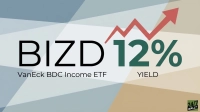
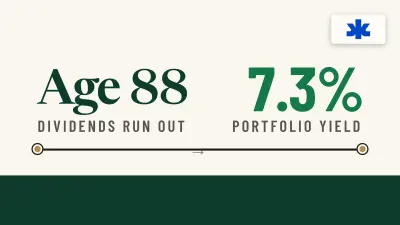
We pulled yields in early November 2026, using each holding’s payouts from the last 12 months. Kimberly-Clark yields 4.6%, SPHD 4.7%, and BIZD 12.4%. With an even split, the portfolio yields about 7.3%. On a $1 million IRA, that’s roughly $72,500 a year in cash. Here’s the required withdrawal at each age, assuming the balance and yields stay flat:
- Age 73: about $37,700. Dividends cover it with a wide margin, and you can reinvest the extra cash.
- Age 80: about $49,500. Still covered comfortably.
- Age 85: about $62,500. Covered, but with a smaller margin.
- Age 87: about $69,400. Covered, just barely.
- Age 88: about $73,000. This is the year dividends alone stop covering the withdrawal.
- Age 90: about $82,000. The gap keeps getting wider.
Starting at 88, the shortfall has to come from selling shares or moving them out of the IRA in kind. Our earlier piece on taking an RMD in shares instead of cash walks through that second option.
Kimberly-Clark: 54 Years of Raises, Thin Coverage
The company behind Huggies, Kleenex, and Cottonelle just raised its dividend for the 54th consecutive year, to $1.28 a quarter. Management calls these “very stable consumption categories where consumption doesn’t change because of promotion.”
Coverage is the weak spot, as the payout ratio is the share of earnings a company pays out as dividends. Trailing GAAP earnings of $5.07 a share barely match the $5.08 paid in dividends, which puts the payout ratio near 100%. The balance sheet also carries significant leverage: $16.7 billion in total liabilities against $1.9 billion in shareholder equity at midyear, and the Kenvue (NYSE:KVUE) deal just closed on November 2, 2026.
VanEck BDC Income ETF: Highest Yield, Bumpiest Payouts
Business development companies, or BDCs, invest in small and midsize businesses, often through loans and other forms of financing. They have to pay out most of their taxable income, so their yields run high. BIZD owns a basket of them, with about $1.6 billion in net assets.
Keep two things in mind. First, the fund’s total expense ratio looks high because it includes fees from acquired funds. Those are the operating and interest costs of the BDCs it holds, which it passes through to the fund. The prospectus lists the current figure. Second, the payouts move around. BIZD paid about 24 cents a share in July 2026, compared with about 44 cents in July 2025.
Invesco S&P 500 High Dividend Low Volatility ETF: Monthly Cash With Less Swing
SPHD tracks the 75 highest-yielding S&P 500 stocks and then chooses 50 with the lowest realized volatility. It pays monthly, about 20 cents a share recently, which keeps cash flowing steadily into the IRA. The fund gained about 17% over the past year. Its holdings lean toward utilities, real estate, telecom, and consumer staples. Kimberly-Clark makes up about 2% of the fund, so the two overlap a little.
When the Dividends Stop Covering the RMD
On these numbers, the portfolio covers the RMD by itself through age 87 and comes up short from 88 on. That assumes no dividend cuts, and cuts happen, especially at BDCs. A cut moves that crossover age earlier.
Each December, do one check. Divide the portfolio’s last 12 months of dividends by its balance, then compare that yield with next year’s required percentage. If the yield comes in lower, plan the share sale or in-kind transfer early, before a downturn forces the timing. The whole idea of a dividend ladder is to build the account so the checks do the work, not the share sales, which we laid out in a free guide here.
Contact [email protected] for any questions or corrections.
David Beren has been a Flywheel Publishing contributor since 2022. Writing for 24/7 Wall St. since 2023, David loves to write about topics of all shapes and sizes. As a technology expert, David focuses heavily on consumer electronics brands, automobiles, and general technology. He has previously written for LifeWire, formerly About.com. As a part-time freelance writer, David’s “day job” has been working on and leading social media for multiple Fortune 100 brands. David loves the flexibility of this field and its ability to reach customers exactly where they like to spend their time. Additionally, David previously published his own blog, TmoNews.com, which reached 3 million readers in its first year. In addition to freelance and social media work, David loves to spend time with his family and children and relive the glory days of video game consoles by playing any retro game console he can get his hands on.