How Much It Takes to Collect $3,000 a Month From Covered Call Funds GPIX, RYLD, and BST
Covered call funds advertising 9% yields make $3,000 monthly look almost effortless, but before you wire a single dollar, you need to understand exactly where that income originates and which part of it may quietly be your own money coming…

This post may contain links from our sponsors and affiliates, and Flywheel Publishing may receive compensation for actions taken through them.
Covered call funds pay big monthly checks, and that’s the draw. Taking in $3,000 a month, or $36,000 a year, from funds paying close to 9% looks much easier than doing it with a 3% dividend fund. Before counting on that income, ask one question: where does that money actually come from?
A covered call fund owns stocks and sells someone else the right to buy them at a set price. It takes in a fee for that, and the fee becomes your income. In return, the fund gives up some upside when stocks surge.
This portfolio puts equal amounts into three funds: Goldman Sachs S&P 500 Premium Income ETF (NASDAQ:GPIX), Global X Russell 2000 Covered Call ETF (NYSEARCA:RYLD) and BlackRock Science and Technology Trust (NYSE:BST). I took each fund’s latest monthly payout, annualized it, and measured it against the November 2026 share price. Based on that, the combined rate comes to about 8.9%. That means you’d need roughly $404,000 invested, or about $134,700 in each fund.
Goldman Sachs S&P 500 Premium Income ETF Keeps Some Upside
Goldman’s fund holds a portfolio designed to track the S&P 500. Apple (NASDAQ:AAPL | AAPL Price Prediction) made up about 6% of net assets in its mid-2026 holdings report. It sells index call options, and Goldman says it does this “dynamically,” so the fund still “allows for participation with rising markets.” Because it only sells calls on part of the portfolio, it keeps more upside than funds that sell calls on everything.
Its most recent monthly payout was about $0.40 a share. With shares near $55, that’s about an 8.7% rate, or roughly $11,700 a year from your stake. The payout moves with option premiums. It has climbed from about $0.30 in December 2023, but nothing ensures it.
Global X Russell 2000 Covered Call ETF Pays the Most but Erodes
RYLD owns the Global X Russell 2000 ETF, about 101% of net assets in its July 2026 filing. It then sells at-the-money calls (options with a strike price at the current share price) on 100% of that exposure. That squeezes out the most premium but gives up nearly all the upside.
The latest payout was about $0.15 a month. On a share price near $15, that works out to about 11.6%, or roughly $15,600 a year. That’s the biggest portion of your income.
Both the payout and the price have fallen. Monthly checks reached about $0.31 in 2021. Shares opened near $25 in May 2019 and are down about 39% since then. Counting the distributions, the total gain since April 2019 is about 49%. In plain terms, a good share of what RYLD paid out came off its share price. Global X’s Section 19(a) notices show how much of each payment counts as return of capital, which means part of your own money handed back and called income. Read those notices before you count on the yield.
BlackRock Science and Technology Trust Adds Tech Growth and Extra Payouts
BST is a closed-end trust. The fixed number of shares trades like a stock, so buyers and sellers set the price. That price can sit above the value of what the fund owns (a premium) or below it (a discount). BST holds global tech stocks and sells calls on part of the portfolio to help fund its payouts.
Under its managed distribution plan, BST has paid $0.25 a month since January 2022. It added extra payouts of about $1.45 in December 2025 and about $2.30 in September 2026. Counting only the regular payout against a price near $46, the rate is about 6.5%. That adds roughly $8,700 a year. Check BlackRock’s fund page for the current premium or discount. If it’s at a premium, you’re paying more than $1 for each $1 of stock.
Which Fund Kept Its Value Best
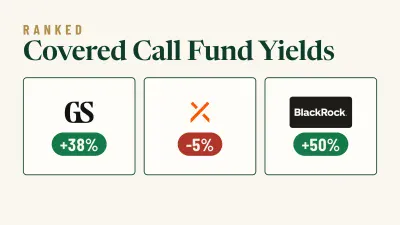
All three have traded since late 2023. Since then, BST’s price has risen about 50% and GPIX’s about 38%, while RYLD has slid about 5%. BST gained the most, but it swings hard. It fell about 9% in the past month and still trades below its late-2021 price of about $55. GPIX has held its value most steadily. A high payout can hide a falling share price, and total return tells you whether that’s happening.
What Your $404,000 Depends On
A portfolio of about $404,000 gets you to the target today. That income depends on option premiums, which grow when markets get volatile and fall when they calm down. It also depends on BST keeping its monthly payout. Three steps keep the plan on track:
- Each year, check every fund’s total return (price change plus payouts). If it trails the payout, you’re spending principal.
- Base the target on what you actually spend. A lower number falls below the portfolio you need.
- Look at RYLD’s share of the mix. It brings in the most income, and it’s also the fund whose price has declined.
Contact [email protected] for any questions or corrections.
David Beren has been a Flywheel Publishing contributor since 2022. Writing for 24/7 Wall St. since 2023, David loves to write about topics of all shapes and sizes. As a technology expert, David focuses heavily on consumer electronics brands, automobiles, and general technology. He has previously written for LifeWire, formerly About.com. As a part-time freelance writer, David’s “day job” has been working on and leading social media for multiple Fortune 100 brands. David loves the flexibility of this field and its ability to reach customers exactly where they like to spend their time. Additionally, David previously published his own blog, TmoNews.com, which reached 3 million readers in its first year. In addition to freelance and social media work, David loves to spend time with his family and children and relive the glory days of video game consoles by playing any retro game console he can get his hands on.