What Size Roth IRA Replaces a $135,000 Salary Tax-Free at 62?
Your paycheck shrinks before it hits the bank, so replacing it dollar for dollar may mean saving far more than you need. See which target a 62-year-old retiree should actually chase, and why a six-fund income mix decides it.

This post may contain links from our sponsors and affiliates, and Flywheel Publishing may receive compensation for actions taken through them.
Picture a married 62-year-old making $135,000 who wants to stop working without taking a pay cut. A Roth IRA can cover that, since qualified withdrawals come out tax-free. This article works out how big that Roth needs to be with a six-holding income portfolio, with all pricing confirmed as of November 5, 2026.
Your Real Target Is Smaller Than Your Salary
Taxes come out of a paycheck before it reaches the bank. For a married couple filing jointly in 2026, they can deduct $32,200 without itemizing, and the 22% bracket starts above $100,800. That puts federal income tax on $135,000 at about $12,040. Social Security (6.2%) and Medicare (1.45%) take roughly $10,328 more.
That leaves take-home pay near $112,600, before state tax, which varies by state. Qualified Roth withdrawals owe none of these taxes, and your 401(k) contributions stop once you retire.
What This Portfolio Requires
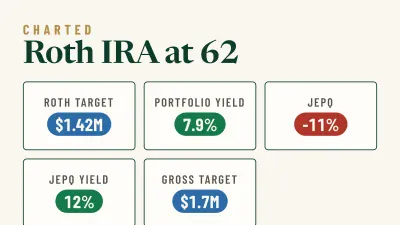
Six holdings at fixed weights produce a combined yield of about 7.9%. Yield is just the annual cash payout divided by the price. Divide the income you need by that yield, and you get the balance required:
- Replacing the full $135,000 gross salary takes about $1.7 million.
- Replacing the $112,600 take-home takes about $1.42 million.
JPMorgan Nasdaq Equity Premium Income ETF
JPMorgan Nasdaq Equity Premium Income ETF (NASDAQ:JEPQ) owns Nasdaq-100 stocks and writes call options against them. It collects cash in exchange for giving up some upside. A 20% weight at a forward yield near 12% supplies about 30% of the income.
Its monthly payouts move around, from $0.47 to $0.70 per share in 2026. That 12% also looks bigger than usual because shares fell 11% over the past month.
Global X S&P 500 Covered Call ETF
Global X S&P 500 Covered Call ETF (NYSEARCA:XYLD) sells at-the-money calls on the S&P 500 every month, giving up nearly all upside for premium income. A 10% weight at a 9.4% yield delivers about 12% of the income.
Including distributions, XYLD gained 135% over the past decade. ALPS Sector Dividend Dogs ETF (NYSEARCA:SDOG), the lowest yielder here, gained 173% over the same stretch. More yield bought less growth.
Realty Income
Realty Income (NYSE:O) leases properties to tenants who cover most building costs, and it pays monthly. A 15% weight at a 5.5% yield supplies about 10% of the income.
In September 2026, it announced its 116th consecutive quarterly dividend increase, with occupancy at 99%. Those raises help income keep pace with inflation.
Blue Owl Capital Corporation
Blue Owl Capital Corporation (NYSE:OBDC | OBDC Price Prediction) is a BDC, a fund that lends to midsize private firms. It holds 73% of its portfolio in first-lien loans, which get repaid first. A 15% weight at an 11.5% yield delivers about 22% of the income.
Credit quality decides how long that lasts. The regular dividend fell from $0.37 to $0.31 this year. Loans that stopped paying make up 3% of the portfolio at cost, and debt runs 1.1x equity.
Reaves Utility Income Fund
Reaves Utility Income Fund (NYSEAMERICAN:UTG) is a closed-end fund. That means a fixed number of shares trade like a stock, so the price can sit above (a premium) or below (a discount) the value of what the fund owns. It holds utility, telecom, and infrastructure stocks and adds some borrowed money on top.
A 15% weight at a 7.8% distribution rate provides about 15% of the income. The monthly payout rose to $0.21 from $0.20 in July 2026. Check the current premium or discount, because the borrowed money makes interest-rate swings hit harder.
ALPS Sector Dividend Dogs ETF
SDOG buys the five highest-yielding stocks in each of 10 S&P 500 sectors, gives each the same weight and rebalances once a year. Its 25% weight is the biggest in the portfolio, yet its 3.5% yield supplies only about 11% of the income.
Its value comes from growth. The quarterly dividend rose from $0.39 in late 2020 to $0.63 in September 2026.
Why 62 Works for Roth Income
Federal law excludes qualified Roth distributions from gross income. A withdrawal qualifies once you’re past age 59½ and five tax years have passed since your first Roth contribution.
This matters a lot before Medicare starts at 65. Marketplace health insurance subsidies depend on modified adjusted gross income, which adds back only excluded foreign income, tax-exempt interest, and untaxed Social Security (26 U.S.C. § 36B(d)(2)(B)).
Qualified Roth withdrawals aren’t on that list. Traditional IRA withdrawals are taxed as ordinary income, so pulling $112,600 from one could reduce or eliminate a subsidy. When the Roth pays the bills, it’s also easier to delay Social Security, which our tax-coverage plan explains.
Building the Balance With Conversions
Annual contribution limits make $1.42 million very hard to reach through contributions alone. Conversions close the gap. You move traditional IRA or 401(k) money into a Roth during lower-income years before retirement and pay tax on it in the year you convert.
Our conversion pieces walk through the bracket math, and if you want the full blueprint for turning a lump sum into a monthly paycheck, we put the mix, the payout calendar, and the withdrawal order into a free guide here.
Which Target Is Real
Your real number is the $1.42 million take-home target. The $1.7 million gross target pays for taxes you won’t owe anymore.
Before retiring, check whether five tax years have passed since your first Roth IRA contribution or conversion. If not, withdrawals of investment earnings may be taxable, although withdrawals of regular contributions remain tax-free.
Contact [email protected] for any questions or corrections.
David Beren has been a Flywheel Publishing contributor since 2022. Writing for 24/7 Wall St. since 2023, David loves to write about topics of all shapes and sizes. As a technology expert, David focuses heavily on consumer electronics brands, automobiles, and general technology. He has previously written for LifeWire, formerly About.com. As a part-time freelance writer, David’s “day job” has been working on and leading social media for multiple Fortune 100 brands. David loves the flexibility of this field and its ability to reach customers exactly where they like to spend their time. Additionally, David previously published his own blog, TmoNews.com, which reached 3 million readers in its first year. In addition to freelance and social media work, David loves to spend time with his family and children and relive the glory days of video game consoles by playing any retro game console he can get his hands on.