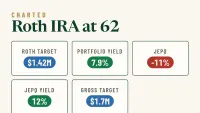
How to Convert an $840,000 401(k) to a Roth IRA and Collect $4,050 a Month Tax-Free for Life
A pre-tax 401(k) hides a tax bill nobody has paid yet, and the way you settle it can swing the cost by six figures. One timing choice, plus a December 31 deadline, decides how much of the balance you actually…

This post may contain links from our sponsors and affiliates, and Flywheel Publishing may receive compensation for actions taken through them.

An $840,000 401(k) funded with pre-tax contributions carries a tax bill nobody has paid yet. Every dollar that comes out is subject to ordinary income tax. A Roth IRA conversion pays that tax up front, and the goal here is $4,050 a month of tax-free income after.
Moving Money From a 401(k) to a Roth
A saver can take one of three options: roll the 401(k) into a traditional IRA and convert it in pieces over several years, roll it straight into a Roth IRA, or use an in-plan Roth conversion while still employed if the plan offers one, which the tax code permits under 26 U.S.C. § 402A(c)(4). Whichever path is used, the converted amount is included in gross income for that year.
Using savings to cover the tax bill works better than having it withheld. Withheld money never reaches the Roth, so it never grows tax-free, and anyone under 59½ can owe the 10% additional tax on early distributions.
Roth withdrawals face no taxes after the owner reaches age 59½ and five tax years have passed since the first Roth contribution. Traditional IRAs generally require withdrawals starting at age 73, rising to 75 for younger generations. Roth IRAs have no required minimum distributions during the owner’s lifetime.
All at Once or Over Four Years
For a married couple with no other income, the 2026 write-off against income is $32,200, and the top 37% rate starts at $768,700. Converting all $840,000 in one year creates a federal bill of about $221,051.
Converting $210,000 a year for four years keeps taxable income in the 22% bracket, ending at $211,400. Each year costs $28,540, or $114,160 total, saving about $106,891. The low-tax years between a last paycheck and the first required withdrawal are usually the cheapest time to run conversions like this, which is the whole subject of our free Roth Window guide.
Medicare premiums can also go up. Joint filers with income above $218,000 pay a surcharge. At $750,000 or more, Part B reaches $690 per person per month, plus a $91 Part D add-on. Social Security uses the most recent federal tax return the IRS provides, so a conversion shows up in premiums later.
Assuming the couple has no other income, each $210,000 conversion stays below the 2026 Medicare surcharge threshold of $218,000. Future thresholds may differ.
Income From the Converted Balance
Covering the tax from outside money leaves $840,000 in the Roth. Across the six holdings below, trailing 12-month yields average to about 6.0%, which works out to around $4,223 a month, above the target from the first year. If the four-year tax bill were withheld from the conversions, income would drop to about $3,649.
Vanguard’s Broad Dividend Basket
Vanguard High Dividend Yield ETF (NYSEARCA:VYM) holds a broad basket of dividend stocks, led by its top holding at about 7% of assets. It carries a 20% weight, yields about 2.3%, and supplies about 8% of the income. Most of its contribution is growth, with shares up about 210% over 10 years.
Monthly Option Income From JPMorgan
Selling options against a lower-volatility stock basket, JPMorgan Equity Premium Income ETF (NYSEARCA:JEPI) pays monthly. Its 20% weight and around 8.1% yield create about 27% of the income. Over the past year its monthly payments ranged from about $0.34 to $0.45 a share. The fund’s tax features don’t matter within a Roth.
Casino Rents at VICI Properties
VICI Properties (NYSE:VICI) is a REIT that owns property and pays out most of its rent, and its holdings include Caesars Palace and MGM Grand. About 18% of the income comes from its 15% position, yielding about 7.2%. Its quarterly dividend grew from $0.16 in 2018 to $0.46. Those two resorts’ operators account for 38% and 32% of its rent.
Main Street Capital’s Regular and Supplemental Payouts
A business development company, Main Street Capital (NYSE:MAIN | MAIN Price Prediction) lends to and invests in smaller private businesses. With a 15% weight and a yield of about 7.6% including supplemental dividends, it creates about 19% of the income. Its regular monthly payment moves to $0.27 in early 2027, plus a quarterly $0.30 supplemental. Non-accruing loans sit at 1% of the portfolio.
Pfizer’s Dividend Coverage
Pfizer, at a 10% weight, supplies about 9% of the income on a yield of about 5.7%. Its payout is 56% to 58% of 2026 adjusted EPS guidance of $2.95 to $3.05. Earnings cover the dividend, but cash flow came up short last year. In 2025, free cash flow was about $9.1 billion against $9.8 billion in dividends.
Preferred Stock and Rate Sensitivity
Preferred stock, which pays fixed dividends that come ahead of common shareholders, makes up iShares Preferred and Income Securities ETF (NASDAQ:PFF). Its 20% position yields about 5.8% and provides about 19% of the income. Its price moves opposite interest rates. With the 10-year Treasury yield at 5%, shares are down about 4% over the past year.
How Durable “For Life” Income Is
Dividends carry no guarantee, and any of these payers can cut them. Pfizer’s finance chief described the plan as an aim to “maintain and, over time, grow our dividend,” while the portfolio spreads income across six payers, none of which ensures its distribution.
Tax Bill, Monthly Income and a Year-End Deadline
Spreading the conversion costs about $114,160 in federal tax, compared with $221,051 for converting everything at once. Either way, the $840,000 balance creates about $4,223 a month at current yields. Conversions count toward the year they’re completed, so the decision to make before December 31 is whether the first $210,000 conversion goes into 2026.
Contact [email protected] for any questions or corrections.
David Beren has been a Flywheel Publishing contributor since 2022. Writing for 24/7 Wall St. since 2023, David loves to write about topics of all shapes and sizes. As a technology expert, David focuses heavily on consumer electronics brands, automobiles, and general technology. He has previously written for LifeWire, formerly About.com. As a part-time freelance writer, David’s “day job” has been working on and leading social media for multiple Fortune 100 brands. David loves the flexibility of this field and its ability to reach customers exactly where they like to spend their time. Additionally, David previously published his own blog, TmoNews.com, which reached 3 million readers in its first year. In addition to freelance and social media work, David loves to spend time with his family and children and relive the glory days of video game consoles by playing any retro game console he can get his hands on.