At 66 He’ll Owe the IRS $18,000 in Back Taxes. The Agency Can Take Up to 15% of His Social Security Check Until It’s Paid
Frank's Social Security deposit came up short this month, and the explanation sits in a stack of unopened letters. The levy has already started, but one phone call could change what the IRS keeps and what he does next.

This post may contain links from our sponsors and affiliates, and Flywheel Publishing may receive compensation for actions taken through them.
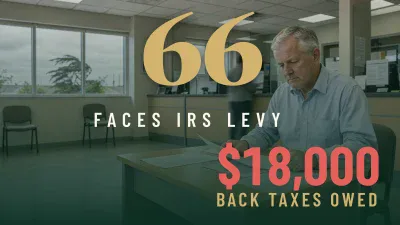
Frank is 66, and as he does every month, he opens his banking app on the morning his Social Security deposit usually lands, and the number’s short by about $311. Nothing in today’s mail explains it, because the letters came months ago. He just didn’t open them.
He owes the IRS $18,000 in back taxes, and the agency has started taking a cut of every check. It’s a common spot for retirees who fell behind during their working years or stopped having tax withheld once paychecks turned into benefit deposits. The levy has started, but you can still stop it.
How the IRS Gets Into a Social Security Check
It’s called the Federal Payment Levy Program. A levy is the IRS legally taking money you’re owed instead of waiting for you to pay. Under federal law, a continuous levy can attach to up to 15% of each qualifying federal payment, and it stays on every month until the IRS releases it.
It comes with advance warning. The IRS has to send written notice at least 30 days before the first levy, and that notice must explain your right to a hearing, per 26 U.S.C. § 6330(a). That letter often comes as a CP90, which the IRS describes as notice of its intent to levy along with the right to a Collection Due Process hearing. For Social Security levies, the IRS also sends Notice CP91, giving taxpayers another 30 days to resolve the debt before withholding begins, but that notice doesn’t restart the earlier hearing deadline.
Supplemental Security Income is treated differently. The 15% levy applies only to federal payments not based on the payee’s income or assets, and SSI eligibility is based on exactly that. So SSI falls outside it.
What a 15% Levy Does to an Average Check
The average retired worker’s benefit is $2,071 a month after the 2026 cost-of-living adjustment. We can assume Frank gets that, so a full 15% levy takes about $311 a month. At that rate, before interest and penalties, it would take roughly 58 months to cover his balance.
Now compare a payment plan. Long-term payment plans are generally available to taxpayers owing $50,000 or less, including penalties and interest. Under current IRS rules, taxpayers must generally pay the balance before the collection deadline, not within a fixed 72-month period. Spread $18,000 over 72 months, and the payment is $250 before interest.
| Option | Monthly Cost | Who Sets It |
|---|---|---|
| 15% levy on a $2,071 check | About $311 | The IRS |
| 72-month plan on $18,000 | $250 plus interest | You, within IRS limits |
The retiree tax trap is wider than most people see. We mapped the IRS rules that quietly drain six-figure amounts from retirement accounts in a free guide here. A payment plan may give him more monthly breathing room than the levy, depending on the payment amount the IRS approves.
Why a Payment Plan Should Be Your First Call
Under 26 U.S.C. § 6343(a)(1)(C), the IRS has to release a levy once you’ve entered an installment agreement, unless the agreement says otherwise. For most people owing around $18,000, the move is simple. Call the number on the notice or apply online, set up the plan, and ask for the levy release in the same conversation. Interest and penalties keep running until the balance hits zero, so pay extra when you can.
If Even $250 a Month Is Too Much
Ask for currently not collectible status. That’s the IRS agreeing to pause collection because you can’t cover basic costs. Treasury rules say a levy must come off if it leaves you unable to pay “reasonable basic living expenses”, considering your age, housing, medical costs and local cost of living. You’ll usually prove it with a financial statement such as Form 433-F, often by phone. The debt stays on the books while collection pauses.
An offer in compromise, filed on Form 656, lets you settle for less than the full balance. It fits mainly when your income and assets can’t realistically cover the debt. Both options can also be raised at a Collection Due Process hearing under 26 U.S.C. § 6330(c)(2)(A)(iii).
There’s also a clock, as the IRS generally gets 10 years from assessment to collect. Don’t build a strategy around running it out unless your finances are truly tapped.
Stop Next Year’s Tax Bill Before It Starts
Social Security won’t withhold federal income tax unless you ask. You do that by filing Form W-4V. If you’d rather not, quarterly estimated payments work too. The IRS’s general rule is that you need them if you expect to owe at least $1,000 after withholding and credits.
One Envelope You Can’t Leave Sealed
Never ignore the final notice of intent to levy. It opens your 30-day window to request a hearing, and a timely request suspends the levy while it’s pending. Miss that window, and the IRS can start taking up to 15% of every check until the debt is settled.
Contact [email protected] for any questions or corrections.
David Beren has been a Flywheel Publishing contributor since 2022. Writing for 24/7 Wall St. since 2023, David loves to write about topics of all shapes and sizes. As a technology expert, David focuses heavily on consumer electronics brands, automobiles, and general technology. He has previously written for LifeWire, formerly About.com. As a part-time freelance writer, David’s “day job” has been working on and leading social media for multiple Fortune 100 brands. David loves the flexibility of this field and its ability to reach customers exactly where they like to spend their time. Additionally, David previously published his own blog, TmoNews.com, which reached 3 million readers in its first year. In addition to freelance and social media work, David loves to spend time with his family and children and relive the glory days of video game consoles by playing any retro game console he can get his hands on.