How Much Does a 60-Year-Old Need Invested to Replace a $125,000 Salary With Dividends and Never Sell a Share?

This post may contain links from our sponsors and affiliates, and Flywheel Publishing may receive compensation for actions taken through them.
Picture a 60-year-old who just stopped drawing a $125,000 salary and has set one rule for retirement: never part with a single stock. The idea is to live only on the dividends and fund payouts, so a bad market never forces a sale at the bottom. Below, we test that rule on an income portfolio with six holdings, with every yield pulled on November 9, 2026.
How Big the Portfolio Needs to Be
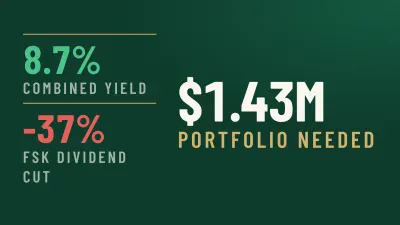
Combined at the weights below, these six holdings yield about 8.7%, with yield being the yearly payout divided by the price. At that rate, generating $125,000 a year before taxes takes about $1.43 million invested. Replacing the $125,000 in take-home income may require more.
On the other hand, age helps here: once you’re past 59½, withdrawals from a traditional IRA skip the 10% additional tax on early distributions. Regular income tax still applies, though.
Goldman Sachs Nasdaq-100 Premium Income ETF
Goldman Sachs Nasdaq-100 Premium Income ETF (NASDAQ:GPIQ) owns Nasdaq-100 stocks and sells call options against them. A call option pays the fund cash today, and in return the fund gives up gains above a set price. It gets 20% of the money, yields about 10.7%, and supplies about 25% of the income. Option funds can mail big checks while their share prices slip. GPIQ dropped about 8% over the past month, and its monthly checks ran from $0.43 to $0.52 per share this year.
Amplify CWP Growth & Income ETF
Amplify CWP Growth & Income ETF (NYSEARCA:QDVO) launched in August 2024. It owns large growth stocks and writes calls on some of them for income. It gets 15% of the money, yields about 11.6%, and supplies about 20% of the income. Its track record covers barely two years, and none of it includes a deep bear market. Shares fell about 7% in the past month.
STAG Industrial
STAG Industrial (NYSE:STAG) rents out single-tenant warehouses, and 96% of its operating portfolio is leased. It gets 15% of the money, yields about 4.2%, and supplies about 7% of the income. STAG was a longtime monthly payer, but its 2026 records show quarterly checks of $0.3875, compared with $0.124 a month in 2025. Plan your budget around longer gaps between checks.
FS KKR Capital
FS KKR Capital (NYSE:FSK | FSK Price Prediction) operates as a BDC. It lends to midsize private companies and passes the interest along to shareholders. It gets 15% of the money, yields about 14.8% on its regular payout, and supplies about 26% of the income.
FS KKR cut its dividend this year. It paid $0.70 a quarter through 2025, then $0.48, $0.42 and $0.44 in 2026, which works out to a 37% cut. A cut that size today would trim about $11,800 a year off this portfolio’s income, or about 9%. Chief executive Michael Forman put it simply: “We expect our quarterly distribution level will fluctuate as our net investment income varies on a quarter-to-quarter basis.”
ONEOK
ONEOK (NYSE:OKE) runs a roughly 60,000-mile pipeline network. It’s organized as a regular corporation, so you won’t have to deal with partnership tax forms. It gets 15% of the money, yields about 4.9%, and supplies about 9% of the income. This holding is the portfolio’s raise. ONEOK’s quarterly dividend rose from $0.935 in 2022 to $1.07 today, and S&P and Fitch upgraded its credit to BBB+.
iShares iBoxx $ High Yield Corporate Bond ETF
The iShares iBoxx $ High Yield fund (NYSEARCA:HYG) holds junk bonds, meaning loans to companies with weaker credit. It gets 20% of the money, yields about 6.2%, and supplies about 14% of the income. In a recession, some of those borrowers stop paying, and its price and income can fall together. Its monthly checks already ran from $0.34 to $0.44 per share this year.
Building a Cushion So the Rule Holds
The $1.43 million target assumes every payout holds, and this portfolio’s own history shows they don’t. A cash reserve sized to two years of an FS KKR-style hit comes to about $23,700, and that covers just one holding struggling.
The habit that makes the never-sell rule work is a cash reserve. Put surplus payouts into it in good years. Draw on it in the years checks shrink, so you never need to sell holdings to cover the gap (we walked through the full dividend ladder built around that same rule in a free guide).
Contact [email protected] for any questions or corrections.
David Beren has been a Flywheel Publishing contributor since 2022. Writing for 24/7 Wall St. since 2023, David loves to write about topics of all shapes and sizes. As a technology expert, David focuses heavily on consumer electronics brands, automobiles, and general technology. He has previously written for LifeWire, formerly About.com. As a part-time freelance writer, David’s “day job” has been working on and leading social media for multiple Fortune 100 brands. David loves the flexibility of this field and its ability to reach customers exactly where they like to spend their time. Additionally, David previously published his own blog, TmoNews.com, which reached 3 million readers in its first year. In addition to freelance and social media work, David loves to spend time with his family and children and relive the glory days of video game consoles by playing any retro game console he can get his hands on.