How to Build $9,800 a Month in Dividend Income Without Selling a Single Share

This post may contain links from our sponsors and affiliates, and Flywheel Publishing may receive compensation for actions taken through them.
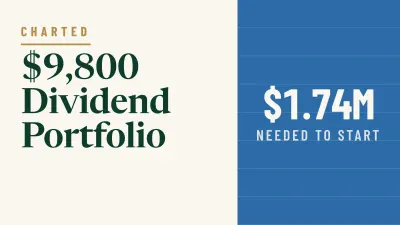
Picture a retiree who wants $9,800 to land in checking every month and never wants to sell a share to get it. That works out to $117,600 a year, paid entirely by what the portfolio throws off in cash.
Living only on payouts matters most when markets fall. If you sell shares to pay bills during a crash, you lock in losses and shrink what’s left to recover. Spending only the payouts lets the shares ride out the drop (the whole point of a dividend ladder, which we walk through step by step in a free guide here). The trade-off: companies and funds can cut payouts, and share prices can still fall.
The mix uses six holdings at fixed weights. Yield here means the annual payout divided by each share’s cost, using prices from the first week of November 2026. Combined, the portfolio yields about 6.8%.
ProShares S&P 500 High Income ETF
ProShares S&P 500 High Income ETF (CBOE:ISPY) owns S&P 500 stocks and sells options on the index daily. Selling an option means you collect a fee now and give up some upside if stocks rally. It gets a 20% weight, with a yield around 6.2% and roughly 18% of the income coming from it.
The one thing to know: the checks swing. Monthly payouts in 2026 ran from $0.21 to $0.30 per share. Shares have held up, rising 8% over the past year.
iShares Core High Dividend ETF
iShares Core High Dividend ETF (NYSEARCA:HDV) screens for financially healthy large companies paying high dividends. At a 15% weight, it yields about 4.2% on its latest payout and supplies about 9% of the income. Fees are tiny at 0.08% a year.
Payouts now come monthly, and amounts vary. Recent checks ranged from $0.056 to $0.106 per share.
LTC Properties
LTC Properties (NYSE:LTC) is a property trust that owns senior housing and skilled nursing properties. Shareholders get $0.19 every month, or $2.28 a year. That’s a 5.1% yield at a 15% weight, which is about 11% of the income. The one thing to know: the payout hasn’t grown since 2017. Coverage looks solid, though. Management expects core funds from operations, a REIT’s cash earnings measure, of $2.76 to $2.78 per share this year.
Blue Owl Capital Corporation
Blue Owl Capital Corporation (NYSE:OBDC | OBDC Price Prediction) is a business development company that lends to midsize U.S. companies and returns most of the interest to shareholders. The payout runs about 11.3%. Its 15% weight supplies roughly 25% of the income, the biggest share of any holding.
Blue Owl cut its regular quarterly dividend from $0.37 in 2025 to $0.31 in 2026. Third-quarter adjusted net investment income of $0.33 per share covers the new base. About 96% of its loans carry floating rates, so falling rates would shrink income.
United Parcel Service
United Parcel Service (NYSE:UPS) pays $1.64 per quarter, or $6.56 a year. That’s a 6.1% yield on a 15% weight, worth about 13% of the income.
The one thing to know: the dividend is effectively frozen. It rose a cent from $1.63 in 2024 and hasn’t moved since. The payout eats about 90% of the $7.28 in adjusted earnings per share management expects this year, and dividends of $5.4 billion sit close to $6.1 billion of free cash flow.
State Street SPDR Portfolio High Yield Bond ETF
State Street SPDR Portfolio High Yield Bond ETF (NYSEARCA:SPHY) owns junk bonds, which are loans to companies with weaker credit. The payout runs about 7.6%, well above the 4.8% 10-year Treasury. Its 20% weight covers about 22% of the income.
The one thing to know: in a recession, more of these borrowers default, and the fund’s price drops. Payouts have stayed steady, ranging from $0.136 to $0.142 per share per month this year.
Sizing the Portfolio and Keeping It Paid
At a 6.8% combined yield, you’d need about $1.74 million to collect $9,800 a month. That puts roughly $348,000 in each 20% holding and $261,000 in each 15% holding. Blue Owl, the junk bond fund, and the options fund together supply about 66% of the income. Those are the paychecks most likely to shrink.
One practice keeps the plan working: once a year, check each payer’s coverage. Compare Blue Owl’s net investment income, LTC’s operating cash flow, and UPS’s free cash flow against what each pays out. When coverage slips, you’ll see a cut coming before it hits your checking account.
Contact [email protected] for any questions or corrections.
David Beren has been a Flywheel Publishing contributor since 2022. Writing for 24/7 Wall St. since 2023, David loves to write about topics of all shapes and sizes. As a technology expert, David focuses heavily on consumer electronics brands, automobiles, and general technology. He has previously written for LifeWire, formerly About.com. As a part-time freelance writer, David’s “day job” has been working on and leading social media for multiple Fortune 100 brands. David loves the flexibility of this field and its ability to reach customers exactly where they like to spend their time. Additionally, David previously published his own blog, TmoNews.com, which reached 3 million readers in its first year. In addition to freelance and social media work, David loves to spend time with his family and children and relive the glory days of video game consoles by playing any retro game console he can get his hands on.