A 70-Year-Old Swapped O for ADC in a $1.03 Million Income Portfolio. Here’s What Happened to Her $5,650 Monthly Paycheck
Two monthly-paying REITs look nearly identical on paper, yet one retiree is betting her income on swapping a giant for a smaller rival. What does she gain, what does she give up, and does her paycheck survive?

This post may contain links from our sponsors and affiliates, and Flywheel Publishing may receive compensation for actions taken through them.
A 70-year-old retiree owns shares in two monthly dividend-paying REITs that look identical on paper, and she wants to know whether they really are.
She’s a prime example of someone in this situation, with a $1.03 million income portfolio that needs to produce $5,650 a month. Based on her research, her new plan is to sell Realty Income (NYSE:O) and buy Agree Realty (NYSE:ADC) with a matching 15% allocation.
Switching Realty Income for Agree Realty
Both companies are net lease REITs. They own buildings and rent each to a single tenant on a long lease, and the tenant pays property taxes, insurance, and maintenance, so the landlord mostly collects rent.
Realty Income is the giant, worth about $56.2 billion and expanding into Europe and data centers. Agree is worth about $9.1 billion and sticks to U.S. retailers like Walmart and Tractor Supply.
It’s 99.8% occupied, and about 65% of its rent comes from investment-grade tenants, meaning companies with strong credit. S&P rates it at BBB+. Agree’s net debt runs at 4.8x annual cash earnings, or 3.9x after accounting for anticipated equity proceeds, compared with about 5.4x at Realty Income.
On dividends, Realty Income pays more today. It yields 5.5% and just made its 116th consecutive quarterly increase, but its monthly payment is up less than 1% from a year ago. Agree yields 4.7%, and its $0.271 monthly payment is up 3%.
Both payouts look well covered. Agree paid out about 69% of its AFFO (a REIT’s version of cash earnings). Realty Income’s dividend equals about 73% of its 2026 AFFO guidance midpoint.
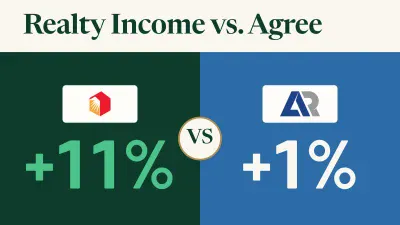
Over the past year, Realty Income’s adjusted share price rose about 11%, while Agree’s rose about 1%.
Her 15% stake is worth $154,500. In Realty Income, it pays about $710 a month. In Agree, it pays about $599. Her total monthly income slips from roughly $6,344 to $6,233. Both versions still clear the $5,650 target.
A lower yield can still be the better trade if the dividend grows faster. Each raise builds on the last. Agree’s recent raises have outpaced Realty Income’s, though nothing guarantees that will continue. Both land in the small club of monthly payers (we rounded up seven of our favorites in a free report here).
Taxable Account or IRA?
Inside an IRA, the sale doesn’t trigger a taxable event. In a taxable account, selling Realty Income locks in a gain or loss against what she paid.
Her broker reports the sale on Form 1099-B. Most REIT dividends don’t get the lower qualified-dividend tax rates. The qualified business income deduction cushions that by letting her deduct 20% of qualified REIT dividends.
Goldman Sachs Nasdaq-100 Premium Income ETF
Nasdaq-100 stocks like NVIDIA and Apple fill Goldman Sachs Nasdaq-100 Premium Income ETF (NASDAQ:GPIQ). The fund sells call options, which means it gives up some upside in exchange for cash now. Her 15% stake yields about 11.0%. Each month the payout changes: the latest was about 47 cents, down from about 51 cents.
Amplify CWP International Enhanced Dividend Income ETF
Foreign dividend payers like TSMC and Bank of Montreal make up Amplify CWP International Enhanced Dividend Income ETF (NYSEARCA:IDVO). The fund writes options on some positions. At 15% of her money, it yields about 6.2%. Its monthly payout has climbed from about 16 cents in early 2025 to about 20 cents.
Carlyle Secured Lending
Carlyle Secured Lending (NASDAQ:CGBD) is a fund that lends to middle-market companies, mostly backed by private equity. Her 15% stake yields about 12.5%. Its quarterly dividend, though, has dropped from $0.48 in early 2024 to $0.35.
Enbridge
Canadian pipeline operator Enbridge (NYSE:ENB | ENB Price Prediction) fills 15% of the portfolio and yields about 5.9%. Because it pays in Canadian dollars, her quarterly check in U.S. dollars slipped from about 71 cents in February to about 70 cents.
In a taxable account, Canada deducts 15%, and she may be able to claim a U.S. credit or deduction. U.S. retirement accounts like IRAs are generally exempt under the tax treaty.
iShares iBoxx $ Investment Grade Corporate Bond ETF
Corporate bonds from issuers like Amazon and AT&T (NYSE:T) make up iShares iBoxx $ Investment Grade Corporate Bond ETF (NYSEARCA:LQD), her 15% bond piece. It yields about 4.6%. Bond prices fall when interest rates rise. Its adjusted price is down about 5% over five years, and the 10-year Treasury yield stands at 4.8%.
AT&T
AT&T fills the final 10% and yields about 5.1%. In 2022, it cut its quarterly dividend from $0.52 to $0.2775, and the payout hasn’t changed since. Management expects $18 billion+ in free cash flow this year to support it.
What the Swap Did to Her Paycheck
Before you switch any income-holding, compare each dividend’s growth rate with today’s yield. She’s giving up about $111 a month today in exchange for Agree’s stronger recent dividend growth. Whether that trade pays off over the next decade depends on how quickly each company raises its dividend.
Contact [email protected] for any questions or corrections.
David Beren has been a Flywheel Publishing contributor since 2022. Writing for 24/7 Wall St. since 2023, David loves to write about topics of all shapes and sizes. As a technology expert, David focuses heavily on consumer electronics brands, automobiles, and general technology. He has previously written for LifeWire, formerly About.com. As a part-time freelance writer, David’s “day job” has been working on and leading social media for multiple Fortune 100 brands. David loves the flexibility of this field and its ability to reach customers exactly where they like to spend their time. Additionally, David previously published his own blog, TmoNews.com, which reached 3 million readers in its first year. In addition to freelance and social media work, David loves to spend time with his family and children and relive the glory days of video game consoles by playing any retro game console he can get his hands on.