How Much Does a 65-Year-Old Need in a Roth IRA to Collect $7,700 a Month Tax-Free Without Selling a Single Share?

This post may contain links from our sponsors and affiliates, and Flywheel Publishing may receive compensation for actions taken through them.
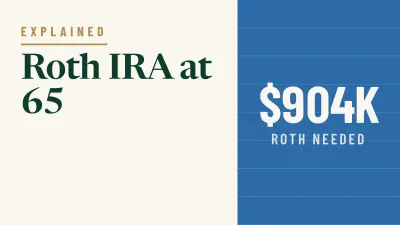
A 65-year-old filling out Medicare paperwork learns quickly that income sets the premium. Traditional IRA withdrawals land on the tax return and can push that premium higher. Qualified Roth IRA withdrawals stay off the return entirely. That makes a Roth paying $7,700 a month, or $92,400 a year, about the clearest retirement income there is. Covering the whole amount with six income funds and stocks, without selling shares, takes a Roth of about $904,000.
Why Tax-Free Income Counts More at 65
Federal law says a qualified Roth distribution “shall not be includible in gross income” under 26 U.S.C. § 408A(d)(1). That keeps it out of the income Medicare uses for its surcharge, called IRMAA, and out of the formula that determines how much of your Social Security gets taxed.
Standard Part B costs $202.90 a month in 2026. For single filers, those with income over $109,000 pay $284.10, plus a $14.50 Part D surcharge. For joint filers, the first tier starts over $218,000.
Suppose that $92,400 came from a traditional IRA instead, on top of the average retirement benefit of $2,170 a month after the 2027 raise. With that much other income, up to 85% of benefits become taxable, or $22,134. That puts modified adjusted gross income at roughly $114,534, above the 2026 IRMAA threshold of $109,000 for single filers, although Medicare generally uses income from two years earlier to determine premiums.
Roth withdrawals only qualify after age 59½ and once five years have passed since your first Roth contribution, per 26 U.S.C. § 408A(d)(2).
How Big the Roth Needs to Be
Using current prices and payouts, the weighted portfolio yields about 10.2%. Divide $92,400 by that yield, and you need about $904,000.
JPMorgan Nasdaq Equity Premium Income ETF
JPMorgan Nasdaq Equity Premium Income ETF (NASDAQ:JEPQ) holds Nasdaq-100 stocks and sells call options on them, giving up some upside for cash today. At 25%, it’s the largest weight. A $6.47 annualized payout on $55 shares works out to roughly 11.7%, or about $26,400 a year. Payments swing monthly: $0.70 in August, $0.54 in November.
Eaton Vance Tax-Managed Diversified Equity Income Fund
Eaton Vance Tax-Managed Diversified Equity Income Fund (NYSE:ETY) is a closed-end fund: a fixed pool of shares trading on an exchange, so the price can run above or below the holdings’ value. It holds stocks and writes index options. Weighted at 15%, it just raised its monthly payout to $0.1094 from $0.0992. That’s about 9.7% on $14 shares, or $13,100 a year. Its tax management adds nothing inside a Roth, which already shields every dollar.
VICI Properties
VICI Properties (NYSE:VICI) holds casinos like Caesars Palace and MGM Grand, with tenants covering taxes, insurance, and maintenance. At 15%, its $1.84 forward dividend on $25 shares yields about 7.4%, roughly $10,000 a year. September’s raise was its ninth consecutive annual increase. Its two largest tenants supply 38% and 32% of rent.
Capital Southwest
One class of lender funds midsize private firms and passes most income to shareholders. Capital Southwest (NASDAQ:CSWC) is one, weighted at 15%. Its trailing $2.56 (monthly payouts plus supplements) yields about 10.8% on $24 shares, or $14,700. Pre-tax net investment income of $0.58 matched the $0.58 quarterly dividend, with $0.92 per share of retained income as a cushion.
Virtus Stone Harbor Emerging Markets Income Fund
Virtus Stone Harbor Emerging Markets Income Fund (NYSE:EDF) is a closed-end fund holding bonds from developing economies. At 10%, its $0.72 annual payout on $4.50 shares yields about 15.9%, or $14,400. It once paid $0.18 a month, so cuts happen. Its shareholder reports list current borrowing and discounts.
Cohen & Steers Infrastructure Fund
Utilities, pipelines and towers fill Cohen & Steers Infrastructure Fund (NYSE:UTF), which borrows to lift income. Its $1.98 payout yields about 7.7% at $26, or $13,800 at a 20% weight. Monthly notices identify the sources of distributions, and through
What This Income Avoids
Before counting on any of it, confirm the Roth is qualified: past 59½ and five years since your first contribution. Then watch each fund’s payout notices. One cut means $904,000 no longer covers the target, though qualified withdrawals still won’t lift Part B above $202.90. A setup like this lets you live off the checks while the shares stay put, and we walked through how to build that kind of dividend ladder in a free guide here.
Contact [email protected] for any questions or corrections.
David Beren has been a Flywheel Publishing contributor since 2022. Writing for 24/7 Wall St. since 2023, David loves to write about topics of all shapes and sizes. As a technology expert, David focuses heavily on consumer electronics brands, automobiles, and general technology. He has previously written for LifeWire, formerly About.com. As a part-time freelance writer, David’s “day job” has been working on and leading social media for multiple Fortune 100 brands. David loves the flexibility of this field and its ability to reach customers exactly where they like to spend their time. Additionally, David previously published his own blog, TmoNews.com, which reached 3 million readers in its first year. In addition to freelance and social media work, David loves to spend time with his family and children and relive the glory days of video game consoles by playing any retro game console he can get his hands on.