The Roth Conversion Mistake That Turns $6,175 a Month Tax-Free Into a Five-Figure Tax Bill

This post may contain links from our sponsors and affiliates, and Flywheel Publishing may receive compensation for actions taken through them.
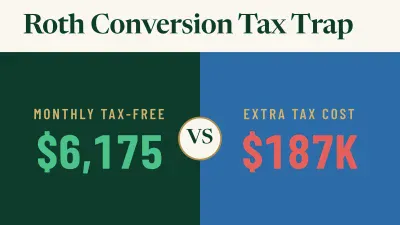
Picture a retired couple who decides to convert their entire traditional IRA to a Roth this year so they can “get it over with.” Their goal is $6,175 a month in tax-free income for life. The goal is reasonable. Doing the whole conversion in one year is the expensive part. Below you’ll find what that income requires, the six holdings built to produce it, and what the one-year shortcut costs.
What $6,175 a Month Requires Inside a Roth
The total comes to $74,100 a year. At mid-November prices, the six-holding portfolio below yields about 6.5%. Divide $74,100 by 0.065, and you get roughly $1.14 million in Roth money.
Converting It All at Once Costs About $187,000 More
A conversion moves money from a traditional IRA into a Roth. The amount you convert counts as taxable income in that year (26 U.S.C. § 408A(d)(3)(A)(i))[1]. We’ll assume a married couple with no other income who takes the $32,200 standard deduction under 2026 brackets.
If they convert $1.14 million in one year, the federal bill comes to about $331,000. The top portion of that income gets taxed at 37%. If they instead convert about $189,500 a year for six years, their highest federal income tax rate is 22%, assuming 2026 brackets and deductions remain unchanged. That costs roughly $24,000 a year, or about $144,000 in total. The gap is about $187,000.
Three IRS rules make the one-year version hard to fix later. Since 2018, you can’t undo a conversion by recharacterizing it (Publication 590-A). If you pay the tax out of the IRA itself, the withheld money never reaches the Roth, and before age 59½ that withheld amount can also face a 10% additional tax. Each conversion also starts its own 5-year clock before you can withdraw it penalty-free if you’re under 59½.
Medicare piles on while Social Security sets premiums from the most recent tax return the IRS sends it (SSA)[2], which generally means income from two years earlier. Joint income above $750,000[3] adds $487 a month to each spouse’s Part B premium, plus $91 for Part D. Conversions of $189,500 stay under the first surcharge threshold of $218,000[3]. We’ve covered Roth withdrawal and rollover mistakes before. This one happens at the conversion itself.
ProShares S&P 500 High Income ETF
ProShares S&P 500 High Income ETF (CBOE:ISPY) holds S&P 500 exposure and sells one-day call options, which are contracts that pay it cash in exchange for giving up gains above a set price. Weight: 20%. Yield: 6.1%. Income: about $13,800. Be aware that monthly payouts swing from $0.21 to $0.30 per share this year.
Invesco S&P Ultra Dividend Revenue ETF
Invesco S&P Ultra Dividend Revenue ETF (NYSEARCA:RDIV) owns the 60 highest-yielding S&P 900 stocks, weighted by revenue. Weight: 20%. Yield: 3.3%. Income: about $7,500. Know this: it has the lowest yield of the six, but its price is up 188% over ten years.
National Health Investors
National Health Investors (NYSE:NHI) is a REIT that owns senior housing and medical facilities. Weight: 15%. Yield: 6.0%. Income: about $10,200. Know this: it just raised its quarterly dividend to $0.94, but that’s still below the $1.1025 it paid in 2020.
New Mountain Finance
New Mountain Finance (NASDAQ:NMFC) operates as a fund that lends to midsize private companies. Weight: 15%. Yield: 14.9%. Income: about $25,500, the largest share. Know this: it cut its quarterly payout from $0.32 to $0.25 in June, and per-share NAV dropped to $10.67[4].
TC Energy
TC Energy (NYSE:TRP | TRP Price Prediction) is a Canadian pipeline company that moves natural gas across North America. Weight: 15%. Yield: 3.9%. Income: about $6,600. The Canada-U.S. tax treaty treats U.S. IRAs as exempt, so a Roth generally gets the full dividend. A taxable account typically loses 15% to Canadian withholding.
Janus Henderson B-BBB CLO ETF
Janus Henderson B-BBB CLO ETF (CBOE:JBBB) buys lower-rated slices of collateralized loan obligations, which are pools of business loans. These slices take losses before the safer slices above them do. Weight: 15%. Yield: 6.2%. Income: about $10,500. Know this: the loans carry floating rates, so payouts follow short-term rates. The monthly payout slid from $0.38 in May 2025 to $0.24 recently.
Size This Year’s Conversion Before Anything Else
You need about $1.14 million in a Roth to fund $6,175 a month. Converting it all in one year costs roughly $187,000 more in federal tax than spreading it over six years. Your first decision is how much fits in this year’s bracket. For joint filers, the 22% bracket ends at $211,400 of taxable income, and that’s measured after the standard deduction. Add up your pensions, Social Security, and other income first.
Then limit the conversion using both your remaining tax-bracket room and Medicare’s modified adjusted gross income rules; a 2026 conversion generally affects 2028 premiums, whose surcharge thresholds are not yet established.
Contact [email protected] for any questions or corrections.
David Beren has been a Flywheel Publishing contributor since 2022. Writing for 24/7 Wall St. since 2023, David loves to write about topics of all shapes and sizes. As a technology expert, David focuses heavily on consumer electronics brands, automobiles, and general technology. He has previously written for LifeWire, formerly About.com. As a part-time freelance writer, David’s “day job” has been working on and leading social media for multiple Fortune 100 brands. David loves the flexibility of this field and its ability to reach customers exactly where they like to spend their time. Additionally, David previously published his own blog, TmoNews.com, which reached 3 million readers in its first year. In addition to freelance and social media work, David loves to spend time with his family and children and relive the glory days of video game consoles by playing any retro game console he can get his hands on.