The 401(k) Rollover Mistake That Turns a $4,575 Monthly Paycheck Into a Tax Bill

This post may contain links from our sponsors and affiliates, and Flywheel Publishing may receive compensation for actions taken through them.
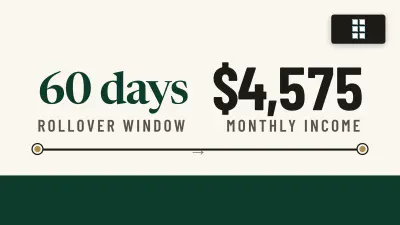
A new retiree asks her old 401(k) plan to cut her a check so she can move the money into an IRA. The check comes, and it’s smaller than her balance. That gap is one of the priciest parts of retirement paperwork. It hurts most when the account has to pay $54,900 a year, or $4,575 a month, from an income portfolio of six holdings.
Why a Paid-to-You Rollover Arrives a Fifth Short
When a plan pays a rollover to you, the payer generally has to withhold 20% for federal income tax. That applies even if you plan to roll over every dollar. It’s set in law at 26 U.S.C. § 3405(c)(1)(B)[1]. This method is called an indirect rollover.
The full pre-withholding amount still has to reach an IRA within 60 days. The IRS says you “can make up the amount withheld with funds from other sources”. Whatever you don’t deposit gets taxed as income. If you’re under 59½, you may also owe an extra 10% tax under 26 U.S.C. § 72(t)[2].
Here’s the math with this portfolio. It takes about $798,000 to produce the income. A paid-to-you rollover deducts $159,600, so the check comes to $638,400. If she can’t come up with $159,600 from savings within 60 days, that amount becomes taxable income.
A direct rollover skips all of this as the plan sends the money straight to the IRA custodian, and you can avoid withholding completely (§ 3405(c)(2)[1]). We’ve covered the once-a-year IRA rollover rule and the risk of rolling over too early. Withholding catches people who get everything else right.
Six Holdings, One Blended Yield
The weights are 20% for the covered-call fund, 20% for the dividend ETF, 15% for the real estate investment trust (REIT), 15% for the business development company (BDC) fund, 15% for the bank, and 15% for the ultra-short fund. The blended yield is about 6.9%, which puts the balance needed at roughly $798,000.
Eaton Vance’s Covered-Call Fund Just Raised Its Monthly Payout
Eaton Vance Tax-Managed Buy-Write Opportunities Fund (NYSE:ETV) holds large-cap stocks and writes call options against them for extra income. It’s a closed-end fund, which means it has a fixed number of shares. So its market price can sit above or below what its holdings are worth (a premium or a discount). It pays about 9.5% and generates roughly $15,100 in income. Its monthly distribution just rose to $0.11 from $0.10. One thing to know: check the fund’s distribution notices for return of capital (your own money handed back), and compare the price with its net asset value before buying.
Invesco’s Dividend Achievers Fund Pays Every Month
Invesco High Yield Equity Dividend Achievers ETF (NASDAQ:PEY) holds high-yielding U.S. stocks with a record of raising dividends and pays monthly. Its yield is about 4.8%, based on its annualized forward payout, and it delivers around $7,600. Expect variability: payouts move around from month to month, from $0.07 up to $0.10 this year.
Kimco Realty Collects Rent From Grocery-Anchored Centers
Kimco Realty (NYSE:KIM) owns grocery-anchored shopping centers with tenants like Publix, Walmart, and Costco. It pays about 4.4% and generates about $5,300. The quarterly dividend rose from $0.24 in 2024 to $0.28[3], and occupancy hit a record 97%. Keep the history in mind: Kimco cut the payout to $0.10 in 2020.
VanEck’s BDC Fund Supplies the Biggest Slice of Income
VanEck BDC Income ETF (NYSEARCA:BIZD) holds business development companies, which lend to midsize private businesses. It pays about 14.0% and produces the biggest piece, about $16,800. Payouts swing: $0.24 in July, then $0.44 in October. The one thing to know: read the prospectus fee table, including acquired fund fees, because each BDC it owns charges its own expenses on top of the ETF’s fee.
Truist Financial Holds Its Quarterly Payout Steady
Truist Financial (NYSE:TFC | TFC Price Prediction) is a regional bank yielding about 4.2%, which adds roughly $5,000. It has paid $0.52 per share per quarter since 2023. The catch: the payout hasn’t grown since then, while Truist spends heavily on buybacks and balance-sheet cleanup, including a $1.4B pre-tax loss[4] on securities sales last quarter.
JPMorgan’s Ultra-Short Fund Serves as the Cash Cushion
JPMorgan Ultra-Short Income ETF is the cash buffer. It holds very short-term bonds and yields about 4.3%, adding roughly $5,100. Its income falls when short-term rates fall. Its monthly distribution went from $0.23 in August 2024 to $0.18 now.
One Sentence That Protects $159,600
If you want to see how the full paycheck-from-savings approach fits together, from holding mix to payout calendar, we laid it out in a free guide here. Give your old plan one instruction: send it as a direct rollover.
Contact [email protected] for any questions or corrections.
David Beren has been a Flywheel Publishing contributor since 2022. Writing for 24/7 Wall St. since 2023, David loves to write about topics of all shapes and sizes. As a technology expert, David focuses heavily on consumer electronics brands, automobiles, and general technology. He has previously written for LifeWire, formerly About.com. As a part-time freelance writer, David’s “day job” has been working on and leading social media for multiple Fortune 100 brands. David loves the flexibility of this field and its ability to reach customers exactly where they like to spend their time. Additionally, David previously published his own blog, TmoNews.com, which reached 3 million readers in its first year. In addition to freelance and social media work, David loves to spend time with his family and children and relive the glory days of video game consoles by playing any retro game console he can get his hands on.