How Much Does a 59-Year-Old Need in a 401(k) Rollover to Collect $8,200 a Month for Life Without Buying an Annuity?

This post may contain links from our sponsors and affiliates, and Flywheel Publishing may receive compensation for actions taken through them.
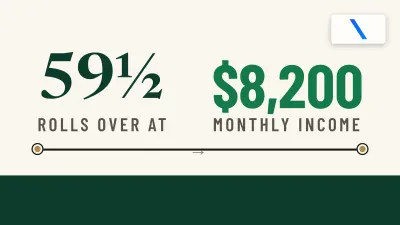
Picture a 59-year-old who just left a long career. A 401(k) rollover form sits on the kitchen table, and an insurance agent has pitched an annuity that promises a lifetime check. The goal is $8,200 a month, or $98,400 a year, paid by investments the retiree still owns.
About $1.27 Million at a 7.7% Yield
At current prices and payouts, the seven-holding mix below yields about 7.7%. Divide $98,400 by that yield, and the rollover needs roughly $1.27 million. Yield here means a year of current payouts divided by today’s price. It shifts whenever either one moves.
Wait for Age 59½ Before Rolling Over
At 59, the retiree is a few months short of the age when withdrawals escape the 10% early withdrawal penalty: age 59½. Until then, the 401(k) has an edge. Federal law waives the penalty on plan withdrawals for someone who leaves the job after reaching age 55, but that exception doesn’t apply to IRAs.
If everything goes into an IRA at 59, any withdrawal before 59½ can trigger the penalty. Wait for the half-birthday to roll over, or leave enough in the plan to cover living costs until then. When the money moves, a direct rollover (plan pays the IRA custodian) avoids withholding. A check made out to the retiree carries 20% withholding, and the full amount must be redeposited within 60 days, with other cash covering the withheld part.
What an Annuity Guarantees That Dividends Can’t
An immediate annuity swaps a lump sum for a fixed check that keeps coming no matter how long the buyer lives or what markets do. Payout rates depend on age, sex, and interest rates, so it pays to compare quotes from several insurers. Dividends come with no such promise and can be cut. In exchange, the dividend route keeps the principal, leaves room to change course and leaves something for heirs (that is the whole case for a dividend ladder, which we walked through in a free guide here).
NEOS S&P 500 High Income ETF
NEOS S&P 500 High Income ETF (CBOE:SPYI) holds S&P 500 stocks like Apple and Microsoft and sells index options against them, which turns option premiums into monthly payouts. It gets 20% of the rollover, yields about 11.7% and supplies roughly 30% of the income. Selling options limits the upside when stocks rally hard.
Schwab US Dividend Equity ETF
Schwab US Dividend Equity ETF (NYSEARCA:SCHD) owns established dividend payers such as Merck, Amgen, and Coca-Cola. At a 15% weight and about a 3.0% yield, it supplies roughly 6% of the income. Shares gained 38% over the past year, and that rally pushed the yield down. Payouts also bounce around from quarter to quarter.
Essential Properties Realty Trust
Essential Properties Realty Trust (NYSE:EPRT) owns buildings leased long term to car washes, child care centers, and quick-service restaurants, and the tenants cover most property costs. It carries a 15% weight, yields about 4.5%, and supplies about 9% of the income. Over the past year, it raised the quarterly dividend from $0.30 to $0.32, and occupancy stands at 99.6%.
PennantPark Floating Rate Capital
As a business development company, PennantPark Floating Rate Capital (NYSE:PFLT) lends to midsize private firms and pays out most of its income. Its 15% slice of the rollover, yielding about 14.6%, delivers roughly 28% of the income. In May, it cut the monthly payout from $0.1025 to $0.0833, and the extra $0.0033 supplemental runs only through December. With 99% of its loans at variable rates, its income shrinks when short-term rates fall.
WEC Energy Group
WEC Energy Group (NYSE:WEC | WEC Price Prediction) is a regulated utility serving 4.8 million customers across four Midwest states. It carries a 15% weight, yields about 3.2%, and supplies about 6% of the income. It has raised the dividend every year since 2017, and its CEO said: “We remain committed to 6.5% to 7% dividend growth.”
Brookfield Real Assets Income Fund
As a closed-end fund, Brookfield Real Assets Income Fund has a fixed share count and trades like a stock, so its price can sit above or below what its holdings are worth. A 10% position paying about 11.8% covers roughly 15% of the income. In 2023, it cut the monthly payout from $0.199 to $0.118, and the fund expects part of its 2026 payouts to be a return of capital, meaning shareholders get some of their own money back. The current discount is listed on the sponsor’s site.
State Street SPDR Bloomberg 1-3 Month T-Bill ETF
State Street SPDR Bloomberg 1-3 Month T-Bill ETF is the cash cushion. It holds short-term Treasury bills, so the retiree can draw from it during a market drop instead of selling other holdings at a loss. It carries a 10% weight, yields about 4.0%, and supplies about 5% of the income. Recent T-bill yields run from 4.0% to 4.4%, and the payout drops when short-term rates fall.
What to Watch
Whether roughly $1.27 million keeps paying $8,200 a month hinges on the two highest yielders, both of which have cut payouts before. Watch whether PennantPark’s supplemental payout ends after December and how much of Brookfield’s distributions turn out to be a return of capital. Falling short-term rates would also trim income from floating-rate loans and T-bills.
Contact [email protected] for any questions or corrections.
David Beren has been a Flywheel Publishing contributor since 2022. Writing for 24/7 Wall St. since 2023, David loves to write about topics of all shapes and sizes. As a technology expert, David focuses heavily on consumer electronics brands, automobiles, and general technology. He has previously written for LifeWire, formerly About.com. As a part-time freelance writer, David’s “day job” has been working on and leading social media for multiple Fortune 100 brands. David loves the flexibility of this field and its ability to reach customers exactly where they like to spend their time. Additionally, David previously published his own blog, TmoNews.com, which reached 3 million readers in its first year. In addition to freelance and social media work, David loves to spend time with his family and children and relive the glory days of video game consoles by playing any retro game console he can get his hands on.