A 70-Year-Old Moved $815,000 Out of Treasury Bills and Into Dividend ETFs. Here’s What Happened to Her $4,418 Monthly Paycheck

This post may contain links from our sponsors and affiliates, and Flywheel Publishing may receive compensation for actions taken through them.
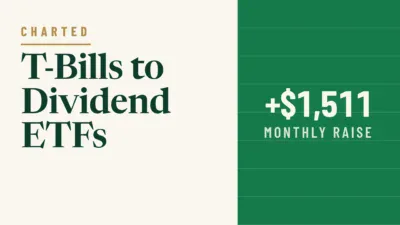
A 70-year-old retiree moved $815,000 from 13-week Treasury bills, which reset every quarter, into seven dividend ETFs. The move changed her monthly income, and the raise came at a cost.
A $1,511 Monthly Raise, on Paper
The 13-week Treasury bill yielded 4.3% on Nov. 23. On $815,000, that’s about $2,907 a month. Her new mix carries a combined yield of 6.5%, which pays $4,418 a month, or $53,016 a year. That’s $1,511 more each month.
T-bills earned their place because the U.S. government backs them, they return principal at maturity, and their interest is exempt from state income tax. Their weakness is the reset. With the Fed’s upper target at 4%[1], every renewal reprices her income. The ETFs pay more, but their prices move, and their payouts can be cut.
What $53,016 a Year Costs at Each Yield
Divide the income by the yield, and you get the required investment:
- Conservative: $53,016 divided by 0.035 equals about $1,515,000.
- Moderate: $53,016 divided by 0.07 equals about $757,000.
- Aggressive: $53,016 divided by 0.12 equals about $442,000.
Her $815,000 falls between the conservative and moderate investment requirements, so she combined holdings from all three tiers.
Conservative Core: Dividend Growers and Real Estate
Schwab U.S. Dividend Equity ETF (NYSEARCA:SCHD) takes 20% of the money and yields about 3.1%. Big health care stocks sit among its largest holdings. Its catch: the lowest yield in the basket, paid quarterly.
Vanguard Real Estate ETF (NYSEARCA:VNQ) gets 15% and yields about 3.4%. REIT dividends are taxed at regular income rates, and its latest quarterly payout of $0.80 came in below the prior $0.86.
Moderate Sleeve: Covered Calls and Preferreds
Goldman Sachs S&P 500 Premium Income ETF (NASDAQ:GPIX) holds 15% and yields about 9.0%, paid monthly. Selling options on S&P 500 stocks generates that income but caps the upside, and distributions may include return of capital.
Global X U.S. Preferred ETF (NYSEARCA:PFFD) holds 15% and yields about 7.2% from a steady $0.10 monthly payout. Preferreds are rate-sensitive, and the price is down 7% this year.
Aggressive Sleeve: Private Credit and Pipelines
VanEck BDC Income ETF (NYSEARCA:BIZD) gets 10% and carries a forward yield near 14.6%. Its largest holding alone makes up 14%[2] of assets. This year’s quarterly payouts ran $0.48, $0.24, then $0.44, and the price is down 7% year to date.
Alerian MLP ETF (NYSEARCA:AMLP) gets 10% and yields about 8.6% from pipeline partnerships. Its quarterly payout rose from $0.88 in early 2024 to $1.04. It’s concentrated in energy, and the fund pays corporate tax, though holders get a 1099 instead of K-1s.
Cash Cushion: Ultra-Short Bonds Near T-Bill Yields
JPMorgan Ultra-Short Income ETF (NYSEARCA:JPST) holds the last 15% and yields about 4.3%, close to what she left. It owns corporate debt and CLO-related securities beyond Treasuries, and its monthly payout floats with short-term rates.
Why the Smallest Yield Can Pay the Most Later
Put all $815,000 at a 3.5% yield and year one pays $28,525, well short of her target. Grow that payout 8% a year, and it reaches about $57,022 by year 10, past $53,016. A 12% yield with no growth pays the same in year 10 as in year one, and inflation chips away at it every year.
Her mix leans on high current income. That buys her the check today, but most of her raises will have to come from SCHD and AMLP. Turning a lump sum into something that acts like a paycheck is its own exercise, and we walked through the mix, when each fund pays, and the order to draw from in a free guide here.
Three Checks Before Building a Similar Income Mix
- Add up your typical monthly expenses. If it comes in below $4,418, a more conservative tier trades current income for more future growth.
- Combining the tiers limits concentration. BIZD represents 10% of her portfolio but generates 22% of its income, so a 50% payout cut would reduce her overall income by roughly 11%.
- Model taxes by account. REIT and BDC payouts are largely ordinary income, SCHD’s are mostly qualified, and GPIX may include return of capital. She also loses the state tax break T-bills gave her. If she was born in 1956, required minimum distributions start at 73, in 2029.
She swapped a guaranteed check that resets every few months for a bigger one that can shift. Next, watch BIZD’s and VNQ’s payouts, both cut recently, and Fed moves that would reset JPST’s yield.
Contact [email protected] for any questions or corrections.
David Beren has been a Flywheel Publishing contributor since 2022. Writing for 24/7 Wall St. since 2023, David loves to write about topics of all shapes and sizes. As a technology expert, David focuses heavily on consumer electronics brands, automobiles, and general technology. He has previously written for LifeWire, formerly About.com. As a part-time freelance writer, David’s “day job” has been working on and leading social media for multiple Fortune 100 brands. David loves the flexibility of this field and its ability to reach customers exactly where they like to spend their time. Additionally, David previously published his own blog, TmoNews.com, which reached 3 million readers in its first year. In addition to freelance and social media work, David loves to spend time with his family and children and relive the glory days of video game consoles by playing any retro game console he can get his hands on.