She Turns 50 in 2027 With $90,000 in Her 401(k) and Fears She Started Too Late. Saving the New $34,000 Maximum Could Carry Her Past $1 Million by 65

This post may contain links from our sponsors and affiliates, and Flywheel Publishing may receive compensation for actions taken through them.

Born in 1977, she turns 50 next year with $90,000 in her 401(k) and about 15 working years left before 65.
Next to the $1 million balances she reads about, that number feels like a late start. But in 2027 the IRS lets her save more each year than it ever has.
On November 12, IRS Notice 2026-66 raised the 2027 elective deferral limit to $25,500 and the age-50 catch-up to $8,500. Together that comes to $34,000.
Workers who turn 60, 61, 62 or 63 during the year can use a larger $11,750 catch-up instead, for a total of $37,250.
Fifteen Maxed-Out Years Make Up for the Late Start
If she stopped contributing today and the $90,000 grew 7% a year, she would have about $248,000 at 65.
If she adds $34,000 every year from age 50 through 64, the projection rises to about $1.1 million.
At a more conservative 6% return, she still ends near $1,007,000.
Her own deposits add up to $510,000. Compounding supplies the rest. The regular contributions do much more for her result than the size of her starting balance.
She turns 60 in 2037, which opens four years of the larger super catch-up.
At today’s limits, the extra $3,250 a year adds about $15,000 by 65 and pushes the 7% projection to roughly $1.12 million. All of these limits rise with inflation, so her actual caps in the 2030s should be higher.
None of these projections include an employer match. The total cap on employee plus employer money is $75,000, so her employer’s match goes in on top of her own $34,000 and adds to every figure above.
A Roth Rule That Can Change Her 2027 Paycheck
If her 2026 wages are above $155,000, SECURE 2.0 requires her 2027 catch-up contributions to go into the Roth side of the plan. That means no tax deduction on that money.
In one New York Times example, a worker in the 24% bracket lost about $1,900 in federal tax savings on an $8,000 catch-up.
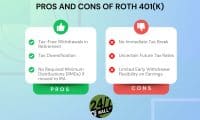
For her, the rule is a good thing. A Roth 401(k) has no required withdrawals while she is alive (26 U.S.C. § 402A(d)(5)). Even if she earns less than the threshold, she should send at least her catch-up money to Roth by choice.
A Fully Pre-Tax Balance Sets Up a Tax Problem at 75
Because of her birth year, her required minimum distributions (RMDs) start at 75, beginning in 2052.
Suppose she leaves $1.1 million untouched from 65 to 75 and it keeps growing 7% a year. It would reach about $2.17 million.
The IRS Uniform Lifetime Table divisor at 75 is 24.6, so her first required withdrawal would be close to $88,000.
That withdrawal sets off a chain of extra taxes. Added to Social Security, it can make up to 85%[1] of her benefits taxable.
Medicare premiums are also based on income from two years earlier. Under 2026 rules, a single filer with income above $109,000[2] pays $284 a month for Part B instead of $203.
Above $137,000[2], the premium rises to $406.
She has 15 years of contributions to decide which part of her savings will be taxable later. Putting a share into Roth now keeps her later RMDs, and the tax hits that follow, smaller (the low-tax years between her last paycheck and her first RMD are the whole subject of our free Roth conversion guide, here).
Three Moves to Make Before Her First 2027 Paycheck
- Raise her deferral to the new maximum. If she is paid every two weeks, $34,000 works out to about $1,308 per paycheck. Most plans make her choose a new election rather than raising it automatically. Waiting until spring means she can only reach the limit with larger paychecks later in the year.
- Check her 2026 wages against the Roth threshold. If she is above $155,000, the Roth catch-up is required. If she is below it and in the 22% bracket, a pre-tax $34,000 saves about $7,480 in federal tax. She can deduct the base deferral and still send the catch-up to Roth to balance her future tax bill.
- Put 2037 on her calendar now. That is the year her larger catch-up limit begins. She should also ask HR whether the plan allows after-tax contributions (money added beyond the normal limit) and in-plan Roth conversions (shifting pre-tax dollars to Roth and paying the tax now), which can move even more money into accounts with no required withdrawals.
Saving the full $34,000 for 15 years gives her a realistic path past $1 million by 65. A calculated mix of pre-tax and Roth money also keeps more of that balance after taxes in retirement.
Contact [email protected] for any questions or corrections.
Gerelyn Terzo is the author of dividend investing handbook "Dividend Investing Strategies: How to Have Your Cake & Eat It Too." A veteran financial journalist, she covers agri-finance for outlets like Global AgInvesting and the broader stock market and personal finance for 24/7 Wall Street. She began at CNBC and later helped launch Fox Business in New York. Gerelyn currently resides in Woodland Park, Colorado and dabbles in nature photography as a hobby.