The Top 1% of Taxpayers Paid 40.4% of All Federal Income Taxes While Reporting 22.4% of the Income. The Top Half Paid 97%

This post may contain links from our sponsors and affiliates, and Flywheel Publishing may receive compensation for actions taken through them.
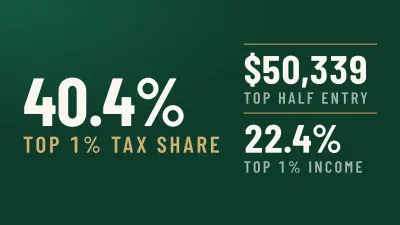
A relatively small group of filers bears most of the federal income tax burden. In tax year 2022, the latest year in IRS Statistics of Income Publication 1304, the top 1% of taxpayers paid 40.4% of all federal income tax and reported 22.4% of the income. Taken together, the top half of filers and their share of the tax rises to 97.0%.
Each of those shares is measured against adjusted gross income, or AGI. AGI is all the income on a tax return, including wages, interest, dividends, business profits, and retirement payouts, minus a short list of adjustments such as deductible IRA contributions. The IRS uses it to rank every return from highest to lowest. Across all nondependent returns, the average AGI in 2022 was $95,915.
Ranking Every Taxpayer Group, From the Smallest Slice to the Top Half
The IRS counts these groups cumulatively, so each one includes everyone above it. The ranking below starts with the smallest slice at the very top. For each group, it shows the share of federal income tax paid, the share of AGI, and, where the report lists it, the minimum AGI needed to qualify.
- Top 0.001%: 3.8% of tax, 2.4% of AGI. Entry point: $85,464,888.
- Top 0.01%: 9.3% of tax, 5.4% of AGI. Entry point: $17,855,123.
- Top 0.1%: 20.6% of tax, 11.4% of AGI. Entry point: $3,271,387.
- Top 1%: 40.4% of tax, 22.4% of AGI. Entry point: $663,164.
- Top 2%: 48.6% of tax, 28.0% of AGI. Entry point: $438,918.
- Top 5%: 61.0% of tax, 38.3% of AGI.
- Top 10%: 72.0% of tax, 49.4% of AGI.
- Top 25%: 87.2% of tax, 69.9% of AGI.
- Top 50%: 97.0% of tax, 88.5% of AGI. Entry point: $50,339.
Every group on the list pays a larger share of the tax than its share of the income. That’s how graduated brackets work: each additional slice of income gets taxed at a higher rate. In the report, the top 0.1% paid the highest average tax rate at 26.2%. Average rates dropped with each wider group, down to 15.9% for the top 50%.
Bottom Half of Filers Pays a Thin Slice
Filers below the $50,339 threshold reported 11.5% of all AGI and paid 3% of federal income tax. At those incomes, the standard deduction covers a big piece of what people earn. Credits such as the earned income credit can then reduce the remaining bill, sometimes to zero.
These shares also change when markets move. In 2021, the top 1% reported 26.3% of AGI and paid 45.8% of income tax. Both shares fell the next year as income at the very top dropped, and total AGI for the top 0.001% fell 21.5%. Capital gains and business income rise and fall more sharply than wages, so the top group’s share follows them.
Federal Income Tax Is Only One Piece of the Bill
Publication 1304 covers federal income tax only. It leaves out Social Security and Medicare payroll taxes, sales taxes, and state and local taxes. Payroll taxes start with the first dollar of wages, and sales taxes take a larger share of a smaller budget. As a result, those taxes cost lower earners more relative to their income. A household that owes nothing on its 1040 still pays tax out of every wage and sales tax at the store.
Why Many Retirees Owe Little or Nothing
Many retired people fall into the low-tax half, and two rules explain much of that. Under IRS Publication 554, Social Security benefits can become taxable only after half of the benefits plus all other income goes over a base amount. That base amount is $25,000 for single filers and $32,000 for joint filers. Even above those amounts, federal law caps the taxable portion at 85%[1] of benefits.
Deductions then reduce taxable income further. For 2025, the standard deduction is $15,750 for single filers and $31,500 for joint filers. Filers 65 and older add an extra $2,000, or $1,600 per eligible spouse if they’re married.
A new enhanced deduction for seniors adds up to $6,000 per person. It shrinks once modified AGI goes above $75,000, or $150,000 for joint filers. A retired person who lives mostly on Social Security and a modest pension can end up with little or no taxable income. Our coverage of how Social Security benefits are taxed goes through the IRS worksheet step by step, and we charted eight more IRS rules that quietly drain retirement accounts in a free tax trap map.
What the IRS Numbers Add Up To
The federal income tax relies heavily on top earners. In 2022, the top 1% paid 40.4% of it and the top half paid 97.0%. Payroll, sales, and state taxes are spread more evenly across income levels, so the full tax picture is flatter than the income tax alone. Later IRS releases will show whether the top group’s share recovered along with markets.
Contact [email protected] for any questions or corrections.
David Beren has been a Flywheel Publishing contributor since 2022. Writing for 24/7 Wall St. since 2023, David loves to write about topics of all shapes and sizes. As a technology expert, David focuses heavily on consumer electronics brands, automobiles, and general technology. He has previously written for LifeWire, formerly About.com. As a part-time freelance writer, David’s “day job” has been working on and leading social media for multiple Fortune 100 brands. David loves the flexibility of this field and its ability to reach customers exactly where they like to spend their time. Additionally, David previously published his own blog, TmoNews.com, which reached 3 million readers in its first year. In addition to freelance and social media work, David loves to spend time with his family and children and relive the glory days of video game consoles by playing any retro game console he can get his hands on.