She’ll Retire at 63 With $480,000 in a 401(k) and Live on Savings for 12 Years. By 75 It Will Be About $860,000, and Her First RMD Will Be $35,000, Every Dollar Taxable

This post may contain links from our sponsors and affiliates, and Flywheel Publishing may receive compensation for actions taken through them.
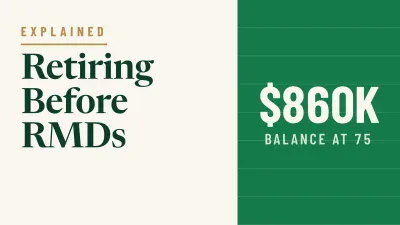
A single woman retiring at 63 with $480,000 in her 401(k) has the same options as many savers with other assets. She can leave the account alone and live on cash and taxable savings first, a plan that covers 12 years on other savings while the 401(k) keeps growing.
When required minimum distributions (RMDs) begin, the projection puts the balance at about $860,000, and her first required withdrawal comes to $35,000. All of it is taxed as ordinary income, and that tax bill usually gets less attention than the growth.
What It Takes to Reach $860,000 by 75
To grow $480,000 into $860,000 over 12 years with no withdrawals, the account needs an average annual return of about 5% after fees. That is a moderate assumption for a balanced portfolio. The order of returns still matters, though. A weak market early in retirement would leave the balance short, and a strong decade would push it higher, because the $860,000 is a projection and every tax figure that follows rises or falls with what the account actually holds.
Why Her RMDs Start at 75
Her starting age depends on her birth year. Under federal law, anyone born on or after January 1, 1960 has an applicable RMD age of 75. A woman retiring at 63 now was born after that date, so she is in that group. People born from 1951 through 1959 start at 73. Her first distribution can wait until April 1 of the year after she reaches 75. Waiting that long means two RMDs land in the same tax year.
Checking the $35,000 Against the IRS Table
IRS Publication 590-B calculates the RMD by dividing the account value on December 31 of the prior year by a factor from the Uniform Lifetime Table. At age 75, that factor is 24.6. Assuming her 401(k) holds $860,000 on December 31 of the year before she turns 75, dividing by 24.6 gives a first RMD of $34,959, or about $35,000. The factor gets smaller every year, so the share she has to withdraw rises with age even if the balance stays flat.
How $35,000 Ripples Through Her Tax Return
The RMD’s biggest indirect effect is on her Social Security. She would owe no tax on her benefits. At the average retired-worker benefit of $2,071 a month, or $24,852 a year, that assumes she had no other income. Once the RMD is added, her provisional income (half her benefits plus her other income) comes to $47,426. That is well above the $25,000 base amount for single filers.
Running the IRS worksheet with those figures, about $15,912 of her Social Security becomes taxable, and her adjusted gross income comes to about $50,912. After the 2026 single standard deduction of $16,100, and before any extra deduction for age, her taxable income is about $34,812.
That keeps her in the 12% federal bracket, which for single filers on the 2026 schedule runs up to $50,400 of taxable income. IRMAA, Medicare’s income-based premium surcharge, starts above $109,000[1] for individual filers in 2026, so her first RMD keeps her well under it. The pressure grows later, as the IRS factor shrinks and the balance keeps growing, her RMDs get bigger. Each added dollar of withdrawal can also make up to 85%[2] of a matching dollar of Social Security taxable.
Twelve Years to Shrink the Tax Bill
If she lives on savings, her income from 63 to 74 will be the lowest of her adult life, making those years a good time for Roth conversions (that gap between the last paycheck and the first RMD is the whole subject of our free Roth Window guide). IRS Publication 17 says money converted from a traditional account is includible in gross income in the year it moves.
Roth IRAs, however, have no RMDs while the owner is alive. Converting each year enough to fill the 10% and 12% brackets shrinks the pre-tax balance that drives her future RMDs. Qualified Roth withdrawals are tax-free after age 59.5, provided the Roth IRA’s five-year requirement has also been satisfied. Conversions also raise the income Medicare uses to set IRMAA, so each year’s amount needs to be sized with that in mind.
What an IRA Rollover Changes
Moving the 401(k) into a traditional IRA leaves the RMD formula the same, but it gives her more options. Qualified charitable distributions (QCDs) come only from IRAs and are allowed starting at age 70½. They count toward the RMD and are not taxed.
The 2026 limit is $111,000. If she gives to charity, sending part of each RMD straight to a charity can reduce the taxable portion below $35,000. The rollover also simplifies things. It makes withdrawals from the account much easier to manage. 401(k) RMDs must be taken from each plan separately, while IRA owners can take the combined total from one or more of their IRAs.
What to Watch Before Age 75
At today’s thresholds, a $35,000 first RMD is manageable for a single filer. Three steps matter most. She can plan Roth conversions year by year from 63 through 74. She can decide on an IRA rollover before 70½ if charitable giving is part of her plan.
And she can mark the first RMD deadline on her calendar, because missing it triggers a 25% excise tax on the shortfall, cut to 10% if corrected in time. Tax brackets, deductions, and IRMAA levels will change over the next 12 years. The IRS has also signaled future final RMD regulations, so the projection is worth updating every few years.
Contact [email protected] for any questions or corrections.
David Beren has been a Flywheel Publishing contributor since 2022. Writing for 24/7 Wall St. since 2023, David loves to write about topics of all shapes and sizes. As a technology expert, David focuses heavily on consumer electronics brands, automobiles, and general technology. He has previously written for LifeWire, formerly About.com. As a part-time freelance writer, David’s “day job” has been working on and leading social media for multiple Fortune 100 brands. David loves the flexibility of this field and its ability to reach customers exactly where they like to spend their time. Additionally, David previously published his own blog, TmoNews.com, which reached 3 million readers in its first year. In addition to freelance and social media work, David loves to spend time with his family and children and relive the glory days of video game consoles by playing any retro game console he can get his hands on.