The IRS Requires 3.77% of an IRA at 73, 4.95% at 80 and 6.25% at 85. Here’s the Schedule for a 72-Year-Old With $1.5 Million Who Never Planned to Sell That Fast

This post may contain links from our sponsors and affiliates, and Flywheel Publishing may receive compensation for actions taken through them.
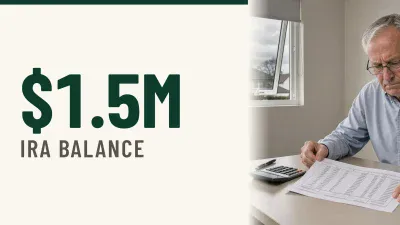
Consider a 72-year-old whose traditional IRA holds $1.5 million. Starting at age 73[1], the IRS requires 3.77% of that balance to come out, or $56,603.77 in the first year. By 85 the required share reaches 6.25%, which on the same balance is $93,750.
A Shrinking Divisor Produces Every Percentage in the Headline
Each year’s required minimum distribution (RMD) is the IRA’s value at the close of business on December 31 of the prior year, divided by a distribution period from the Uniform Lifetime Table, which is Table III in IRS Publication 590-B (Publication 590-B (2025)). The factors are 26.5 at 73, 20.2 at 80 and 16.0 at 85.
The required percentage is 1 divided by the factors. The factors falls every year, so the required share grows every year, whatever the balance does.
The starting age is 73 for anyone who reaches 72 after December 31, 2022[1], and 73 before January 1, 2033. If you were born in 1954, your first RMD year is 2027, your first deadline is April 1, 2028, and every later RMD is due December 31.
Running the Schedule on a Flat $1.5 Million
Assumptions: federal rules only (state tax changes); RMD rules in effect for 2026; owner turns 73 in 2027; one traditional IRA worth $1.5 million on each prior December 31 (0% net growth, to isolate the rate); spouse not more than 10 years younger, or no spouse beneficiary. Social Security and other income do not enter the RMD formula.
| Age | Prior Dec. 31 balance | Table III factors | Required share (1 ÷ factors) | RMD (balance ÷ factors) |
|---|---|---|---|---|
| 73 | $1,500,000 | 26.5 | 3.77% | $56,603.77 |
| 80 | $1,500,000 | 20.2 | 4.95% | $74,257.43 |
| 85 | $1,500,000 | 16.0 | 6.25% | $93,750.00 |
The flat balance shows the rate by itself. If the account grows faster than the required share, the dollar RMD rises on top of the percentage; if it shrinks, the dollar increases slow down.
Shares Can Leave the IRA Without a Sale
The rule measures what leaves the IRA, and securities can leave as easily as cash. Custodians can generally move shares in kind into a taxable brokerage account, so the holdings stay invested and the distributed value counts toward the RMD.
The tax stays the same. Under 26 U.S.C. § 408(d)(1)[2], any amount distributed from an IRA is included in gross income, and Publication 590-B says traditional IRA distributions are taxed as ordinary income with no capital gain treatment (Publication 590-B (2024)). With no cash coming out, the tax has to be paid from other funds.
A Younger Spouse or a Widow’s Return Changes the Math
Table III applies when the spouse is the only designated beneficiary and is not more than 10 years younger. When the spouse is more than 10 years younger, Publication 590-B points to Table II, Joint Life and Last Survivor Expectancy, which uses both spouses’ ages (Publication 590-B (2025)).
A surviving spouse faces the same RMD dollars on a single return. Medicare’s 2027 Part B schedule adds no surcharge on joint income up to $224,000[3], while for single filers the cutoff is $112,000. Just above that cutoff, the single filer’s premium grows from $209.40[3] to $293.10 a month. Medicare bases those surcharges on income from an earlier tax return.
Three Levers Still Open Around Age 73
- Timing. Delaying that initial required distribution to April 1, 2028 puts the 2027 and 2028 RMDs on the same 2028 return. Not to take an RMD triggers a 25% excise tax on the shortfall, cut to 10% if it is made up within the legal window.
- Qualified charitable distributions. A QCD paid directly from the IRA to an eligible charity counts toward the RMD and stays out of income, up to $111,000 for 2026. It only helps if you were going to give the money anyway.
- A 2026 Roth conversion. 2026 is the last year in this example with no RMD. Each $100,000 converted by December 31, 2026 cuts the 2027 RMD by $3,773.58, but the converted amount is taxable in 2026. From 2027 on, the RMD itself can’t be converted, because required amounts aren’t eligible for rollover (Publication 590-B (2024)). A conversion can’t be recharacterized under 26 U.S.C. § 408A(d)(6)(B)(iii)[4], so it is permanent.
Check the January 2027 RMD Statement Against the Formula
The custodian holding the IRA at the end of 2026 must report the 2027 RMD, or offer to calculate it, by January 31 of 2027, along with the deadline. On that statement, check the December 31, 2026 fair market value and confirm the RMD matches that value divided by 26.5. If you hold more than one IRA, each one gets its own calculation, though the combined total can come from any of them (IRS RMD FAQs).
Contact [email protected] for any questions or corrections.
Jake has been been working in financial media for almost 15 years. He focuses on all things personal finance for 24/7 Wall St. with high hopes to educate and entertain. Most recently, Jake spent 12 years working various roles at The Motley Fool. He started copy editing fool.com content, worked on premium and marketing campaigns, and helped launch The Ascent, a personal finance brand.
His work has been featured on platforms like MSN, Yahoo Finance, USA Today, and more. He's written about credit cards, social security, ETFs, savings accounts, and just about anything else you can imagine when thinking about money. Jake love to cook, play golf, and tell people he's never had a cavity. (It's true!)