She Is 52, Earns $140,000, and Will Inherit Her Father’s $600,000 IRA. He Never Converted a Dollar, So Every Withdrawal for Ten Years Will Be Taxed on Top of Her Salary

This post may contain links from our sponsors and affiliates, and Flywheel Publishing may receive compensation for actions taken through them.
A daughter who inherits her father’s traditional IRA faces a significant tax decision. She is the beneficiary of a $600,000 traditional IRA, and none of it was ever converted to a Roth. At 52 and earning $140,000, she learns that every dollar she withdraws is taxed as ordinary income on top of her salary, and federal rules give her a fixed window to empty the account. Each withdrawal has a tax cost.
A Ten-Year Deadline Starts at Her Father’s Death
For IRA owners who die after December 31, 2019, the SECURE Act generally requires heirs to empty the whole balance within ten years. IRS Publication 590-B (2025) sets the deadline as December 31 of the year containing the 10th anniversary of the owner’s death.
In the IRS’s own example, an owner who died in 2025 leaves an account that must be fully paid out by December 31, 2035. A healthy 52-year-old daughter falls outside the exceptions. Those cover a surviving spouse, a minor child, a disabled or chronically ill person, or someone not more than ten years younger than the owner. That puts her on the standard ten-year track.
Her father’s age when he died also affects her withdrawal schedule. If he had reached his required beginning date (age 73 for anyone born from 1951 through 1959), Publication 590-B says her annual minimums are based on the longer of her single life expectancy or the owner’s. In practice, she has to take money out every year from year one through year nine, and whatever is left comes out in year ten.
If she’s 52 when her father dies, her first required distribution is generally due the following year, when she’ll be 53. The IRS Single Life Table gives her a factor of 33.4, making the first-year minimum about $17,964 on a $600,000 prior year-end balance.
If she misses a required withdrawal, she owes an excise tax of 25% of the shortfall, which drops to 10% if she corrects it in time.
How the Math Lands on a $140,000 Salary
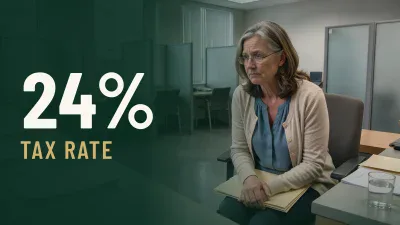
Her income puts her near the top of the Federal Reserve’s 60th to 80th income percentile group, which runs from $90,796 to $151,328[1]. For 2026, the IRS lists a $16,100 standard deduction for unmarried taxpayers, with the 24% bracket starting above $105,700. Assuming she files as single, her salary alone already lands her in the 24% bracket.
Say she spreads the money evenly and ignores investment growth. That’s $60,000 a year, which raises her taxable income to $183,900. That’s still under the line where the 32% rate starts, which is above $201,775. So the federal cost is $60,000 times 24%, or $14,400 a year.
She has about $77,875 of room each year before any withdrawal gets taxed at 32%. That gap sets how much she can take each year while staying in the 24% bracket. Waiting until the end costs a lot more. If she took the whole balance in year ten, her taxable income would jump to $723,900, past the $640,600 point where 37% applies.
Big portions of the inheritance would be taxed at 32%, 35% and 37% instead of 24%. And if annual minimums apply, she can’t put off every withdrawal anyway.
Lower-Income Years Are Where the Savings Sit
Within the ten years, she can take more in some years and less in others. If she retires early, the years between her last paycheck and her other income sources are the cheapest time to take bigger withdrawals. The 22% rate starts above $50,400 of taxable income and 12% above $12,400. A sabbatical, a layoff, or a part-time stretch opens up the same kind of room.
A lower-tax approach is to take the minimum in high-salary years, take more in low-income years, and watch the 32% threshold every December. Rules are still settling: IRS Announcement 2026-7 says that until final regulations take effect, taxpayers must apply “a reasonable good-faith interpretation of the statutory provisions underlying the regulations.”
What Roth Conversions Would Have Changed
Her father paid no tax on that money going in, so she pays it coming out, at her own rate. Roth IRAs have no required distributions while the owner is alive. Beneficiaries still face distribution rules, but qualified Roth withdrawals are tax-free.
If her father had converted part of the IRA each year, especially in retirement years when his income was low, he would have paid the tax at his own bracket. She would have inherited money that adds nothing to her taxable income, even with the same ten-year deadline.
Anyone planning to inherit a parent’s traditional IRA can ask two questions now. Has the parent started required distributions? And would converting some of it at the parent’s tax rate cost less than the heir’s 24% or higher later? Those quiet years between a parent’s last paycheck and their first required withdrawal are usually the cheapest time to convert, and we sized up that window in a free Roth guide here. You owe tax either way, and the rate and bracket it falls in can still be planned.
Contact [email protected] for any questions or corrections.
David Beren has been a Flywheel Publishing contributor since 2022. Writing for 24/7 Wall St. since 2023, David loves to write about topics of all shapes and sizes. As a technology expert, David focuses heavily on consumer electronics brands, automobiles, and general technology. He has previously written for LifeWire, formerly About.com. As a part-time freelance writer, David’s “day job” has been working on and leading social media for multiple Fortune 100 brands. David loves the flexibility of this field and its ability to reach customers exactly where they like to spend their time. Additionally, David previously published his own blog, TmoNews.com, which reached 3 million readers in its first year. In addition to freelance and social media work, David loves to spend time with his family and children and relive the glory days of video game consoles by playing any retro game console he can get his hands on.