He Turns 73 This Year With IRAs at Two Firms and a 401(k) From a Job He Left in 2009. Each Firm Will Calculate Its Own RMD, and Only Two of the Three Can Be Combined

This post may contain links from our sponsors and affiliates, and Flywheel Publishing may receive compensation for actions taken through them.
Three year-end statements arrive from three different firms, and each one comes with its own required minimum distribution (RMD) notice. For someone turning 73 in 2026, the obvious plan is to add up the three numbers, take one large withdrawal from whichever account is easiest, and be finished for the year.
The problem is that this plan only works for two of the three accounts, since the two traditional IRAs can be combined. The 401(k) from a job left in 2009 has to pay out its own amount from inside the plan. Below is how each firm figures its number, how the first-year deadline can force two withdrawals into one year, what a missed distribution costs, and why some retirees roll an old 401(k) into an IRA.
Why 73 Is the Starting Age
The SECURE 2.0 Act, signed on December 29, 2022, moved the first RMD year from the year an owner becomes 72 to the year the owner becomes 73. Under the statute, the applicable age is 73 for people born from 1951 through 1959. Anyone born in 1960 or later can wait until 75.
How Each Firm Arrives at Its Own Figure
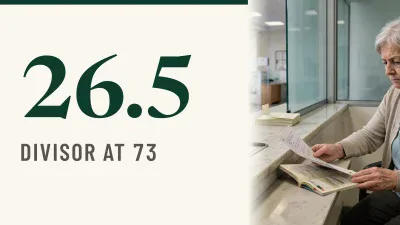
IRS Publication 590-B for tax year 2025 gives the formula. You take the account balance as of the close of business on December 31 of the prior year and divide it by the distribution period. For most owners at 73, that period comes from the Uniform Lifetime Table, where the divisor is 26.5. A different table applies only when a spouse who is the sole beneficiary is more than 10 years younger.
Each firm sees only its own balance, so each does that division separately and mails its own notice. Publication 590-B says the owner or the trustee must figure the amount each year. IRS guidance also requires IRA custodians to send a statement showing the amount due or offering to calculate it. That’s how one person ends up with three different numbers, and none of the firms knows what the other two hold.
Two IRAs Combine While the 401(k) Stands Alone
The IRS spells out the IRA rule in its RMD FAQs: “An IRA owner must calculate the RMD separately for each IRA they own but can withdraw the total amount from one or more of the IRAs.” So the two IRA figures can be added together, and the full total can come out of either firm or be split between them.
Employer plans follow a stricter rule. The same FAQ says RMDs from 401(k) and 457(b) plans “must be taken separately from each of those plan accounts.” Leaving that employer years ago doesn’t change the account’s status, so the old 401(k) still owes its own withdrawal. Taking out an extra-large amount from an IRA leaves the 401(k) short. Publication 590-B also says amounts taken above the minimum in one year earn no credit toward later years.
April 1 and the Two-Withdrawal Year
The first distribution can wait until April 1 of the year after you turn 73. Every RMD after that is due by December 31. If you wait, the first-year and second-year distributions both fall in the same calendar year and count as gross income[1] on the same return. Under Publication 590-B, anything withdrawn during the year you turn 73 counts toward the April 1 deadline, so taking the first RMD early keeps the two years separate.
What a Missed Distribution Costs
Falling short triggers an excise tax equal to 25%[2] of the shortfall, and the owner pays it. Before SECURE 2.0, that rate was 50%. It drops to 10% when the shortfall is fixed within a correction window. That window ends at the earliest of three dates: when the IRS mails a notice of deficiency, when the tax is assessed, or the last day of the second taxable year after the year the tax applied.
Rolling the Old 401(k) Into an IRA
Rolling the old 401(k) into one of the IRAs puts that money under the IRA aggregation rule. Three separate requirements become one combined IRA total. There’s one catch in the year of the move: any distribution required under section 401(a)(9)[3] can’t be rolled over under IRS rules. So the 401(k)’s RMD for that year has to come out before the rest is transferred.
Consolidating also changes how charitable giving can count toward the requirement. Qualified charitable distributions come out of IRAs and can count toward an IRA’s RMD. For 2026, up to $111,000 can be excluded from income this way, according to IRS Notice 2025-67.
What the Three Notices Add Up To
Three statements and three notices come down to two requirements. One is a combined amount for the IRAs, which can be taken from either. The other is a separate amount that has to come out of the 401(k) itself. One large IRA withdrawal covers only the first. The 401(k) needs its own withdrawal, and so does every RMD year after that.
Contact [email protected] for any questions or corrections.
David Beren has been a Flywheel Publishing contributor since 2022. Writing for 24/7 Wall St. since 2023, David loves to write about topics of all shapes and sizes. As a technology expert, David focuses heavily on consumer electronics brands, automobiles, and general technology. He has previously written for LifeWire, formerly About.com. As a part-time freelance writer, David’s “day job” has been working on and leading social media for multiple Fortune 100 brands. David loves the flexibility of this field and its ability to reach customers exactly where they like to spend their time. Additionally, David previously published his own blog, TmoNews.com, which reached 3 million readers in its first year. In addition to freelance and social media work, David loves to spend time with his family and children and relive the glory days of video game consoles by playing any retro game console he can get his hands on.