He Wants to Protect His Retirement Savings by Betting on Treasury Yields. Kalshi’s Proposed New Futures Contract Could Cost Him $5,000 on a Half-Point Move

This post may contain links from our sponsors and affiliates, and Flywheel Publishing may receive compensation for actions taken through them.
Picture a married retiree born in 1954 with $1.2 million in his 401(k) (a hypothetical example). Most of his fixed income sits in short-term funds, and he worries that falling rates will shrink the interest his portfolio throws off. He has read that Kalshi wants to list a contract linked to the 10-year Treasury yield, and he believes it could protect his savings.
On Nov. 20, Bloomberg reported that Kalshi reworked its proposal for perpetual futures tied to 10-year Treasury yields. In a Nov. 19 filing, Kalshi withdrew its August version and submitted a revised one for Commodity Futures Trading Commission (CFTC) approval, which starts a new 45-day review period. The product is still only a proposal, and it is a leveraged derivative, not a government-backed Treasury investment.
One Half-Point Swing Costs $5,000 Per Contract
Kalshi’s Nov. 19 CFTC filing sets the payout at $100 in gains or losses per basis-point move per contract. A basis point is one hundredth of a percentage point, so a half-point move against him equals a $5,000 loss before funding payments and fees. A perpetual contract never expires. Once a day, one side pays the other a funding amount based on where the contract trades relative to the 10-year yield, and those payments keep coming for as long as he holds the position.
Moves of that size happen quickly. The 10-year yield rose from 4.84% on Nov. 5 to 5.15% on Nov. 13. If he had positioned for falling yields, that one run would have cost him $3,100 per contract.
A week later the yield was back at 4.92%, a swing worth $2,300 per contract. Five contracts would have multiplied every one of those figures by five.
His 401(k) Pays Back Losses at a 22% Tax Rate
He turns 73 in 2027, which makes that his first required minimum distribution (RMD) year, with a deadline of April 1, 2028.
At that age the Uniform Lifetime divisor is 26.5, so a $1.2 million balance produces a required withdrawal of roughly $45,283. All of it is taxed as ordinary income.
Say he takes extra money out of the 401(k) to cover contract losses. In 2027, a married couple’s 12% bracket runs from $25,600 to $104,050, and with the RMD as their only other income, they land inside it.
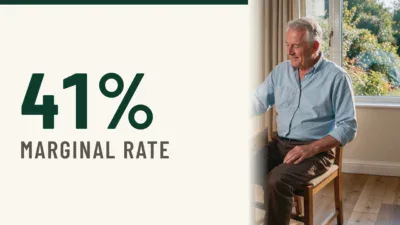
Each extra dollar he withdraws can make up to 85 cents more of the couple’s Social Security benefits subject to income tax, so his effective marginal rate reaches about 22%. Replacing a $5,000 loss would then take a withdrawal of roughly $6,427.
For retirees with larger incomes, Medicare can add to the bill. In 2027, a joint return with income above $224,000 adds $83.70 a month to Part B and $15.40 to Part D for each spouse.
For a couple, that comes to about $2,378 a year based on 2027 rates. Because IRMAA (Medicare’s income-related monthly adjustment amount) looks back two years, the surcharge arrives long after the trade is closed.
A Plain Treasury Note Already Locks In the Rate
Buying the debt itself does the job he wants done. The 10-year Treasury yields 4.92%, so $100,000 in 10-year notes pays about $4,920 a year for a decade.
There are no margin calls and no funding charges, and the payments are supported by the government. Investors willing to go longer can get 5.34% on the 20-year. Both figures are well above the Fed’s 4%[1] upper policy rate, which is the level short-term cash yields tend to follow.
His real risk is reinvestment risk: short-term money rolling over at lower rates. Moving some of that money into longer maturities inside the 401(k), through a Treasury fund or a brokerage window, deals with that risk directly. It also keeps every dollar sheltered from tax until he takes it out.
Three Steps Before Touching a Yield Contract
- Work out the worst case in dollars. Multiply the number of contracts by $100 per basis point, then by the biggest monthly range from the past year, and if the result is more than one year’s RMD, the position is too big for a retiree.
- Map your 2027 income now. Divide your Dec. 31, 2026 balance by 26.5. Add the taxable part of your Social Security and any other income, subtract your deductions, and compare the result with the $218,250 ceiling on the 22% bracket. Then compare your modified adjusted gross income (MAGI) with the current $224,000 IRMAA line. Plan around whatever room is left.
- Keep 401(k) money away from margin. A yield hedge funded with taxable cash avoids setting off extra 401(k) withdrawals, whereas covering losses with 401(k) withdrawals means a $5,000 loss can take roughly $6,427 in pretax money.
Contact [email protected] for any questions or corrections.
Gerelyn Terzo is the author of dividend investing handbook "Dividend Investing Strategies: How to Have Your Cake & Eat It Too." A veteran financial journalist, she covers agri-finance for outlets like Global AgInvesting and the broader stock market and personal finance for 24/7 Wall Street. She began at CNBC and later helped launch Fox Business in New York. Gerelyn currently resides in Woodland Park, Colorado and dabbles in nature photography as a hobby.