What Size Roth IRA Replaces a $105,000 Salary Tax-Free at 61?

This post may contain links from our sponsors and affiliates, and Flywheel Publishing may receive compensation for actions taken through them.
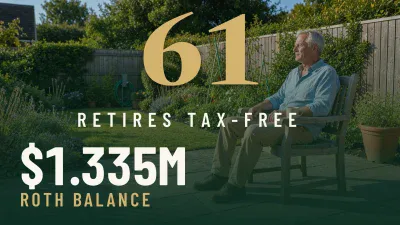
You’re 61, your job pays $105,000, and you’re wondering if your Roth IRA could take over. That salary works out to $8,750 a month. The amount you need depends on how much yield you’re willing to reach for, and each answer carries its own trade-offs.
Why a Roth at 61 Lets You Keep Every Dollar
You’re past 59½, which passes half the test. IRS Publication 590-B (2025) covers the other half: the distribution has to come after the five-year period that starts with the first tax year you contributed to a Roth. If you meet both, the tax code says the money “shall not be includible in gross income”[1] under 26 U.S.C. § 408A(d)(1).
High-yield holdings fit a Roth for a simple reason. REITs, BDCs, and covered call funds often pay distributions taxed as ordinary income. For a single filer, the 22% bracket ends at $105,700 of taxable income in 2026. Inside a Roth, $105,000 of yield is $105,000 you can spend. Roth IRAs also have no required minimum distributions while you’re alive, so you decide when money comes out.
Three Price Tags for an $8,750 Monthly Paycheck
Conservative Tier: 3% to 4% Yield
A 3.5% yield means $105,000 divided by 0.035, which matches $3,000,000. Higher-yield dividend stocks and dividend-focused funds make up this tier. The amount of money required here is the largest, but payouts tend to rise every year, and the principal has the best chance to grow.
Moderate Tier: 5% to 7% Yield
At 6%, $105,000 divided by 0.06 matches $1,750,000. REITs, preferred shares, and high-dividend ETFs sit here. Income grows more slowly, and some of these strategies cap your upside.
Aggressive Tier: 8% to 14% Yield
A 10% yield means $105,000 divided by 0.10, which matches $1,050,000. This tier includes BDCs, leveraged option-writing funds, and mortgage REITs. Payouts can be cut, and principal often contracts even while the checks keep coming.
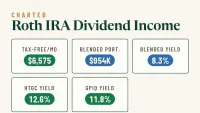
A Six-Holding Roth Paycheck Yielding 7.9%
This mix sits between the moderate and aggressive tiers. At an average 7.9%, replacing the salary takes about $1,335,000.
- Global X S&P 500 Covered Call ETF (NYSEARCA:XYLD), 20%: It sells calls on the S&P 500 for a forward yield of about 10%. The catch: monthly payouts this year ran from $0.30 to $0.41, and the calls cap your upside.
- First up is the SPDR Portfolio S&P 500 High Dividend ETF (NYSEARCA:SPYD), 15%: It holds the highest-yielding S&P 500 stocks and yields about 4.3%. It’s the diversified anchor of the mix. The catch: quarterly payouts in 2026 ran from $0.45 to $0.54.
- Apple Hospitality REIT (NYSE:APLE), 15%: It pays $0.08 a month (about 5.1%) from 216 hotels. The catch: travel demand drives the results, and the payout fell to $0.01 in 2021.
- Fidus Investment (NASDAQ:FDUS), 15%: It yields about 11.9% counting its $0.11[2] supplemental, or 9.4% on the $0.43 base alone. Test that double-digit figure before you count on it. Adjusted NII of $0.54[2] a share covered the base, and spillover income of $0.95 a share adds a buffer. The catch: NAV slid to $19.47 from $19.55[2].
- Amcor (NYSE:AMCR | AMCR Price Prediction), 10%: It yields about 6.2% after raising its quarterly dividend to $0.66. Packaging for pet food and other everyday goods supports it. The catch: Amcor cut its transition-period adjusted EPS outlook to $1.70 to $1.80, with leverage near 3.6x.
- Cohen & Steers Infrastructure Fund (NYSE:UTF), 25%: The biggest slice yields about 8.2% from utilities, pipelines and communications assets. It has paid $0.165 a month since an April raise. The catch: the fund uses leverage, which makes price swings bigger.
Lower Yield, Bigger Paycheck by Year Nine
Picture the $3,000,000 conservative portfolio paying 3.5%, with dividends growing 8% a year. Your $105,000 turns into roughly $210,000 in nine years. A 7.9% portfolio with flat payouts still pays about $105,000, and inflation cuts into what that purchases every year.
The higher-yield mix gives up that growth in exchange for a much lower starting balance. If you can’t reach $3,000,000, that’s a reasonable trade, and a dividend run built to live on the checks without selling shares is the whole premise of a free guide we put together on exactly that. Go in knowing what it costs you.
Three Moves Before You Hand In Your Notice
- Confirm your five-year clock. Start with the tax year of your first Roth contribution. Conversions and new accounts don’t restart the qualified-distribution test once you’ve met it.
- Price your actual retirement spending. Once payroll taxes and 401(k) deferrals stop, you may need well under $8,750 a month, which reduces the balance you need.
- Stress-test the volatile pieces. Rerun the math with XYLD at $0.30 a month and Fidus paying only its base dividend, then check whether the paycheck covers your monthly expenses.
Contact [email protected] for any questions or corrections.
David Beren has been a Flywheel Publishing contributor since 2022. Writing for 24/7 Wall St. since 2023, David loves to write about topics of all shapes and sizes. As a technology expert, David focuses heavily on consumer electronics brands, automobiles, and general technology. He has previously written for LifeWire, formerly About.com. As a part-time freelance writer, David’s “day job” has been working on and leading social media for multiple Fortune 100 brands. David loves the flexibility of this field and its ability to reach customers exactly where they like to spend their time. Additionally, David previously published his own blog, TmoNews.com, which reached 3 million readers in its first year. In addition to freelance and social media work, David loves to spend time with his family and children and relive the glory days of video game consoles by playing any retro game console he can get his hands on.