She Retires at 65 With a $900,000 All-Stock 401(k) as the S&P 500 Swings From Its Worst Week to Its Best Day Since April 2025. The 8.6% Drop Erases $77,400, and the Rebound Still Leaves Her $38,409 Short

This post may contain links from our sponsors and affiliates, and Flywheel Publishing may receive compensation for actions taken through them.
She turns 65, retires this month and holds $900,000 in a 401(k) invested entirely in an S&P 500 index fund.
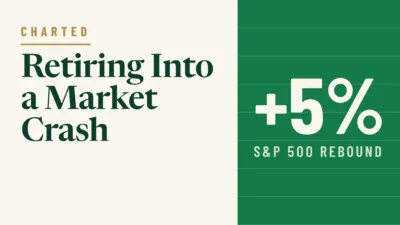
In the week ending November 20, the index fell 8.6%, its worst week since April 2025.
On Monday, November 23, it posted its best day since April 2025 after NVIDIA (NASDAQ:NVDA | NVDA Price Prediction) reinstated Jensen Huang as CEO.
She has no cash buffer and her whole balance is pretax, so Monday’s rally repairs less of her position than it seems to.
A 4.7% Rally Still Leaves Her $38,409 in the Hole
Yardeni Research said the selloff pushed the benchmark into a correction but called a bear market unlikely. Fear jumped too. By Friday’s close, the VIX stood near 36[1], up 86% in a week.
On her account, the 8.6% drop erased $77,400 and left $822,600.
The SPDR S&P 500 ETF Trust (NYSEARCA:SPY), a common proxy for her fund, gained nearly 5% on Monday. That adds $38,991 and brings her to $861,591.
She is still $38,409 short.
An 8.6% loss takes a 9.4% gain to recover, and even after Monday she needs about 4.5% more to get back to $900,000.
Her First $36,000 Withdrawal Is Where the Loss Becomes Permanent
A 4% first-year withdrawal on $900,000 comes to $36,000.
Taken after Monday’s rally, it leaves $825,591. Taken at Friday’s low, it would have left $786,600, because every share sold at that price is gone before any recovery.
This is sequence risk in its plainest form. With 100% of her money in stocks, she has nothing else to sell when prices fall. A bad market in year one hurts far more than one in year fifteen, which is why we built a free guide around holding those first few years of withdrawals: The First Five Years.
Tax Bill Building Inside a Fully Pretax 401(k)
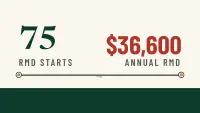
She was born in 1961, so her required minimum distributions start at 75. The first is due for 2036.
The Uniform Lifetime Table factor at 75 is 24.6, so if her balance grows to a hypothetical $1.2 million, the first RMD forces out about $48,780.
That RMD stacks on top of Social Security. For a single filer, up to 85%[2] of benefits become taxable once provisional income passes $34,000. With an hypothetical $48,000 benefit, her provisional income comes to $72,780.
That puts her well inside the 85% zone.
Each extra $1,000 she draws there adds $1,850 of taxable income, or $407 of tax in the 22% bracket.
Her effective rate on that money is close to 41%.
Medicare adds a third layer. The standard Part B premium is $202.90[3] a month in 2026. A single filer with income above $109,000[3] pays $284.10 instead.
Add the $14.50[3] Part D surcharge and crossing that line by a single dollar costs $1,148 a year. These surcharges, called IRMAA, are based on income from two years earlier. A Roth conversion she makes in 2027 will set her 2029 premiums.
Three Moves That Could Shrink Her Tax Bill Before the Rebound Fades
- Start Roth conversions in January 2027, her first full year without a paycheck. Converting while shares still trade below their pre-selloff level moves more shares into the Roth for the same tax bill. Any recovery on those shares then grows tax-free and never adds to a future RMD. Keep total income, withdrawals included, just under the single IRMAA threshold. It is $109,000 today and adjusts each year for inflation.
- Move two years of withdrawals, $72,000, into the plan’s stable value or money market option while prices are up after the rebound. Then replenish it after strong years. If she skips this, every withdrawal in the next downturn comes from selling stock at low prices, as it would have on Friday.
- Run your own RMD projection. Grow your current balance to age 75 and divide by 24.6. If that figure plus 85% of your expected Social Security comes close to the IRMAA line, the years between retirement and taking benefits are your cheapest window to convert. Delaying Social Security keeps that window open longer.
Contact [email protected] for any questions or corrections.
Gerelyn Terzo is the author of dividend investing handbook "Dividend Investing Strategies: How to Have Your Cake & Eat It Too." A veteran financial journalist, she covers agri-finance for outlets like Global AgInvesting and the broader stock market and personal finance for 24/7 Wall Street. She began at CNBC and later helped launch Fox Business in New York. Gerelyn currently resides in Woodland Park, Colorado and dabbles in nature photography as a hobby.