A 66-Year-Old Couple With $580,000 Across an IRA, a Roth and a Brokerage Account Is Spending Them Backwards. Here’s the Order That Makes the Same Money Last Years Longer

This post may contain links from our sponsors and affiliates, and Flywheel Publishing may receive compensation for actions taken through them.
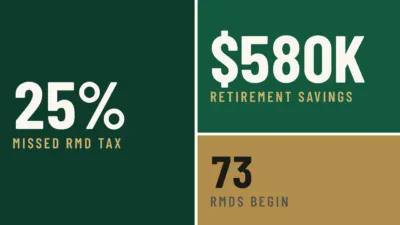
A 66-year-old couple has $580,000 spread across a tax-deferred IRA, a Roth IRA, and a taxable brokerage account. They’ve been paying their bills out of the Roth first because those withdrawals are tax-free, and the small tax bill each April makes that feel like the safe choice.
Over a long retirement, though, that order can give up more than it saves. The cause is how the 2026 federal rules treat each account and when the IRS starts forcing money out of the traditional IRA.
How Each Account Gets Taxed
Qualified withdrawals from a Roth don’t count as income under 26 U.S.C. § 408A(d)(1)[1]. A Roth also has no required minimum distributions during the owner’s lifetime, according to IRS guidance. So the money can keep growing tax-free for as long as the couple leaves it alone.
Traditional IRA withdrawals work the other way. The IRS says they’re generally taxable in the year they come out, according to Publication 554. The brokerage account falls in between. A sale returns the cost basis tax-free, and long-term gains are taxed at 0% for married couples filing jointly whose 2026 taxable income stays at or below $98,900.
How Spending the Roth First Affects Taxes
Every dollar taken out of the Roth stops growing tax-free for good, while the traditional IRA keeps growing, and so does the tax that will eventually be owed on it. Required distributions start at 73 for people born in 1959 and at 75 for people born in 1960 or later, so a 66-year-old’s start age depends on their exact birth date.
At age 73, the Uniform Lifetime Table divisor is 26.5. That means every $100,000 left in the tax-deferred account forces a first-year withdrawal of about $3,774, and the share goes up each year after that.
Whether they need the money or not, they have to take it. If they miss it, they face a 25% excise tax on the shortfall, which can drop to 10% if corrected within the required timeframe.
Where the Textbook Order Falls Short
The usual advice is to spend from the taxable account first, then the tax-deferred account, then the Roth. T. Rowe Price (NASDAQ:TROW | TROW Price Prediction) points out that sticking to that order too strictly can cost retirees money. If a couple lives only on brokerage sales for several years, their taxable income can drop close to zero, and those low-bracket years go unused while the IRA arrives at RMD age even bigger.
Filling the Low Brackets Every Year
In 2026, a joint-filer couple where both spouses are 65 or older gets a $32,200 standard deduction.
On top of that, each spouse gets an extra $1,650 for age and a $6,000 senior deduction, which runs through 2028. Together, that shields $47,500 of income from tax.
The 12% bracket ends at $100,800 of taxable income. Add the deductions, and the couple can have about $148,300 of ordinary income before any of it is taxed at 22%.
That figure comes before any taxable Social Security is counted. It also sits just under the $150,000 income level where the senior deduction starts to shrink.
That room can be filled with IRA withdrawals for spending or with Roth conversions. Either way, you pay 10% or 12% now instead of possibly higher rates later when RMDs kick in. Conversions are permanent, though. Under 26 U.S.C. § 408A(d)(6)(B)(iii), a conversion can’t be undone. IRA income also raises provisional income, and that can make up to 85% of Social Security benefits taxable.
Keeping Medicare Premiums in View
Income sets what Medicare charges. In 2026, the standard Part B premium is $202.90 a month. Once joint income passes $218,000, it rises to $284.10.
The Social Security Administration uses income from two years earlier, so a large conversion at 66 shows up in premiums at 68.
The 2027 surcharge brackets have already been published. A conversion sized to fill only the 12% bracket stays well under the first threshold.
An Order That Holds Up Over Time
One alternative order looks like this: spend from the brokerage account, use traditional IRA withdrawals or conversions to fill the low brackets each year, and leave the Roth for last. A worked example would need assumptions about returns, spending, and how the $580,000 is split among the three accounts.
The advantage comes from paying tax at low rates now, which leaves a smaller IRA to force out money later. It also leaves more money in the one account the IRS never makes the couple touch. Spending the Roth first lowers the tax bill in the year it happens.
Filling the low brackets and saving the Roth for last can mean paying more tax now and less later. (Those quiet years after work ends but before RMDs begin may be the lowest rate the couple ever sees again, which is the whole subject of our free Roth Window guide.)
Contact [email protected] for any questions or corrections.
David Beren has been a Flywheel Publishing contributor since 2022. Writing for 24/7 Wall St. since 2023, David loves to write about topics of all shapes and sizes. As a technology expert, David focuses heavily on consumer electronics brands, automobiles, and general technology. He has previously written for LifeWire, formerly About.com. As a part-time freelance writer, David’s “day job” has been working on and leading social media for multiple Fortune 100 brands. David loves the flexibility of this field and its ability to reach customers exactly where they like to spend their time. Additionally, David previously published his own blog, TmoNews.com, which reached 3 million readers in its first year. In addition to freelance and social media work, David loves to spend time with his family and children and relive the glory days of video game consoles by playing any retro game console he can get his hands on.