The Portfolio Blueprint for $11,100 a Month in Dividend Income Without Selling a Single Share

This post may contain links from our sponsors and affiliates, and Flywheel Publishing may receive compensation for actions taken through them.

You’re seeing a paycheck that shows up whether the market rises or falls: $11,100 a month, or $133,200 a year, without ever hitting the sell button.
Divide the income by the yield to find how much capital the plan requires. Below is an eight-holding blueprint, what each piece does, and the catch that comes with each one.
How Much Money Each Yield Level Demands
At a conservative 3.5% yield from broad dividend growth funds, $133,200 divided by 0.035 equals about $3,806,000. You need the most money, but income usually grows and principal tends to appreciate.
A moderate 6% yield comes from REITs, preferreds, and covered call funds. At a moderate 6% yield, $133,200 divided by 0.06 equals $2,220,000. Dividend growth slows, and some of these strategies cap your upside.
At an aggressive 10% from BDCs and leveraged closed-end funds, $133,200 divided by 0.10 equals $1,332,000. Cuts are more common, and principal can erode.
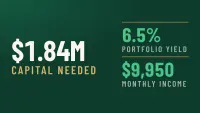
An 8.3% Blueprint Built on About $1.6 Million
This mix sits between moderate and aggressive. Based on the listed yields, the portfolio blends to 8.31%, so the income target is about $1,603,000. Each 15% slot works out to roughly $241,200, and each 10% slot is about $160,800.
- Eaton Vance Tax-Managed Global Diversified Equity Income Fund (NYSE:EXG), 15%. Option income from global stocks, yielding about 9.7%. The catch: the monthly payout has bounced around, from $0.0813 in 2013 to $0.0553 in 2023. Check whether that yield holds up before you count on it.
- Global X Super Dividend ETF (NYSEARCA:DIV), 15%. It holds 50 high-dividend-paying U.S. stocks and yields about 6.9%. The catch: monthly payouts were $0.1705 in 2015 and are $0.106 now.
- Gaming and Leisure Properties (NASDAQ:GLPI), 15%. A casino landlord yielding about 8.7%, with Q3 AFFO of $1.04[1] per share covering the $0.82 dividend. The catch: tenants are concentrated, with PENN Entertainment (NASDAQ:PENN) leasing 34 properties.
- Capital Southwest (NASDAQ:CSWC), 10%. This BDC lends to small private companies and yields about 9.9% on its regular monthly payout. The catch: non-accruals rose to 1.4%, and every 25-basis-point rate cut trims NII by about $0.06 per share.
- MPLX (NYSE:MPLX | MPLX Price Prediction), 15%. A pipeline partnership yielding about 8.6%. It raised its distribution 13% for the third straight year with 1.3x coverage. One drawback: it sends a K-1 instead of a 1099, which makes filing messier and complicates holding it in an IRA.
- AT&T (NYSE:T), 10%. Telecom anchor yielding about 4.8%, supported by free cash flow of $18B+[2] in 2026. The catch: the dividend stays flat through 2028.
- PIMCO Dynamic Income Opportunities Fund (NYSE:PDO), 10%. A leveraged bond fund yielding about 13.5%. The catch: shares fell 8% over the past year. Make sure that yield is real before you lean on it.
- iShares 0-3 Month Treasury Bond ETF (NYSEARCA:SGOV), 10%. Your cash cushion, yielding about 3.9%. The catch: payouts follow T-bill rates, and the 13-week bill now yields 4.3%. When the Fed cuts, this check shrinks.
Why Never Selling Matters in a Down Market
Living on payouts means a bear market leaves your share count alone. You collect the checks and let prices recover on their own schedule. Selling to cover spending locks in losses at the worst moment.
The Treasury slot holds more than a year of income, so you can cover a dividend cut without dumping anything. That is the whole point of building a dividend ladder, and we walked through how to structure one in a free guide here.
Your After-Tax Check Comes in Smaller
In a taxable account, most BDC, bond fund, and REIT payouts get taxed as ordinary income. AT&T’s qualified dividends get lower rates. Either way, the money you actually keep lands below $11,100, so build in a buffer for your bracket.
Where High Yield Falls Behind Over Time
A 3.5% yield growing 8% a year takes $133,200 of income to roughly $246,550 in year nine. A flat 12% yield still pays $133,200 in year nine, and inflation has eaten part of it by then. You can see both inside this blueprint: MPLX keeps raising its payout while AT&T’s stays put.
Three Moves Before You Commit Capital
- Add up what you actually spend each year. Your real number may sit well below $133,200, and that changes how much capital you need.
- Put PDO’s, Capital Southwest’s, and EXG’s distribution histories next to their share prices over 10 years. The comparison tests whether the payouts came from earnings or ate into principal.
- Match each holding to the right account. Ordinary-income payers usually fit inside an IRA, and MPLX usually fits better outside one, where you owe taxes each year.
A higher yield shrinks the check you have to write today, while a growing yield protects the check you’ll be cashing ten years from now.
Contact [email protected] for any questions or corrections.
David Beren has been a Flywheel Publishing contributor since 2022. Writing for 24/7 Wall St. since 2023, David loves to write about topics of all shapes and sizes. As a technology expert, David focuses heavily on consumer electronics brands, automobiles, and general technology. He has previously written for LifeWire, formerly About.com. As a part-time freelance writer, David’s “day job” has been working on and leading social media for multiple Fortune 100 brands. David loves the flexibility of this field and its ability to reach customers exactly where they like to spend their time. Additionally, David previously published his own blog, TmoNews.com, which reached 3 million readers in its first year. In addition to freelance and social media work, David loves to spend time with his family and children and relive the glory days of video game consoles by playing any retro game console he can get his hands on.