Grand Junction, Colorado, Sits Among Red Rock Canyons and Orchards. What It Takes to Retire There at 65 on $900,000

This post may contain links from our sponsors and affiliates, and Flywheel Publishing may receive compensation for actions taken through them.
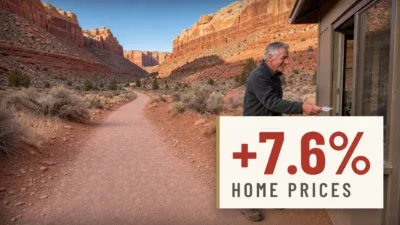
Grand Junction draws retirees with the red rock and orchards of the Grand Valley. It has a slower Western pace, real services, and costs less than the Front Range. The follow-up question is always about money.
Can a couple retire there at 65 on $900,000? Yes, but with less margin than most people assume. A few Colorado rules that calculators skip determine how much room there is.
What Grand Junction Really Costs a Retired Couple
Housing comes first, and it has gotten more expensive. Federal Housing Finance Agency data show Grand Junction home prices up 7.6% over one year[1] and 38.09% over five years, and the index is at its highest level on record. Insurance is going the same direction.
Colorado State University researchers report that wildfire risk is fueling a steep increase in insurance costs for Colorado homeowners, and homes on canyon edges carry that risk. Water is a cost to watch too. Ute Water adopted temporary drought rates in 2026 for the first time since 1977, though customers returned to normal rates on Nov. 1.
Health care is a strength: St. Mary’s in town runs the region’s highest level trauma center, so serious care doesn’t mean a long drive over the mountains to Denver. Medicare Part B costs $209.40 per person in 2027, which comes to about $5,026 a year for two people before supplemental and drug coverage.
For an overall spending benchmark, the average U.S. household spent $81,905 last year. Colorado’s price level stands at 103.052 against a national 100, so this analysis handles that average as a working budget that already includes housing, insurance, food, and reserves.
Worked Example: Turning $900,000 Into a Paycheck
Here are the assumptions: a married couple, both 65, with the full $900,000 in traditional IRAs and a paid-off home. Their benefit matches the SSA’s average for a couple, $3,208 a month[2], and they take 4% a year, which fits a 30-year horizon.
| Income source | Annual amount |
|---|---|
| Social Security | $38,496 |
| 4% portfolio withdrawal | $36,000 |
| Total gross income | $74,496 |
That leaves the couple about $7,400 short of the national average budget. To close the gap entirely at 4%, they’d need roughly $1.085 million. In practice, $900,000 supports a spending plan of about $74,500, and only with a paid-off house.
Colorado’s Retirement Break Keeps the Tax Bill Small
Taxes barely dent that income, since only about $15,560 of the Social Security counts as federally taxable. Their deductions total $47,500: the $32,200 joint standard deduction, two $1,650 age add-ons, and two $6,000 senior deductions. Federal tax comes out to near $406.
Colorado taxes income at a flat 4.4% through 2026, and voters approved graduated rates, starting at 3.7% on the first $25,000, from 2027. Each spouse 65 and older can subtract up to $24,000 of qualifying income, including Social Security benefits and certain IRA distributions. For this couple, state tax stays at or near zero.
One catch: the senior deduction applies only to taxable years beginning before January 1, 2029. Once it expires, the federal bill rises to about $1,606. That increase is modest relative to the couple’s income.
Ten-Year Wait on Colorado’s Senior Property Tax Break
Colorado’s senior property tax break carries a residency requirement. Colorado exempts 50% of the first $200,000 of the actual value[3] of a senior’s home from property tax. To qualify, though, the owner must be 65 or older and have owned and occupied the home as a primary residence for the ten years preceding the assessment date[3].
A couple who buys at 65 pays full property tax until about 75, during the same decade when insurance and water costs are climbing.
The break comes just as health spending tends to rise, so it’s a later-life buffer that starts only after the first ten years of the budget (Claiming age is a bigger decision than this example shows, and we boiled it down to a single page: The Social Security Decision).
The numbers work for a couple that comes in with $900,000, has the house outright, takes no more than 4%, and keeps core spending near $74,500. That leaves room for full property tax through the first decade and for the jump in federal tax after 2028.
Living at the national average budget takes about $1.085 million, or a few years of part-time work. If the higher earner delays Social Security, the couple gets bigger checks and a larger survivor benefit for whichever spouse survives.
The first ten years carry no senior exemption, and that’s when Grand Junction is most expensive for a new arrival.
Contact [email protected] for any questions or corrections.
David Beren has been a Flywheel Publishing contributor since 2022. Writing for 24/7 Wall St. since 2023, David loves to write about topics of all shapes and sizes. As a technology expert, David focuses heavily on consumer electronics brands, automobiles, and general technology. He has previously written for LifeWire, formerly About.com. As a part-time freelance writer, David’s “day job” has been working on and leading social media for multiple Fortune 100 brands. David loves the flexibility of this field and its ability to reach customers exactly where they like to spend their time. Additionally, David previously published his own blog, TmoNews.com, which reached 3 million readers in its first year. In addition to freelance and social media work, David loves to spend time with his family and children and relive the glory days of video game consoles by playing any retro game console he can get his hands on.